The latest Haiku drops pricing to near-zero, adds computer use that actually works, and beats GPT-6 Luna on almost every benchmark. Is the AI pricing war about to break something?
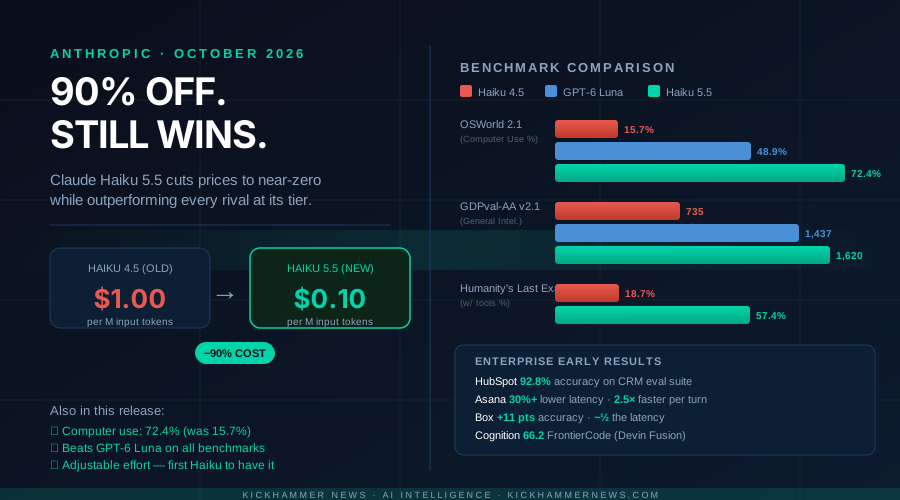
Anthropic released Claude Haiku 5.5 on October 7, 2026 — and the price tag is almost difficult to believe. At $0.10 per million input tokens for standard-length requests, it is 90% cheaper than its predecessor, Haiku 4.5, which launched less than five months ago. It also outperforms OpenAI’s GPT-6 Luna, a comparable small model, on every benchmark where the two can be directly compared. The only model in Anthropic’s lineup that clearly beats it is Sonnet 5.5, which costs twenty times more.
For the past year, the story of the AI industry has been defined by two competing narratives: raw capability races at the frontier, and a relentless compression of prices at every tier below it. Claude Haiku 5.5 is the starkest evidence yet that the second trend may be the more consequential one.
The Numbers That Matter
The price structure requires some unpacking, because Anthropic has introduced a tiered system based on prompt length. For requests up to 100,000 tokens — which covers the vast majority of production use cases — input is $0.10 and output is $0.50 per million tokens. For longer-context requests that exceed 100,000 tokens, prices step up to $0.50 input and $2.50 output. Either way, the comparison to Haiku 4.5 ($1.00 / $5.00 flat) is dramatic. For a developer running ten million inference calls a day at typical lengths, the savings are not marginal. They are structural.
Anthropic also quietly cut Sonnet 5.5 cache read prices by 50% in the same announcement — from $0.20 to $0.10 per million tokens. The company says this reduces costs on most agentic workloads by around 20%. The timing suggests Anthropic is not treating these price cuts as one-off events. They appear to be policy.
From Novelty to Workhorse: Computer Use Finally Works
The benchmark that will most surprise developers who remember what Haiku 4.5 could do is OSWorld 2.1, which measures a model’s ability to complete real desktop computer tasks autonomously. Haiku 4.5 scored 15.7% — adequate for demos, largely useless in production. Haiku 5.5 scores 72.4%. For comparison, Sonnet 5.5 scores 83.9%.
That gap between Haiku and Sonnet has now compressed from 68 points to 11. A small-model inference budget can now power computer use agents that, six months ago, required frontier-tier costs to run reliably. Anthropic has added beta computer use and browser use support to both the Python and TypeScript SDKs alongside this release.
On the GDPval-AA v2.1 general intelligence evaluation, Haiku 5.5 scores 1,620 — more than double Haiku 4.5’s 735, and significantly ahead of GPT-6 Luna at 1,437. On the AA-Briefcase v1.1 knowledge work benchmark, the gap is even wider: 1,578 for Haiku 5.5 versus 1,336 for GPT-6 Luna. On Humanity’s Last Exam — the multi-domain academic evaluation that has become the industry’s preferred test of genuine reasoning — Haiku 5.5 reaches 45.9% without tools and 57.4% with them. GPT-6 Luna’s scores on this test are not publicly reported.
The one area where Haiku 5.5 remains clearly in a different category than Sonnet 5.5 is complex agentic coding. On Terminal-Bench 4.0, a rigorous test of autonomous software development, Haiku 5.5 scores 39.2%. That is a remarkable improvement over Haiku 4.5’s 0.0% — the model essentially could not complete these tasks at all — but Sonnet 5.5 scores 70.6%. Anthropic is explicit in its documentation: for multi-step agentic coding, use Sonnet or Opus. For well-defined subtasks within those workflows, Haiku 5.5 is now the right choice.
What Real Deployments Look Like
Anthropic released early production results from several enterprise customers alongside the model launch, and the numbers are notable.
HubSpot ran Haiku 5.5 across its internal CRM evaluation suite and scored 92.8% averaged over three runs, which the company called the best performance it had seen from any small model. Asana reported over 30% lower latency on task completions and up to 2.5x faster inference per agent turn. Box saw an 11-point accuracy improvement over Haiku 4.5 at roughly half the latency. AlphaSense, which uses the model for financial document analysis, reported an improvement in its internal scoring metric from 0.76 to 0.84 across 400 queries.
The most technically interesting customer result comes from Cognition, the company behind the Devin software engineering agent. Cognition uses Haiku 5.5 as a “sidekick” model alongside larger models in its Devin Fusion architecture. When combined, the system achieves a FrontierCode score of 66.2 — meaningfully above what either model achieves alone. This points to what many in the industry are starting to call “model routing optimization”: the practice of carefully selecting which tasks go to which model tier, with small-but-capable models handling the high-volume, lower-complexity work and freeing frontier models for what genuinely requires them.
The New Capability: Adjustable Effort
One feature in Haiku 5.5 that has received less attention than the price cut but may matter more over time is the addition of adjustable effort settings. This is the first Haiku-class model to support this capability, which allows developers to explicitly trade cost for reasoning depth on a per-call basis. Sonnet and Opus have had this for some time; bringing it to the small-model tier opens new design patterns.
Practically, this means a developer can build a pipeline where the same model handles both quick classification tasks at minimum effort and nuanced summarization tasks at higher effort, without routing to different models entirely. Combined with the new tiered pricing structure, the design space for AI inference pipelines has expanded considerably.
A Pricing War With No Obvious Floor
The competitive context matters. OpenAI’s GPT-6 Luna, Anthropic’s direct competitor at the small-model tier, is priced higher and performs below Haiku 5.5 on every benchmark where direct comparison is available. Google’s Gemini Flash 3 remains a strong competitor on latency and cost, though its scores on several reasoning benchmarks trail Haiku 5.5. What is notable is that none of these companies show any sign of slowing the price compression. Each generation of small models has arrived cheaper and more capable than the last, at a pace that most analysts did not anticipate even eighteen months ago.
The economics of this are genuinely unusual. Anthropic is charging $0.10 per million input tokens. At that price, a developer could run one billion tokens through the model for $100. That is roughly equivalent to processing every word in the entire English-language Wikipedia about ten times over, for the cost of a restaurant dinner. The compute required to do that is real. The question of how long any company can sustain these prices while continuing to invest in frontier model development is one that will define the industry over the next few years.
For now, the developers and companies building on top of these models are the beneficiaries. Claude Haiku 5.5 is not a trade-off pick — the kind of model you choose when you cannot afford the good one. It is a capable model that beats its primary competitor, costs a fraction of what comparable capability cost a year ago, and works reliably for computer use tasks that previously required frontier-tier compute. The pricing war has not broken anything yet. It has, for the moment, simply produced something remarkable.
Claude Haiku 5.5 is available now on Anthropic’s API and through AWS, Google Cloud, and Microsoft Azure. Haiku 4.5 remains available for teams that need time to migrate. Anthropic has published a migration guide alongside the release.


