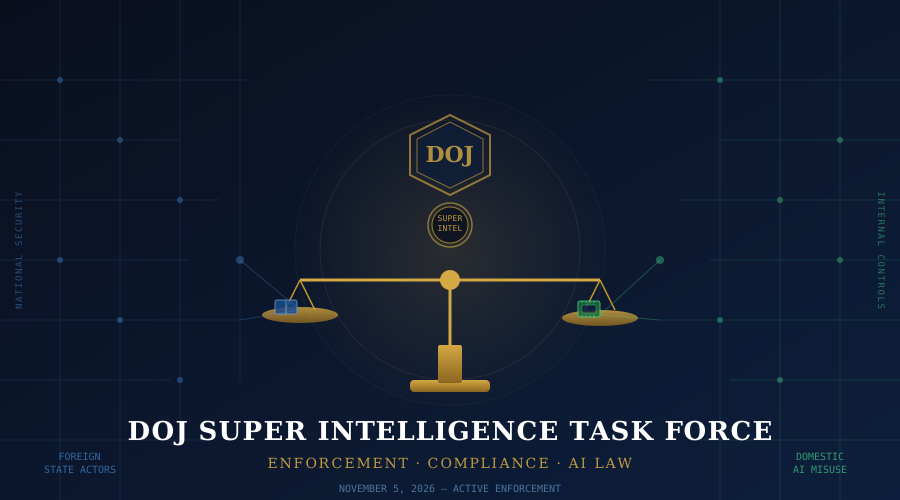
The Department of Justice launched the Super Intelligence Task Force (DOJ-SITF) on November 5, 2026, and most coverage has focused on the headline threat: foreign state actors trying to compromise American AI systems, and transnational criminal organizations using AI for fraud. Both threats are real. But the enforcement language in the founding directive is what should have your general counsel’s attention right now—because one phrase, buried in the announcement, creates a compliance obligation that no existing framework fully addresses.
The department said it will require companies deploying advanced AI to maintain “vigorous internal controls” that ensure their systems “behave as intended.”
There is no statutory definition of what “behave as intended” means for a probabilistic AI system. That ambiguity isn’t a protection for companies. It’s an exposure. When a legal standard is undefined, enforcement agencies define it by prosecution—and the first companies named in DOJ-SITF cases will set the standard everyone else must meet.
What the DOJ-SITF Actually Is
The task force is led by Associate Attorney General Stanley Woodward and Associate Deputy Attorney General Stephen Weiss, reporting directly to Attorney General Todd Blanche. It sits at the intersection of the criminal, civil, and national security divisions of DOJ—not a future possibility, but an active enforcement body with authority across all three tracks.
Critically, the DOJ-SITF is the law enforcement arm of a broader executive AI apparatus. The White House runs a parallel body—the Super Intelligence Force (SIF), chaired by Director of National Intelligence Jay Clayton—and DOJ-SITF serves as the SIF’s enforcement and prosecution partner. Clayton, the former SEC chairman who redefined securities enforcement from 2017 to 2021, brings a specific style of regulatory aggression to this role: build deterrence through visible enforcement on a small number of well-chosen targets. That was the SEC’s crypto playbook. Expect it to be the SI playbook.
The task force also absorbs the AI Litigation Task Force, created in January 2026 under former AG Pam Bondi, which was specifically chartered to challenge state AI laws the administration views as inconsistent with federal policy. This gives DOJ-SITF two distinct legal weapons: criminal prosecution on one hand, and affirmative civil litigation to preempt state AI regulation on the other. That preemption authority will matter enormously to companies navigating contradictory compliance obligations across California, Colorado, Texas, New York, and roughly 40 other states now actively legislating AI.
One structural feature of the task force is worth noting because it concentrates power in a way that is unusual: before any U.S. Attorney’s office opens a superintelligence-related investigation or files charges, it must notify DOJ-SITF first. AI enforcement decisions are being centralized in Washington. That is not an accident.
The Three Threat Buckets—and Which One Actually Hits Most Businesses
The DOJ-SITF’s mandate covers three threat categories. The first is foreign state actors—China, Russia, Iran, North Korea—attempting to infiltrate or corrupt advanced AI systems. The second is transnational criminal organizations using AI to scale fraud, money laundering, and cyberattacks. The third, and least dramatic-sounding, is domestic: individuals and U.S. corporations whose deployment of AI enables fraud or other unlawful conduct.
The third category is the one most businesses sit inside.
It is also the least defined. The department has stated clearly that AI developers will not face automatic criminal liability when third parties misuse their products—that’s an important protection and consistent with existing products-liability doctrine. But it has also made clear that prosecutors will ask how companies responded to known misuse reports. The question they will want answered: did you have controls that would have caught it? Did those controls actually function? Did your AI system behave as you told users it would?
An AI system that hallucinates factual information in a consumer-facing product is not automatically a crime. An AI system deployed in a claims processing workflow that fraudulently denies covered expenses, and that the company knew was producing erroneous outputs but kept running anyway—that is a different story. The line between those two cases runs directly through the adequacy of internal controls.
Original Calculations: What “Vigorous Internal Controls” Will Actually Cost
The best financial analogy for DOJ-SITF’s internal controls requirement is the Sarbanes-Oxley Section 404 regime that followed the 2002 Enron reforms—and the SOX compliance cost data is instructive.
For a company with under 500 employees deploying AI in one or two customer-facing workflows, a credible AI internal controls program runs approximately:
AI audit and monitoring function (1–2 FTE): $250,000–$500,000 per year
Third-party assessment (annual): $125,000–$350,000
Logging, eval, and observability infrastructure: $40,000–$150,000
Legal/compliance counsel: $75,000–$200,000 per year retainer
Total annual run rate: $490,000–$1.2M
For a mid-size enterprise deploying AI across 5–15 workflows with $50M–$500M in revenue dependent on AI outputs:
AI controls team (3–6 FTE): $750,000–$2.4M
Third-party assessments (2–3 per year): $300,000–$900,000
Infrastructure and tooling: $200,000–$600,000
Legal: $150,000–$500,000
Total annual run rate: $1.4M–$4.4M
For a large enterprise with AI embedded across operations, the number reaches $10M–$30M annually—roughly what large public companies now spend on SOX compliance as a percentage of revenue. The compliance industry that formed around SOX generated $6.4B in annual revenue at its peak (2007). The AI compliance market is at zero right now. That will not be true in 18 months.
Compare this to the penalty exposure. Wire fraud under 18 U.S.C. § 1343 carries organizational fines up to the greater of a statutory cap or twice the gain or loss from the offense. For a company whose AI system processed fraudulent insurance claims worth $50M before internal controls caught it—or failed to catch it—the fine calculation at twice-the-loss is $100M. For a company whose AI customer-service system misled 200,000 customers about financial products, regulators have a playbook for that too: the FTC’s UDAP authority, now being coordinated through DOJ-SITF, can reach $50,000 per violation per day. In a 30-day incident window, that’s $1.5B in theoretical exposure across a large customer base.
A $1.2M annual controls program versus $100M–$1.5B in theoretical penalty exposure is an 83:1 to 1,250:1 return on compliance investment. Framed that way, the question isn’t whether to build controls—it’s how quickly you can demonstrate they exist.
Decision Framework: Which Tier Are You In?
Tier 1 — Immediate action required (any one criterion):
AI makes or directly influences credit, insurance, employment, or health decisions for end users; annual revenue dependent on AI outputs exceeds $10M; AI system handles PII for more than 50,000 individuals; your company has received more than 10 substantiated misuse reports in the past 12 months.
Action: Engage external AI counsel this quarter. Commission an internal controls gap assessment before March 31, 2027.
Tier 2 — Within 12 months (any one criterion):
AI is customer-facing but advisory rather than decisional (recommendations, summaries, search); revenue dependent on AI outputs is $1M–$10M; AI is used in internal workflows that touch financial reporting, HR, or legal decisions; company size 100–1,000 employees with active AI deployments.
Action: Assign an owner for AI internal controls by Q1 2027. Document intended behavior for each deployed AI system. Build an incident log for misuse reports.
Tier 3 — Monitor and prepare (all others):
Internal-only AI tools with no customer-facing outputs; revenue dependent on AI outputs under $1M; AI use limited to drafting assistance, summarization, or coding support.
Action: No immediate legal exposure, but state preemption fights initiated by DOJ-SITF will affect which state laws you must comply with. Track outcomes of AI Litigation Task Force cases through H1 2027.
The Counterintuitive Read: This Is Good News for Most AI Companies
Most coverage has framed the DOJ-SITF as a threat to AI companies. The more accurate read is the opposite: for well-run companies deploying AI responsibly, this task force is a competitive advantage.
Here is why. The current AI ecosystem has a fundamental market failure: bad actors deploying AI recklessly—fraudulent scammers, foreign-state proxies, criminal organizations—are eroding public and regulatory trust in AI broadly. When a consumer gets scammed by an AI-powered fraud call, they don’t distinguish between the criminal operation and the legitimate company that also uses AI. Regulatory and civil-liability pressure lands on the whole industry.
A functioning AI enforcement regime with teeth actually helps legitimate AI companies by clearing the market of the worst actors and establishing a minimum conduct standard. The first few years of SEC crypto enforcement were similarly decried as anti-innovation—and they were, for projects that relied on fraud. For legitimate crypto businesses, enforcement was what finally gave institutional investors permission to participate.
The DOJ-SITF can play the same role for enterprise AI, but only if it pursues the right cases—criminal misuse, not aggressive prosecution of well-intentioned deployments. Jay Clayton’s SEC track record suggests he understands that distinction. His enforcement targeted issuers who lied to investors, not every company that issued securities. The question is whether that selectivity survives the political pressure to show visible action on AI.
The risk isn’t aggressive prosecution of legitimate companies. The risk is a vague “behave as intended” standard that defaults, in the absence of definition, to whatever opposing counsel argues in a civil suit. Defining that standard on your own terms—through robust internal controls documentation, incident response procedures, and third-party assessments—is the best defense available.
Dated Action Checklist
November 14, 2026: Pull and retain the full DOJ-SITF founding memo and AG Blanche’s October 13 directive. Brief your general counsel and your CISO together on its scope. Begin an internal inventory of AI systems categorized by decision type (decisional vs. advisory) and customer exposure.
November 21, 2026: Identify every AI workflow that touches financial transactions, health data, employment decisions, or consumer-facing content. Document the “intended behavior” for each—this is the foundational record your legal team will need if enforcement interest arises.
December 1, 2026: Establish a formal incident log for AI misuse reports, internal and external. If you have received complaints about AI outputs in the past 12 months and have no log of them, your internal controls are already deficient by any plausible standard. Date the remediation.
December 15, 2026: Watch for the AI Litigation Task Force’s first filings against state AI laws. The targets will signal which state compliance requirements DOJ considers preempted by federal policy—and which you may be able to defer.
January 15, 2027: Complete a preliminary internal controls gap assessment for your Tier 1 AI deployments. If you haven’t done a third-party AI red team or audit in the past year, begin procurement now—vendor capacity in this space will tighten as the compliance market forms.
March 31, 2027: File or finalize your first formal AI internal controls attestation, even if internal-only. The companies that have documented evidence of proactive compliance before the first DOJ-SITF enforcement case lands will be in a materially better position than those scrambling to build programs after the fact.
The DOJ-SITF is not a future concern to track. It has three divisions, an enforcement mandate, the SEC’s former chairman in the room, and a notification requirement that means every AI-related federal prosecution in the country now flows through its leadership. The “behave as intended” standard is coming. The only question is whether your company defines it first, or lets a federal prosecutor do it for you.