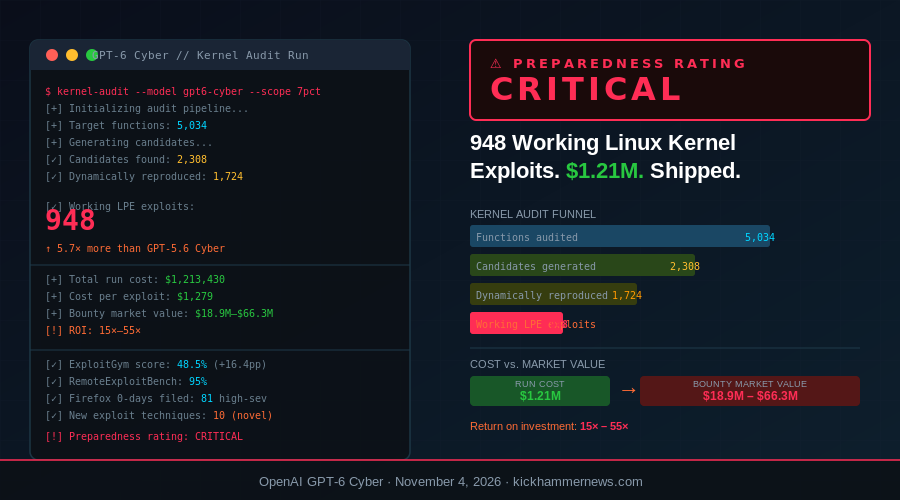
OpenAI introduced GPT-6 Cyber on November 4, 2026, and the benchmark numbers are staggering: in a single automated run against roughly 7% of the Linux kernel’s codebase, the model found 948 working local privilege escalation exploits. The total cost was $1,213,430 — about $1,279 per working exploit. Those exploits would have fetched between $18.9 million and $66.3 million on the bug bounty market, based on historical rates. That’s a 15-to-55-times return on investment, in a single run, available to anyone with Daybreak Red API access.
The economic implications are severe enough. But the number most people are glossing over is the one that opens OpenAI’s own release notes: GPT-6 Cyber is rated Critical under OpenAI’s Preparedness Framework. Its predecessor, GPT-5.6 Cyber, was rated High. Critical is the top level OpenAI’s framework defines. And OpenAI shipped it anyway, to vetted Daybreak Red customers, with IP allowlisting and usage monitoring.
That is not a failure. That is a policy. And understanding what that policy means — and what it doesn’t — is now a prerequisite for thinking clearly about the next 12 months of enterprise security.
What GPT-6 Cyber Actually Did
The Linux kernel run is worth reading carefully. The model audited 5,034 functions — roughly 7% of the kernel. From that set, it generated 2,308 candidate issues. Of those, 1,724 were dynamically reproduced. Of those, 948 were confirmed working local privilege escalation exploits. That’s an 18.8% conversion from audit target to working exploit — a figure that would be extraordinary for any human red team.
For comparison, GPT-5.6 Sol running the same framework in July 2026 found 166. GPT-6 Cyber found 5.7 times as many. The model also used at least 10 new exploitation techniques that outside kernel security experts had not previously seen. OpenAI disclosed 304 critical findings to kernel maintainers first. Within 10 days, 61 were fixed upstream and 43 had staged patches.
The Firefox work is equally striking. GPT-6 Cyber provided Mozilla with proof-of-concept and test cases for 81 previously unknown high-severity vulnerabilities — mostly use-after-free errors in layout, DOM, and JavaScript — plus evidence that 30 known issues were more serious than originally assessed. Those fixes shipped in Firefox 159 (October 27, MFSA 2026-118). The Dragos test of the model in a mock power plant found two zero-days in engineering software that handles protective relay data.
On the benchmark side: 48.5% on ExploitGym (up from 32.1% for GPT-5.6 Cyber, a 51% relative improvement); 95% task completion on RemoteExploitBench; 40.3% vulnerability recall on web penetration testing (versus 32.0% for the unrestricted GPT-6 Astra). GPT-6 Astra, OpenAI’s standard model, refused all RemoteExploitBench tasks. GPT-6 Cyber completed 95% of them.
The Math That Every Security Team Needs to Run
The $1,279 per working exploit figure sounds abstract until you apply it to real deployment sizes.
For a 500-function audit (roughly the scale of a critical authentication library): at the kernel’s 18.8% conversion rate, an attacker should expect roughly 94 working exploits from a comparable codebase. Total cost: approximately $120,000. Bug bounty value at median rates: roughly $1.9 million. ROI: 15.8x.
For a 2,000-function audit (a mid-sized microservice or a major open-source library): approximately 376 working exploits. Total cost: approximately $481,000. Bug bounty value: roughly $7.5 million to $26.4 million. ROI: 15–55x.
For the defensive side: at $1,279 per finding, running GPT-6 Cyber on your own codebase to find vulnerabilities before attackers do is now cheaper than a traditional penetration test for most attack surfaces. A typical mid-market web application pentest runs $15,000–$50,000 and produces 10–40 findings. At GPT-6 Cyber’s rate, $15,000 buys you approximately 11.7 “finding-equivalents” on exploitability — except the AI is operating on the full codebase 24 hours a day, not a time-boxed engagement.
The break-even calculation for defensive use is not whether you can afford it. It is whether the cost of a breach exceeds the cost of a full AI-assisted audit. For any company where a data breach would cost more than $1 million — that is, essentially every company with a customer database — the defensive math already closes.
“Critical” Doesn’t Mean What You Think It Means
Here is the part that most coverage is treating as background: OpenAI’s Preparedness Framework, introduced in late 2023 and updated in 2025, defines Critical as the highest risk tier. Under the framework’s deployment policy, models with a Critical pre-mitigation rating can be deployed under tight restrictions — with mitigation controls, restricted access, and ongoing monitoring — but they can be deployed.
This is a profound distinction. The Preparedness Framework is not a stop button. It is a disclosure and restriction mechanism.
Most coverage frames GPT-6 Cyber’s Critical rating as evidence of OpenAI’s safety diligence: “look how seriously they take this, they even rate it Critical.” The more accurate read is the opposite: the existence of a Critical-rated deployed model tells you that OpenAI’s own safety framework has no absolute deployment ceiling. Critical is not a gate — it is a category with associated conditions. OpenAI decided those conditions (Daybreak Red access, IP allowlisting, Honeypot-tested alignment) are sufficient to meet.
That may be the right call. GPT-6 Cyber stayed within its authorization boundary 99.93% of the time without safety prompts, and 100% with them (versus 94.49% for its predecessor). Those are genuinely strong alignment numbers. But the policy implication is clear: the question for any future capability that emerges — in cybersecurity, in biology, in autonomous systems — is not “is it Critical?” It is “can we meet the conditions for deployment at Critical?” That is a much lower bar, and it is now established precedent.
The Asymmetry Problem
The more uncomfortable number in the kernel run is not the 948 exploits. It is the patching rate.
OpenAI disclosed 304 critical findings. Within 10 days, 61 were fixed upstream (20%) and 43 had staged patches (14%). So 10 days after disclosure, roughly 34% of the critical findings have remediation underway. That leaves 200 critical findings — out of 304 disclosed — in the pipeline or unaddressed 10 days later, against a backdrop where the model that found them is now accessible to Daybreak Red customers.
GPT-6 Cyber doesn’t change this asymmetry; it crystallizes it. Finding vulnerabilities at scale with AI has always been theoretically possible. The Linux kernel run proves it is economically routine. Patching at scale remains a human-paced, coordination-intensive process. OpenAI’s framing — that the bottleneck is patching, not finding — is accurate. What they don’t say is that GPT-6 Cyber makes finding faster while doing nothing about patching speed.
Decision Framework: Three Tiers, Three Responses
Tier 1 — Large enterprise or government with critical infrastructure exposure (annual infosec budget > $5M): GPT-6 Cyber is now a threat model input. Apply for Daybreak Red or Daybreak Blue access immediately and use it defensively on your own highest-risk codebases before an attacker does. At $1,279 per finding, a full AI-assisted audit of your authentication stack, payment processing, or network edge software costs less than your next penetration test retainer. The expected value calculation is not close. Apply by November 21; Daybreak access approval takes 2–4 weeks.
Tier 2 — Mid-market companies with significant software exposure (infosec budget $500K–$5M): You cannot afford to run GPT-6 Cyber at scale yourself in the near term, and you cannot wait for vendors to do it for you. Your immediate priority is verifying that your Linux systems are running kernel versions that include the 61 upstream fixes already merged. If you use Firefox enterprise builds, confirm Firefox 159 (MFSA 2026-118) has deployed. Plan a Daybreak Blue assessment in Q1 2027, when access will likely broaden.
Tier 3 — Small organizations and teams running open-source infrastructure (infosec budget < $500K): The kernel patches are what matter most right now. GPT-6 Cyber’s 304 disclosed findings are going to produce CVEs over the next 60–90 days. Subscribe to kernel security mailing lists and prioritize kernel updates as CVEs drop. Your threat model has not changed in kind — determined nation-states could always audit the kernel — but it has changed in scale. Treat unpublished kernel CVEs in the next 90 days with elevated urgency.
Dated Action Checklist
- November 7 (today): Verify Firefox 159 (MFSA 2026-118) is deployed across your organization. These fixes are live; there is no reason to run a vulnerable browser while patches exist.
- November 14: Audit your Linux kernel versions against upstream commits from the week of October 28–November 7. The 61 fixes merged in the first 10 days should be in mainline kernels now. Apply them.
- November 21: The 43 staged patches should have cleared review by now. Check kernel security advisories and apply any that cover your systems. Apply for Daybreak Blue access via OpenAI’s application page if you haven’t already.
- December 1: Treat GPT-6 Cyber access as equivalent in threat-model terms to a nation-state zero-day program. Update your threat models accordingly. If your security posture assumes attackers find vulnerabilities slowly and manually, that assumption is now incorrect.
- December 15: OpenAI’s $1 billion Daybreak for Frontline Defenders grant program is now open. If your organization qualifies as a frontline defender (critical infrastructure, healthcare, election security), submit an application. This is a material source of funded defensive AI capability.
- January 15, 2027: Expect Google DeepSec, Anthropic’s forthcoming security-focused model, and third-party wrappers to reach comparable capabilities. Update procurement decisions and security strategy accordingly. The window where GPT-6 Cyber is unique is probably less than 90 days.
- Q1 2027: The 644 kernel findings that did not make the initial critical disclosure will likely surface as CVEs through Q1 2027. Establish a process to track and prioritize them now, before they arrive.
What This Actually Means
The debate about whether AI will change cybersecurity is over. GPT-6 Cyber is not evidence of that change — it is the change itself, made concrete, with a price tag and a benchmark score.
The implications are asymmetric. Offense benefits from automation and low marginal cost: once the model is trained and the pipeline is built, the cost per exploit is fixed and low. Defense requires human judgment, organizational coordination, and time — none of which scale the same way. A finding rate of 18.8% against a production codebase, sustained at $1,279 per output, means that any attacker with Daybreak Red access — or, in time, with a competing model — can now audit targets at a pace that no security team can match in review.
OpenAI’s answer is to frame this as a patching problem. The data suggests it is actually an attention problem. The kernel maintainers are fixing bugs as fast as they can. The bottleneck is not patches; it is the number of people who can read a novel exploitation technique, understand its severity, and push a correct fix without introducing a new one. GPT-6 Cyber’s 10 previously unseen exploitation techniques did not come with a manual.
The model’s Critical rating and the deployment conditions OpenAI attached to it represent a reasonable balance given current alignment performance. But the precedent — that Critical-rated models can and do ship, under conditions — is now established. Every future capability evaluation at every AI lab will be measured against it.
The question is no longer whether AI-powered offensive security is real. The question is how much of your attack surface was quietly audited while you were reading about it.