In a landmark move that signals a new era of AI-powered military operations, the U.S. Department of Defense has signed formal agreements with seven of the world’s most powerful technology companies, granting them access to deploy their artificial intelligence tools across the Pentagon’s most sensitive classified networks. The announcement, made on May 1, 2026, represents one of the most sweeping government endorsements of commercial AI in U.S. history — and it comes with a notable controversy.
The Seven Companies Behind the Deal
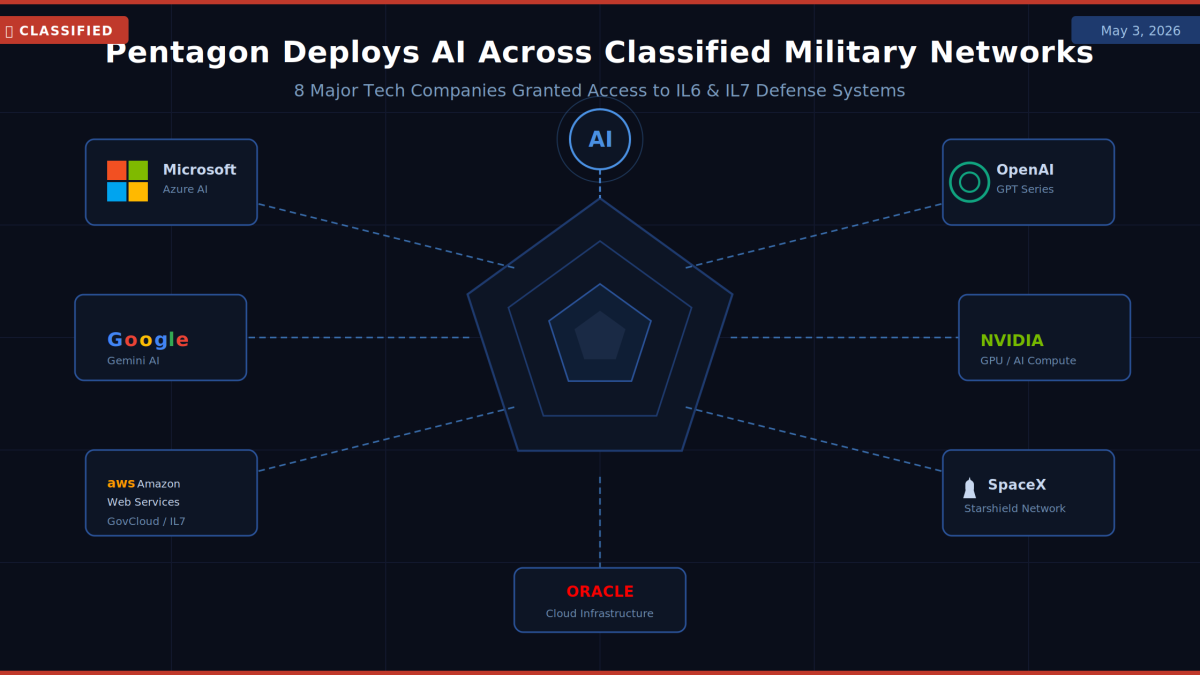
The Pentagon has struck agreements with Amazon Web Services (AWS), Google, Microsoft, NVIDIA, OpenAI, SpaceX, and a lesser-known firm called Reflection. Hours after the initial announcement, Oracle was added as an eighth partner, underscoring the speed and scale of the initiative.
These are not small-scale pilot programs. According to the Department of Defense, the AI systems will be integrated into the DoD’s Impact Level 6 (IL6) and Impact Level 7 (IL7) networks — the most heavily secured tiers in the federal government’s cloud and data infrastructure. IL7, in particular, is reserved exclusively for classified information related to national security and warfare, making this integration historically significant.
The Pentagon stated that the AI tools will be used to “streamline data synthesis, elevate situational understanding, and augment warfighter decision-making in complex operational environments.” In plain terms: AI will help military commanders and analysts process vast amounts of classified intelligence faster and more effectively than ever before.
Why This Deal Matters
For years, the U.S. military has struggled to integrate modern commercial technology into its operations due to bureaucratic hurdles, security requirements, and concerns about vendor reliability. This new framework marks a deliberate shift toward what Pentagon officials describe as becoming an “AI-first fighting force.”
The agreements are also designed with a strategic eye toward avoiding overdependence on any single vendor. Defense officials emphasized that the architecture is meant to “prevent AI vendor lock and ensure long-term flexibility for the Joint Force” by making a diverse portfolio of AI tools available to Defense Department employees. This multi-vendor approach reflects lessons learned from past large-scale government IT contracts, where sole-source dependencies created operational and security vulnerabilities.
From a geopolitical standpoint, the timing of the deal is not accidental. The United States has identified AI supremacy as a critical component of its national security strategy, particularly in the context of competition with China and Russia. Both nations have made significant investments in military AI capabilities, and Washington is eager to ensure the U.S. maintains its technological edge on the battlefield.
The Anthropic Exclusion: A Political Flashpoint
Perhaps the most striking aspect of the announcement is who was left out: Anthropic, the San Francisco-based AI safety company and maker of the Claude AI family of models.
Anthropic was reportedly excluded from the deal after the Trump administration blacklisted the company over its insistence that the Pentagon incorporate certain AI safety guardrails for military use. Anthropic has been a vocal proponent of responsible AI deployment, and the company’s leadership had pushed back on the government’s desire to use AI tools in warfare without specific ethical constraints and fail-safes.
The exclusion ignited a fierce debate in both Silicon Valley and Washington D.C. Critics argue that sidelining one of the leading AI safety companies from a high-stakes military application is precisely the kind of decision that could lead to unintended — and potentially catastrophic — outcomes. Supporters of the deal, however, contend that Anthropic’s requirements were operationally restrictive and that the company’s conditions were incompatible with the speed and decisiveness required in real-world military scenarios.
In a late-breaking development, the White House reportedly reopened discussions with Anthropic in recent weeks, following the company’s announcements of several significant technology breakthroughs. Whether Anthropic will ultimately be brought into the fold remains to be seen, but the episode highlights the growing tension between AI safety advocacy and the national security establishment’s demand for agile, unconstrained AI capabilities.
What Each Company Brings to the Table
The eight firms selected represent a cross-section of AI capability:
Microsoft brings its Azure Government cloud infrastructure and deep integration with OpenAI’s GPT-series models, already widely used across federal agencies. Its presence in classified environments is well-established through existing DoD contracts.
Amazon Web Services is the dominant player in classified cloud hosting via its GovCloud and Top Secret/SCI environments, making it a natural anchor for IL6 and IL7 deployments.
Google brings its Gemini family of AI models and a decade of experience in large-scale data processing and machine learning infrastructure. The company had famously walked away from the DoD’s Project Maven AI program in 2018 under employee pressure, making this deal a notable return to defense AI work.
NVIDIA is the backbone of modern AI computing through its GPU hardware and CUDA software ecosystem. Its involvement likely centers on providing the computational substrate that makes running large AI models in classified environments feasible.
OpenAI, the maker of ChatGPT and the GPT-4 family, brings some of the most capable general-purpose large language models in existence. Its inclusion signals the Pentagon’s interest in deploying conversational and analytical AI for a wide range of intelligence tasks.
SpaceX brings its Starshield communications network — a classified, military-grade satellite internet service built on its Starlink infrastructure — which could play a critical role in transmitting AI-processed intelligence in contested environments.
Reflection is the lesser-known entity in the group, but its inclusion suggests the Pentagon is also looking to cultivate emerging AI capabilities outside the traditional Big Tech ecosystem.
Oracle rounds out the group with its cloud infrastructure and data management capabilities, widely used across the federal government.
Broader Implications for the AI Industry
For the broader AI industry, this deal is a seismic event. The commercial AI market has long courted government contracts as a route to massive, stable revenue streams. Being approved for IL6 and IL7 deployments is the equivalent of receiving the highest security clearance in the cloud world — and it positions these companies for potentially hundreds of billions of dollars in future government AI spending.
The deal also has implications for AI regulation and governance. As commercial AI tools become embedded in life-or-death military decision-making, questions about accountability, transparency, and the rules of engagement for AI-assisted warfare will only intensify. International bodies, human rights organizations, and AI ethics researchers are already calling for greater oversight and the establishment of clear legal frameworks governing AI in armed conflict.
Looking Ahead
The Pentagon’s embrace of commercial AI at the classified level is a watershed moment — one that reflects both the transformative potential and the profound risks of artificial intelligence in national security contexts. The debate over Anthropic’s exclusion underscores the fact that how we deploy AI in warfare is not merely a technical question but a deeply moral and strategic one.
As the AI arms race accelerates, the decisions made in the coming months — about which companies gain access, which safeguards are required, and what boundaries are set — will shape not just the future of military technology, but the future of AI governance for decades to come.
Sources: TechCrunch, The Washington Post, CNN Business, Nextgov/FCW, Breaking Defense, The Hill


