Apple just delivered one of the most impressive quarterly earnings reports in its history — and the numbers tell only half the story. Behind the record-breaking $111.2 billion in revenue lies a bold bet on artificial intelligence that could redefine the company’s next decade. From a landmark partnership with Google to a surge in research and development spending, Apple is making clear that it intends to own the AI era just as thoroughly as it dominated the smartphone revolution.
A Quarter for the Record Books
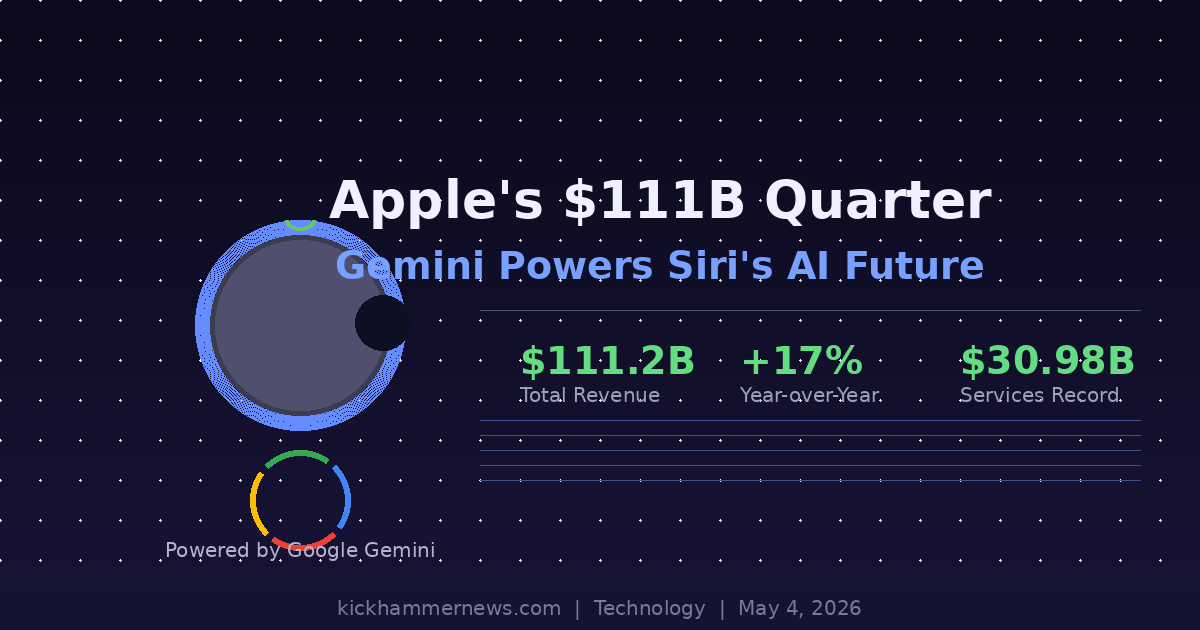
Apple’s fiscal second quarter of 2026 shattered expectations across the board. Revenue hit $111.2 billion, a 17 percent jump year over year, comfortably beating Wall Street’s consensus estimate of $109.66 billion. Diluted earnings per share came in at $2.01, up 22 percent annually and ahead of the $1.95 analysts had projected. The results sent Apple shares climbing in after-hours trading and prompted the company to announce a new $100 billion share buyback authorization — a signal of supreme confidence in its financial position.
The iPhone, perennially Apple’s biggest revenue engine, had an exceptional quarter. iPhone sales reached $56.99 billion, a March-quarter record, representing 22 percent growth year over year. Strong demand in China provided a meaningful tailwind. Analysts credited renewed consumer enthusiasm tied to the promise of AI-enhanced features arriving later this year.
The Mac business also had a strong showing, generating $8.39 billion in revenue, while Services — the segment that includes the App Store, Apple TV+, Apple Music, iCloud, and a growing suite of subscription offerings — posted an all-time record of $30.98 billion, up roughly 16 percent year over year.
The AI Engine Behind the Numbers
Beneath the financial fireworks, the most consequential data point in Apple’s quarterly report may be R&D spending. Apple invested $11.42 billion in research and development during Q2 2026 — a staggering 33 percent increase year over year. CEO Tim Cook made no secret of where that money is going. “We are clearly investing more,” Cook told analysts on the earnings call, pointing squarely to artificial intelligence as the company’s defining priority.
The Gemini Deal: Apple Bets Big on Google AI
Announced in January 2026, the Apple-Google Gemini partnership represents a seismic shift in the AI landscape. Under a multi-year agreement reportedly worth approximately $1 billion per year, Apple gained access to a custom 1.2 trillion parameter Gemini model built specifically for Siri and Apple Intelligence. Apple had evaluated other AI partners — including OpenAI and Anthropic — before settling on Google. Gemini has been placed at the center of Apple’s long-term AI strategy.
The rollout is already underway. With the release of iOS 26.4, Siri has begun leveraging Gemini for improved context awareness and on-screen recognition — early signs of a dramatically more capable assistant. Users are reporting that Siri can now understand follow-up questions more reliably and execute multi-step tasks without losing the thread of a conversation.
When iOS 27 launches alongside the iPhone 18 this September, Apple plans to debut “Full Conversational Siri” — a next-generation assistant capable of sustaining back-and-forth dialogue across 20 or more exchanges and handling complex, multi-step requests.
Privacy Remains the Core Promise
Apple is acutely aware that any AI partnership raises questions about user data and privacy — values it has long staked its brand upon. The company emphasizes that Apple Intelligence will continue to run on-device and through Apple’s Private Cloud Compute infrastructure wherever possible. Apple has also requested that Google explore setting up dedicated servers specifically to handle Siri workloads, anticipating a major increase in cloud usage when the smarter Gemini-powered Siri goes live at scale.
What This Means for the Broader AI Race
Apple’s Q2 results and its deepening AI strategy arrive at a pivotal moment in the technology industry. The AI investment supercycle shows no signs of slowing, with KKR, SoftBank, and other major capital allocators pouring tens of billions of dollars into AI infrastructure and data centers. Against this backdrop, Apple’s move is notable not for the scale of spending — Meta, Google, and Microsoft are all deploying far more capital — but for the strategic clarity it represents.
Rather than building a standalone AI product or competing directly in the large language model arms race, Apple is playing to its unique strengths: a billion-plus active devices, an unmatched distribution platform, and consumer trust built over decades. By embedding Gemini’s capabilities into the most intimate layer of the iPhone experience — the voice assistant — Apple is positioning itself to capture AI value at the point closest to the user.
For consumers, the payoff may finally arrive this fall. After years of Siri being the butt of jokes among tech enthusiasts, Apple appears genuinely committed to making its assistant a peer of Google Assistant and Amazon Alexa — or better. With $111 billion in quarterly revenue, a $100 billion buyback in the war chest, and Google’s most powerful AI model under the hood, Apple has both the means and the motive to get this right.