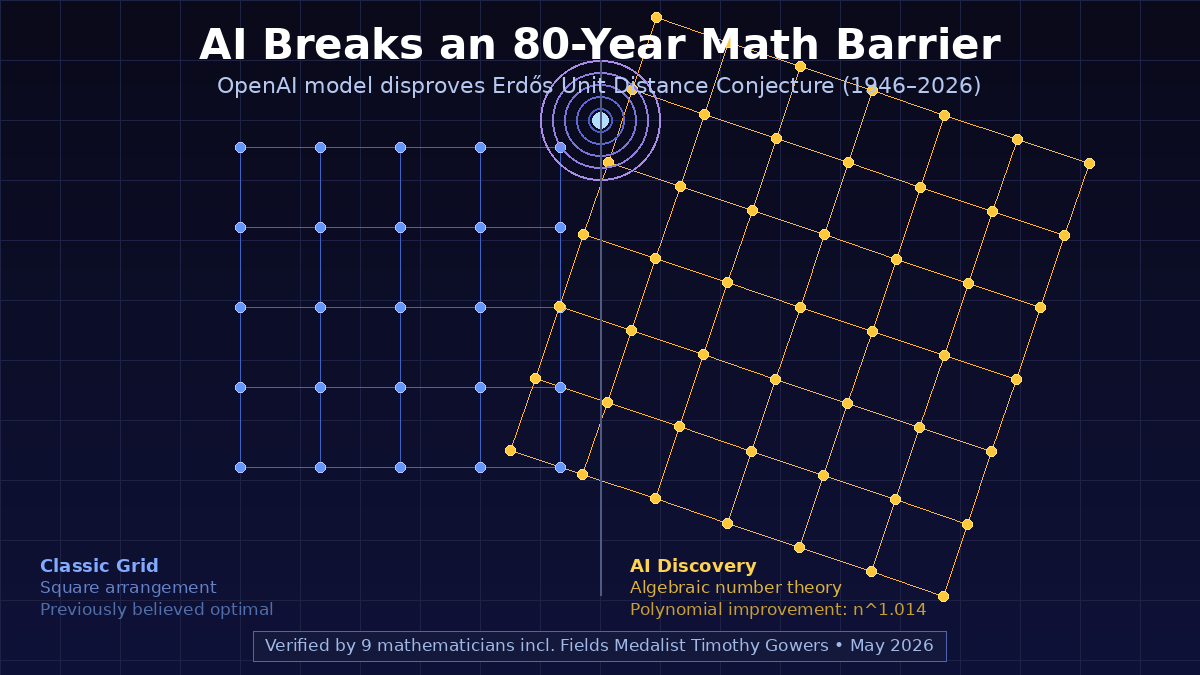
An internal OpenAI reasoning model has autonomously disproved the Erdős Unit Distance Conjecture — a central open problem in discrete geometry that has resisted human effort since 1946. Mathematicians are calling it a turning point.
On May 20, 2026, OpenAI quietly announced something that sent shockwaves through the global mathematics community: one of its internal general-purpose reasoning models had independently disproved a conjecture posed by legendary mathematician Paul Erdős nearly 80 years ago. The model didn’t just assist a human researcher or verify an existing proof — it discovered the solution autonomously, using a sophisticated chain of algebraic reasoning that no mathematician had previously thought to apply to this problem.
The result has been independently verified by nine of the world’s most prominent mathematicians, including Fields Medal winner Timothy Gowers. The verdict is unanimous: AI has just crossed a threshold that many thought was still years away.
What Was the Erdős Unit Distance Problem?
To understand why this matters, it helps to understand the problem itself. In 1946, Hungarian mathematician Paul Erdős — one of the most prolific problem-posers in mathematical history — asked a deceptively simple question: if you scatter n points across a flat plane, what is the maximum number of pairs of points that can be exactly distance 1 apart?
Intuitively, you might guess you could arrange the points in a tight grid and get lots of unit-distance pairs. For nearly eight decades, that intuition held up. The prevailing belief — supported by decades of partial results and failed attempts at improvement — was that a square grid arrangement was essentially optimal. The conjecture, as it crystallized over time, held that the number of unit-distance pairs grows proportionally to n^(4/3), a bound derived from grid-like configurations.
Nobody could prove it definitively. But nobody could beat it, either. The problem became a landmark in combinatorial geometry, a benchmark of difficulty that separated good mathematicians from great ones. It attracted the attention of some of the sharpest minds in the field. It remained stubbornly unsolved.
How the AI Cracked It
What makes OpenAI’s result so striking isn’t just that it solved the problem — it’s how it solved it. According to OpenAI and the accompanying mathematical remarks paper posted to arXiv, the model did not compile a solution from the existing literature or remix known techniques. Instead, it made a conceptual leap into an entirely different area of mathematics: algebraic number theory.
Specifically, the model applied tools from Golod–Shafarevich theory and the theory of infinite class field towers — heavy algebraic machinery that belongs to a completely different mathematical universe from the combinatorial geometry where the Erdős problem lives. The model constructed an infinite family of point configurations that produce dramatically more unit-distance pairs than any grid-based construction, achieving a polynomial improvement over the conjectured bound.
Princeton mathematician Will Sawin subsequently refined the result, showing the improvement can be quantified with a fixed exponent δ = 0.014 — meaning the new configurations produce on the order of n^(1.014) unit-distance pairs, provably more than the best previously known constructions.
The nine-mathematician verification panel — which also included Noga Alon (Princeton), Thomas Bloom, Will Sawin, Melanie Wood, Daniel Litt, Arul Shankar, Jacob Tsimerman, and Victor Wang — reviewed the proof in full and co-authored a companion paper documenting their analysis. Their conclusion: the proof is valid, and the 80-year-old conjecture is dead.
“AI Has Gone Beyond Being Just an Assistant”
The response from the mathematical community has been extraordinary. Timothy Gowers, one of the most celebrated mathematicians alive and a recipient of the Fields Medal — the highest honor in mathematics — called the result “a milestone in AI mathematics.” Writing on his blog, Gowers noted that the model’s use of class field towers to attack a discrete geometry problem represented exactly the kind of unexpected cross-domain insight that historically separates routine verification from genuine mathematical creativity.
“This is not an AI checking a proof that a human found,” Gowers wrote. “This is an AI finding a proof that no human found. That distinction matters enormously.”
Other researchers were equally candid. A prominent post from combinatorics blogger Gil Kalai, who has long chronicled the intersection of AI and mathematics, opened simply with: “Amazing: Erdős’ Unit Distance Problem was Disproved! It was achieved by AI!” Kalai noted that the result is particularly significant because the model used was a general-purpose reasoning system — not a specialized mathematics engine trained exclusively on theorems and proofs.
That last point is crucial. OpenAI’s model was not a narrow tool purpose-built for mathematical discovery. It was a general reasoning model — the same kind of system designed to help with coding, writing, and analysis. That it reached the frontier of mathematical research without domain-specific tuning suggests that general AI reasoning capabilities are now operating at a level that was not widely anticipated this soon.
What This Means for Science and AI
The Erdős result is likely to be remembered as an inflection point — the moment AI transitioned from research tool to research agent.
For decades, AI has been invaluable in science as a pattern-recognition and data-processing layer. AlphaFold’s protein structure predictions transformed biology. AI systems have accelerated drug discovery, materials science, and climate modeling. But those achievements were largely about matching patterns in vast datasets. Mathematical proof is different. It requires constructing logical chains from axioms, making creative leaps that are not contained in any training data, and producing results that are verifiably, absolutely correct or incorrect. There is no gradient descent to convergence here — only valid proof or invalid proof.
The OpenAI model’s success suggests that AI systems are now capable of the kind of deductive, creative reasoning that mathematicians perform. If that capability generalizes — and there is every reason to think it will improve — the implications for theoretical science are profound. Mathematics underpins physics, cryptography, computer science, and engineering. Autonomous AI agents that can navigate frontier mathematical problems could accelerate progress across all of those fields simultaneously.
There is also the matter of what the unit distance result itself means for mathematics. The Erdős problem is not an isolated curiosity. It is connected to a constellation of related problems in combinatorial geometry, additive combinatorics, and number theory. Disproving the conjecture opens new directions for research, raises new questions, and may require revising assumptions that have quietly underpinned other results in the field.
The Broader Picture
This breakthrough arrives at a moment when AI capabilities are advancing faster than most institutions can track. In the same week, regulators in the United States were reportedly negotiating early-access agreements with AI companies to evaluate powerful new models before public release. Governments are grappling with how to govern systems whose capabilities are no longer theoretical.
The Erdős proof is a reminder that those conversations are urgent. An AI that can autonomously produce novel mathematical discoveries is an AI that is genuinely operating at the frontier of human knowledge — not approximating it, not summarizing it, but extending it. That changes the calculus around AI research, AI safety, and what it means to develop these systems responsibly.
For now, the mathematics community is processing a result that would have seemed like science fiction a decade ago. The Erdős Unit Distance Conjecture, posed in 1946, survived nearly eight decades of human effort. It took an AI reasoning model less than a single session to bring it down.
The question now is not whether AI can do science. The question is how fast it will move next.
Sources: OpenAI Blog, arXiv (remarks paper by Alon et al.), TechCrunch, Interesting Engineering, GIGAZINE, Combinatorics and more (Gil Kalai), Knowledge Hub Media


