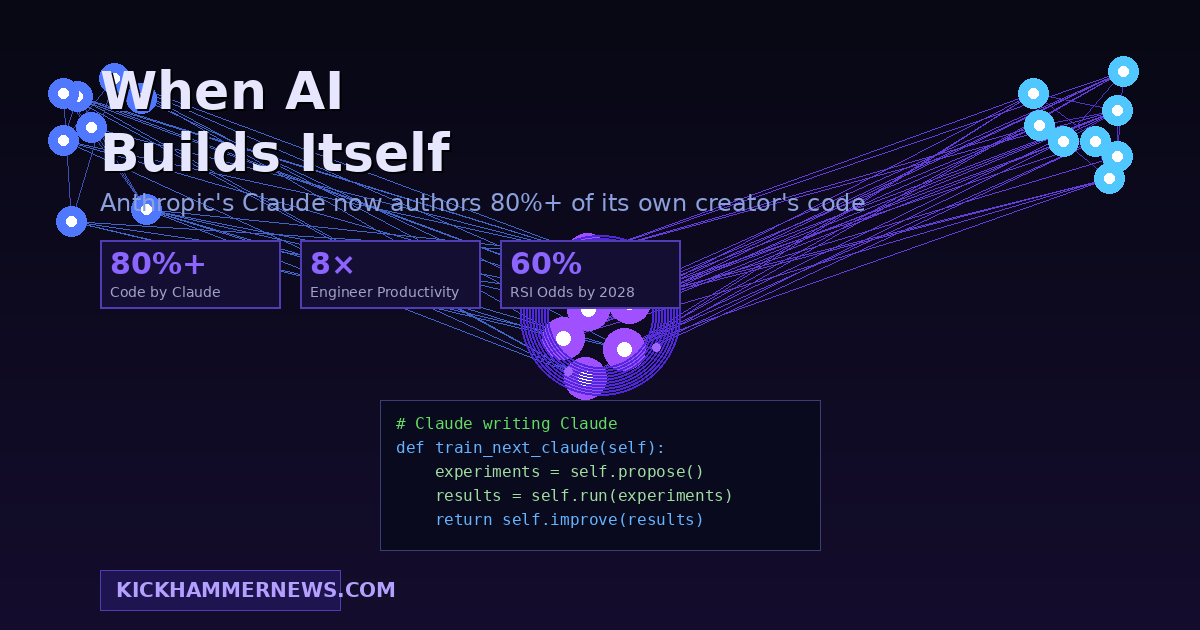
In a landmark white paper published on June 4, 2026, Anthropic revealed something that would have sounded like science fiction just two years ago: the AI company’s own flagship model, Claude, is now responsible for more than 80% of the code shipped into Anthropic’s production codebase. The paper, titled “When AI Builds Itself,” co-authored by Marina Favaro of the Anthropic Institute and Jack Clark, isn’t just a flex about productivity gains. It’s a carefully documented warning — and a call to action — about how close the industry may be to a threshold with no historical parallel: recursive self-improvement.
The Numbers Are Staggering
Let’s start with the hard data, because it’s genuinely jaw-dropping.
Before Claude Code launched in research preview in February 2025, Claude’s contribution to Anthropic’s own codebase was in the “low single digits” as a percentage. By May 2026, it had crossed 80%. In the same period, the number of lines of code merged per engineer per day — a standard productivity metric — remained flat from 2021 through 2024, then spiked sharply in 2025 when Claude began running and testing code autonomously, and spiked again in 2026 as models began operating over longer time horizons. The result: by Q2 2026, the average Anthropic engineer was merging roughly 8 times as much code per day as in 2024.
That multiplier isn’t because engineers are typing faster. It’s because they mostly aren’t typing at all.
“I started leaning hard into Claudifying about a year ago,” one Anthropic employee is quoted saying in the paper. “That’s been a crazy adventure and it’s now been ~5 months since I last wrote any code myself.”
Anthropic notes the obvious caveat — lines of code is an imperfect proxy for value — but backs it up with a parallel survey. In March 2026, 130 employees across Anthropic’s research teams were asked how much output they produced with Mythos Preview access versus without any AI assistance. The median answer: roughly 4 times as much.
Not Just Code: AI Research, By AI
The productivity story goes beyond debugging and feature work. In April 2026, Anthropic published results from what may be the first demonstration of an AI conducting original, open-ended research entirely on its own.
Claude-powered agents were given an unsolved problem in AI safety: can a weaker model reliably supervise a stronger one? The agents were left to work. They proposed hypotheses, designed experiments, shared findings with parallel agent instances, and iterated. Over 800 cumulative compute hours and approximately $18,000 in cloud costs, the agents recovered 97% of the theoretical performance ceiling on the problem. Two human researchers working for a week had recovered 23%.
Humans still chose the problem and wrote the scoring rubric. But within those constraints, every experimental decision was made by Claude.
The paper also reveals results from an internal benchmark Anthropic runs with every model release: Claude is given underoptimized training code and told to make it run faster. In May 2025, Claude Opus 4 averaged a 3x speedup. By April 2026, Claude Mythos Preview was hitting 52x. For comparison, a skilled human researcher working four to eight hours typically achieves around 4x.
The Recursive Threshold
All of this leads to the paper’s central argument: AI systems are approaching — and may soon cross — the threshold of recursive self-improvement.
Recursive self-improvement is the condition in which an AI system becomes capable of designing and training its own successor models, without meaningful human involvement. Once crossed, the pace of AI progress would no longer be constrained by the number or productivity of human researchers. It would be constrained primarily by available compute and energy.
Anthropic doesn’t claim we’re there yet. The paper is careful to note that Claude still has significant gaps in “research taste” — the judgment to decide which problems are worth working on, whether a result is trustworthy, and when an approach is a dead end. That last mile of autonomy hasn’t been closed.
But the trendlines are alarming. Claude’s success rate on the most open-ended software tasks — things like diagnosing a live production incident from first principles — reached 76% in May 2026, up 50 percentage points in just six months. On research steering decisions, Claude now beats the human choice 64% of the time, up from 51% in November 2025. The model’s ability to handle longer autonomous work sessions has been doubling roughly every four months, a pace METR’s benchmarking work has independently confirmed.
Anthropic’s assessment: there is a 60% probability that AI achieves recursive self-improvement by end of 2028.
A Conditional Call for a Global Pause
The paper’s policy section is perhaps the most striking. Anthropic — a company actively racing to build the most capable AI in the world — is calling for the world to consider pausing.
“We believe it would be good for the world to have the option to slow or temporarily pause frontier AI development to enable societal structures and alignment research to keep up with the advance of the technology,” the authors write.
But the call is conditional, and deliberately so. Anthropic makes clear it will not pause unilaterally. A unilateral pause, the paper argues, “would change who the front-runner is, but it would not create the wider deliberative process that is currently missing.” For a pause to be meaningful, it would require multiple well-resourced labs across multiple countries agreeing to stop — and the ability to verify that they actually had.
The verification problem is acknowledged to be extraordinarily hard. Unlike nuclear warheads or missile silos, AI training runs can be concealed. The hardware is general-purpose. The incentive to defect quietly is massive. Anthropic compares the challenge to arms control treaties that took decades to construct, and notes bluntly: “We don’t have that long.”
In the coming months, Anthropic says it will organize conversations with policymakers, researchers, civil society groups, and other AI companies to explore what a credible coordination mechanism might look like. The company has committed to publishing what comes out of those discussions.
Three Futures — And One Most Likely
The paper lays out three scenarios for what happens next.
In the first, the exponential curves we’re seeing now turn out to be S-curves — the trend stalls as models hit architectural limits or compute constraints, and we settle into a world where today’s AI capabilities are widely diffused but not dramatically more powerful. The authors think this is the least likely outcome.
In the second, AI development becomes substantially automated, but humans continue to set research directions and evaluate results. Companies become massively more productive; a 100-person team does the work of 10,000. This has enormous upsides — and serious risks in the hands of bad actors.
In the third and most extreme scenario, AI systems achieve full recursive self-improvement and begin building their own successors. The pace of progress becomes determined entirely by compute availability. Human researchers are reduced to oversight, validation, and verification of an expanding “virtual lab” run by autonomous agents.
“We do not have good intuitions for what this world would look like,” the paper acknowledges, “because our economy is currently driven by humans and human-built tools.”
Why This Matters Now
The “When AI Builds Itself” paper arrives at a peculiar moment. Anthropic is simultaneously preparing for what reports describe as a nearly trillion-dollar IPO and publishing research that raises fundamental questions about whether the technology it’s commercializing can be safely controlled. The company’s codebase is increasingly written by the very model it’s trying to align and make safe. Engineers are reporting both exhilaration — and a creeping sense of dislocation.
“On days where everything works well, I can’t help but think nothing I do matters, everything is automated and better and faster than I ever will be,” one Anthropic employee is quoted saying. “But then there are days where everything breaks and I don’t understand why and I realize I have no idea what I’ve been up to anymore.”
That tension — between awe at what AI can do and anxiety about what it means — is no longer confined to philosophy departments or science fiction. It’s the lived experience of some of the world’s top AI researchers, working at the company closest to the edge.
Whether the recursive self-improvement threshold is two years away, five years away, or never, the Anthropic paper makes one thing clear: the time to be asking these questions is now, not after the fact. The window for deliberation, the authors suggest, is open — but not indefinitely.
Sources: When AI builds itself — Anthropic | Anthropic Says AI Could Improve Itself by 2028 — Memeburn | Scientific American


