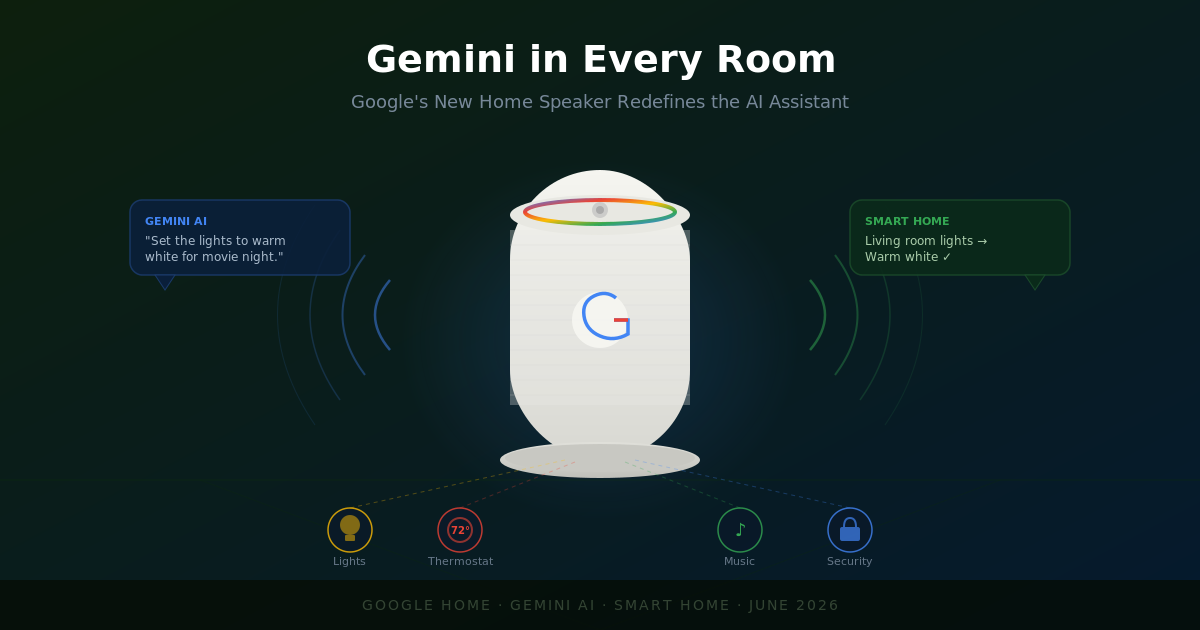
Google officially opened pre-orders today for its new Google Home Speaker, a $99.99 smart speaker that marks the company’s most significant bet yet on conversational AI in the home. Available on shelves June 25, the device is the first audio product Google has built from the ground up for its Gemini AI, and the contrast with the previous generation of voice assistants couldn’t be sharper.
This isn’t an incremental Nest update. Google is signaling a fundamental rethinking of what a home AI device should be — and in doing so, is throwing down the gauntlet to Amazon’s Alexa and Apple’s HomePod.
The End of the Command-and-Obey Model
For a decade, smart speakers operated on a simple, brittle premise: you issued a precisely worded command, the device matched it to a template, and something happened. Say the magic words and your lights dimmed. Deviate slightly from the expected phrasing and you got a confused response or an error.
The Google Home Speaker breaks from that model. Powered by Gemini for Home, the device’s AI is designed to understand natural speech the way a person would — interpreting intent rather than matching patterns.
You can now say something like, “Turn off all the lights except the bedside lamp,” and the speaker figures out what you mean. You can chain multiple tasks in a single breath: “Dim the kitchen lights, play some relaxing music, and set a timer for 20 minutes.” You can even correct yourself mid-sentence — “Turn off the coffee maker… I meant turn it on!” — and Gemini rolls with it.
This might sound like a small quality-of-life improvement, but it represents something deeper. When voice assistants stopped requiring perfect syntax, they stopped feeling like software interfaces and started feeling like something closer to a household presence.
Conversational Context Changes Everything
Perhaps the most technically impressive feature is what Google calls “short-term memory” — conversational context that persists across an exchange. Previous smart speakers treated every utterance as an isolated event. Ask one question, get an answer, ask a follow-up, and the device had no idea what you’d just been talking about.
The Home Speaker maintains the thread of a conversation. You can ask, “What’s the weather going to be like for the next Giants game?” and Gemini will independently determine when the next game is scheduled, where it’s being played, and what the forecast looks like for that location on that day — then deliver a coherent, synthesized answer. No app switches, no manual search, no clarifying questions.
The companion feature is Continued Conversation: after Gemini responds, the microphone stays open briefly so you can ask follow-up questions without repeating “Hey Google.” That small change eliminates the stop-start rhythm that made earlier voice assistants feel transactional rather than conversational. Continued Conversation now works in all supported languages — an expansion from its previous English-only rollout.
Google is also shipping 10 new natural-sounding voices with the device. It’s a detail that reads as cosmetic but matters significantly to usability. Voice assistants that sound robotic create a cognitive distance that discourages the kind of casual, frequent use that makes them genuinely useful.
The Hardware Underneath
The AI capabilities would fall flat on bad speakers, and Google hasn’t neglected the hardware side. The Home Speaker delivers 360-degree balanced audio — no dead spots regardless of where you are in the room — and features a driver roughly twice the size of the previous Nest Mini, with 2.5 times stronger bass. Advanced microphone processing adapts to the acoustic environment, improving voice recognition in noisy spaces like kitchens.
For users who want more serious audio, the Home Speaker pairs with Google’s TV Streamer to create spatial surround sound — a home theater setup built around a $99 speaker.
Aesthetically, the device wraps in a 3D-knit textile with a light ring at the base that softly indicates when Gemini is listening, thinking, or responding. It comes in Hazel and Porcelain, with Jade and Berry offered as US-exclusive colors. A hardware microphone mute toggle is present for users who want physical privacy assurance — a feature that matters more than it might seem in an era of increasing concern about always-on devices in the home.
Premium Tier: Where Gemini Gets More Ambitious
The most powerful Gemini features are gated behind a Google Home Premium subscription, which reveals Google’s real business model here: hardware as the seed, recurring AI services as the long-term revenue.
Gemini Live enables free-flowing conversation. You say, “Hey Google, let’s chat,” and the interaction becomes open-ended — you can brainstorm, change topics, interrupt, and have a genuine back-and-forth without task-completion framing.
Camera History Search integrates with Nest cameras in ways that feel genuinely useful. “Hey Google, is my back gate open?” pulls from live or recent camera footage. “Did Rover go on the couch today?” analyzes footage for familiar pets and surfaces relevant clips. This is the kind of ambient intelligence that surveillance cameras always seemed to promise but never quite delivered.
Home Briefs lets you ask for a summary of what happened around the house while you were away — a digest of camera activity, doorbell events, and device notifications, synthesized into natural language.
The Competitive Landscape
The launch comes at a pivotal moment for AI voice assistants. Amazon has been rebuilding Alexa around large language models for two years, with mixed results. Apple’s HomePod retains a premium audio reputation but has struggled to make Siri feel capable of the kind of open-ended reasoning Gemini promises.
Google has a structural advantage here: Gemini is deeply integrated with Google Search, Google Maps, Google Calendar, and Google Shopping — the informational infrastructure that underlies most of what people actually ask voice assistants about. When you ask when the next home game is, or what the weekend weather looks like, or whether a local restaurant is open, Google’s answer is more likely to be current and accurate than a model that doesn’t have the same real-time data access.
The subscription model is a risk. Consumers have grown weary of paywalled features, and Gemini Live in particular — which seems like a core conversational capability rather than a premium add-on — may frustrate users who pay $100 for a device and then encounter a ceiling.
But for those willing to pay, the total package represents a coherent vision of ambient AI that’s been promised for years and is only now becoming technically feasible.
What This Means for AI in the Home
The Google Home Speaker is the first consumer device that treats Gemini not as a chatbot bolted onto a speaker, but as the fundamental operating layer of the product. Every design decision — the natural voice, the conversational memory, the multi-step commands, the camera integration — flows from that premise.
Whether the device lives up to that vision in practice will depend on how consistently Gemini performs outside controlled demos. But the ambition itself is a signal about where the industry is heading. The era of rigid voice commands is over. The next wave of AI assistants won’t wait for you to say the right words. They’ll try to understand what you actually mean.
Pre-orders for the Google Home Speaker are open now at Google’s online store, priced at $99.99, with shipments beginning June 25.
*Sources: Google Keyword Blog, Android Central, AI Weekly*


