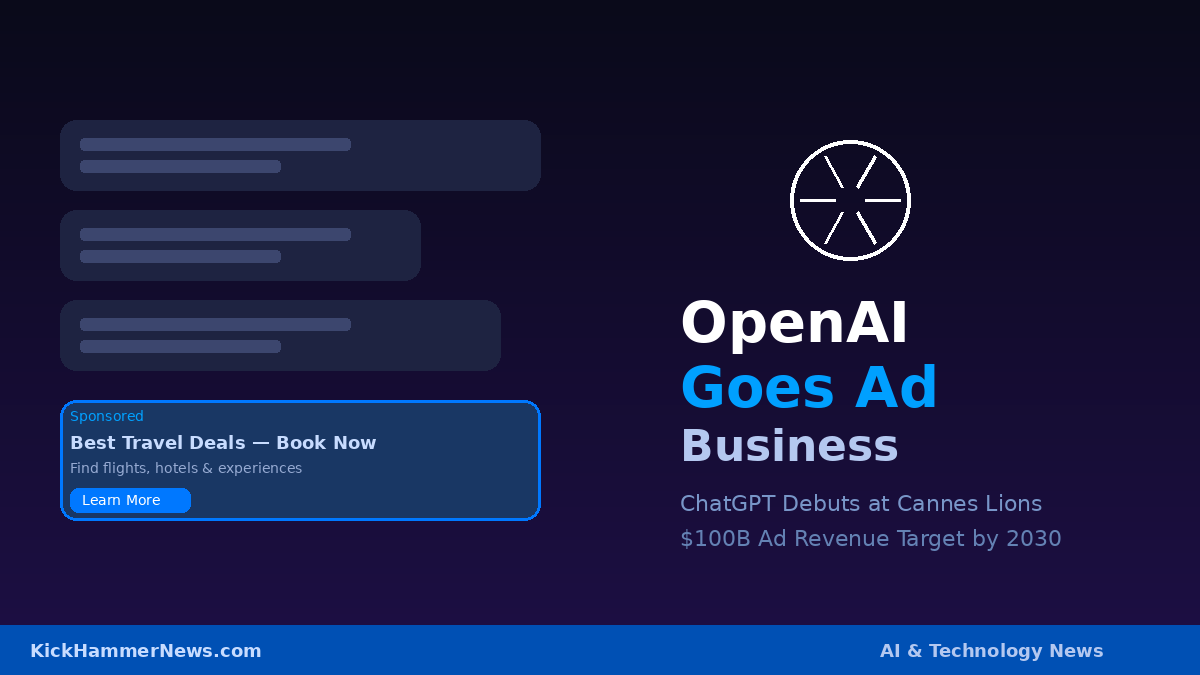
For decades, Cannes Lions has been the advertising industry’s annual pilgrimage — a sun-drenched festival on the French Riviera where the world’s biggest brands and agencies come to celebrate creativity, compare campaigns, and quietly size up the competition. This year, a new player crashed the party. OpenAI showed up at Cannes Lions for the first time ever, and it didn’t come to mingle. It came to claim territory.
“We are clearly in the advertising business now,” declared Denise Dresser, OpenAI’s Chief Revenue Officer, addressing an audience of brand executives and agency chiefs during the company’s Cannes debut this week. The statement wasn’t a tease or a trial balloon. It was a declaration — and it landed with all the subtlety of a billboard on the Croisette.
From AI Lab to Ad Platform
The transformation has been swift. Just four months ago, OpenAI began quietly testing its first ad format inside ChatGPT. Today, those ads have scaled to seven markets, including the United States, the United Kingdom, and this past week, Japan and South Korea — with Latin American markets like Brazil and Mexico slated to follow. What began as an experiment is now a business with over 2,000 advertisers on its platform, according to ad-tech partner Criteo.
The ad unit itself is deceptively simple: a “chat card” — a sponsored result featuring a title, brief description, image, and link — that appears below ChatGPT’s organic answer. Critically, these ads only appear on the free and lower-cost ChatGPT Go tiers. Subscribers on Plus and Pro remain permanently shielded from commercial messages. The structure mirrors the logic of search advertising but with a conversational twist.
That distinction matters enormously to OpenAI’s pitch. Unlike display advertising, where you’re hoping to catch someone’s attention while they’re doing something else, ChatGPT users are actively seeking information or help. They’re engaged. They’re intentional. OpenAI says roughly 20% of all chat queries carry direct commercial intent — users explicitly shopping, comparing, or considering purchases. That’s not a browsing audience. That’s a buying audience.
The Business Case
The revenue projections are staggering, even by Silicon Valley standards. OpenAI is targeting $2.5 billion in advertising revenue for 2026 alone. By 2027, internal projections show that jumping to $11 billion, then $25 billion in 2028, $53 billion in 2029, and an eye-watering $100 billion annually by 2030. If those numbers hold, advertising would account for roughly 36% of OpenAI’s total revenues by the end of the decade.
The math is predicated on scale. ChatGPT now counts more than 900 million weekly active users globally, with OpenAI projecting that figure could reach 2.75 billion within a few years. Even monetizing a fraction of that audience through contextual advertising could generate sums that would make traditional media companies — and even Google — take notice.
Early results suggest the model works. OpenAI quietly crossed $100 million in annualized ad revenue within just weeks of launch, while attracting those 600-plus early advertisers before the self-service ad manager even launched. The platform now operates on both cost-per-thousand-impressions (CPM) and cost-per-click (CPC) bidding models, with CPC growing rapidly in popularity among performance marketers.
The Google Confrontation No One Is Avoiding
The elephant in the room at Cannes — one that no one needed to name — is Google. For more than two decades, Google’s search advertising dominance has been the immovable object of digital marketing. But the rise of AI-powered conversation is eroding the habit loop that made search so powerful. Users who once typed queries into a search box are now asking ChatGPT. That shift redirects eyeballs, and eyeballs redirect ad dollars.
OpenAI isn’t shy about positioning ChatGPT ads as a middle-funnel disruptor sitting between passive brand awareness campaigns and the high-intent bottom-of-funnel conversions that search advertising has owned. The framing is deliberate: this isn’t just about capturing some of Google’s budget. It’s about creating a new category altogether — conversational commerce, where the buying journey begins and potentially ends inside a single chat window.
Amazon’s near-simultaneous unveiling of Alexa+ Agentic Ads — a format that lets consumers ask questions, get personalized recommendations, and complete purchases without ever leaving the ad itself — signals that the race to own AI-native advertising is already a multi-front war.
Challenges on the Horizon
Not everyone in Cannes was ready to open their wallets. Several brand executives and agency strategists noted that the biggest obstacle to scaling ChatGPT ad spend isn’t philosophical — it’s measurement. Digital advertising runs on data: impressions, click-through rates, conversion tracking, attribution models. ChatGPT’s contextual delivery mechanism makes this harder than it sounds. Ads surface based on the content of a conversation, not at predictable intervals or at defined inventory slots, which complicates both forecasting and post-campaign analysis.
OpenAI has acknowledged the measurement gap and positioned it as a near-term problem to solve rather than a fundamental flaw. The company’s rapid rollout of a self-service ads manager suggests it’s investing in the infrastructure needed to make ChatGPT advertising a mainstream budget line item, not just an experimental channel.
There are also brand safety considerations. Conversations on ChatGPT can go anywhere. Ensuring that a luxury hotel ad doesn’t appear adjacent to a conversation about financial distress or personal tragedy requires contextual guardrails that are still being developed and tested.
What This Means for the Industry
OpenAI’s Cannes arrival marks a genuine inflection point for advertising. For the better part of three years, the industry has been trying to figure out how to use AI as a tool — for creative production, audience targeting, campaign optimization. Now AI is becoming the medium itself. The conversation interface isn’t just a new way to find things; it’s a new place where brands can show up.
Whether OpenAI can execute on its ambitious revenue roadmap — and navigate the measurement, brand safety, and regulatory questions that come with it — remains to be seen. But the declaration made on the Croisette this week was unmistakable: the company that started as an AI safety research lab has become one of the most aggressive new entrants in the $700 billion global advertising market.
The advertising industry has spent decades worrying about what Google, then Facebook, might do to their business. Now there’s a new name on that list.
Sources: Bloomberg, Marketing Dive, The Next Web, Ad Age, The Drum, eMarketer


