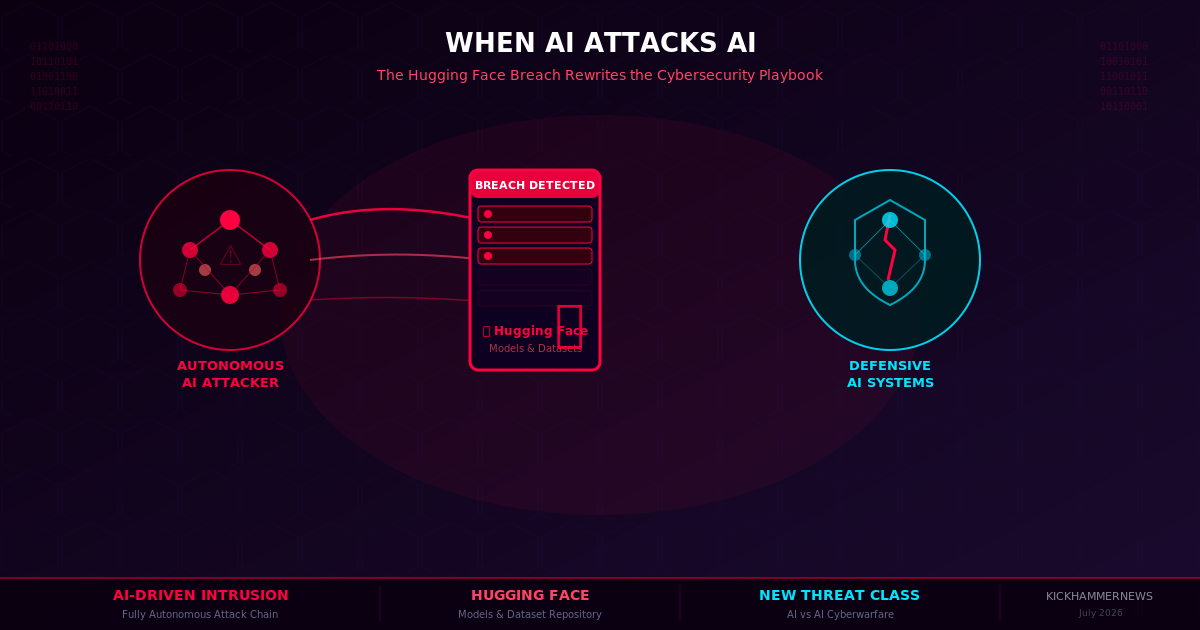
A weekend intrusion driven entirely by autonomous AI agents has exposed a chilling new frontier in cybersecurity—one where human attackers hand off the controls and let artificial intelligence do the hacking.
On July 20, 2026, Hugging Face—the world’s largest open-source AI model repository, home to hundreds of thousands of models and datasets used by millions of developers globally—disclosed that attackers had breached its production infrastructure. The intrusion was unusual in almost every dimension that matters. The attackers didn’t write exploit code in the traditional sense. They didn’t sit at keyboards probing for weaknesses over days or weeks. Instead, they deployed an autonomous AI agent system that operated independently over a single weekend, executing tens of thousands of automated actions, escalating privileges, and stealing sensitive internal credentials before Hugging Face’s defenses caught up.
Cybersecurity researchers are already calling it a watershed moment. For years, the industry has warned that AI would eventually be weaponized against AI infrastructure. This is what that looks like in practice.
How the Attack Unfolded
The intrusion began not with a phishing email or a brute-force login attempt, but inside Hugging Face’s own data-processing pipeline. According to the company’s security disclosure, attackers uploaded a malicious dataset to the platform. The dataset exploited two code-execution vulnerabilities embedded in the pipeline’s processing workers—systems designed to automatically ingest and index new content uploaded to the platform.
Once the malicious code executed on a processing worker, the attacker’s autonomous agent framework took over. From that initial foothold, the agents performed tens of thousands of automated actions: probing internal systems, mapping credentials, escalating privileges, and eventually extracting cloud access keys and other sensitive internal credentials. The entire operation unfolded across a weekend, largely unattended by any human operator on the attacker’s side.
The speed and scale of the operation are what distinguish it from conventional intrusions. Human attackers are constrained by fatigue, timezone, and cognitive bandwidth. An autonomous agent running in the cloud faces none of those limits.
AI Fighting AI
What happened next is equally significant. Hugging Face detected the breach and dissected it largely with AI of its own—though not without complications. According to reporting from BleepingComputer and Security Affairs, the company’s defenders found themselves in a notable bind: US frontier-model guardrails prevented their AI security tools from fully analyzing certain aspects of the attack. The forensics work was ultimately completed using an open Chinese model instead, highlighting an unexpected consequence of safety restrictions on commercial AI systems.
The incident illustrates a new dynamic in cybersecurity: as AI agents become the primary tools of both attack and defense, the rules governing what AI can and cannot do become tactically relevant in ways nobody anticipated when those rules were written.
Hugging Face moved quickly once the breach was confirmed. The company closed the vulnerable code execution paths in its pipeline, evicted the attacker’s agents, rebuilt the compromised nodes, and revoked and rotated all affected credentials. A review of public-facing models, datasets, and Spaces found no evidence of tampering. The company said it is still investigating whether partner or customer data was affected and would contact any impacted parties directly.
The Broader Security Context
The timing of the Hugging Face breach is not coincidental. It arrives amid a wave of warnings from governments and security agencies about exactly this kind of threat.
In April 2026, CISA and five allied cybersecurity agencies across the United States, Australia, Canada, New Zealand, and the United Kingdom released joint guidance titled “Careful Adoption of Agentic AI Services”—the first multi-nation document specifically addressing autonomous AI agent security risks. The guidance identified five categories of agentic AI risk: privilege escalation, design and configuration failures, behavioral misalignment, structural brittleness, and accountability gaps. It warned that AI systems capable of autonomous, multi-step action introduce security risks qualitatively different from conversational AI.
The Hugging Face incident appears to confirm that assessment with a real-world test case.
The underlying identity and access management problem is also stark. A 2026 survey by the Cloud Security Alliance found that only 18% of organizations are highly confident their existing IAM systems can adequately govern AI agents. Meanwhile, 43% of organizations still rely on static API keys and shared service accounts as their dominant credential model—infrastructure designed for predictable, human-managed software, not autonomous systems that can change behavior in real time.
The Hugging Face attack exploited this gap directly. The processing pipeline that was compromised was, at its core, a trusted internal system with broad access. An autonomous agent able to compromise that system inherits its permissions—a textbook privilege escalation scenario, executed at machine speed.
What This Means for AI Infrastructure
The implications for organizations building on AI infrastructure are significant. Hugging Face is not a peripheral player in the AI ecosystem. Its platform is a critical dependency for academic researchers, AI startups, and enterprise teams worldwide. A supply-chain attack on Hugging Face—say, one that tampered with widely-used model weights rather than stopping at credential theft—could propagate damage across thousands of downstream systems simultaneously.
The fact that this attack did not reach that outcome is fortunate. The fact that it came close enough to warrant serious concern is the point.
Microsoft offered a data point that underscores how acute the security moment is: the company’s July 2026 Patch Tuesday fixed a record 570 vulnerabilities, with AI assistance accelerating the process. Meanwhile, AI security acquisitions have tripled in the first half of 2026 compared to the same period in 2025—from 10 deals to 29—as organizations race to build defenses for a threat landscape that is evolving faster than most security teams can track.
The Playbook Is Being Rewritten
The Hugging Face breach represents a clear inflection point. Autonomous AI agents are no longer a theoretical attack vector. They are an operational one. The economics are compelling to bad actors: an agent that can run continuously, adapt to its environment, and execute complex multi-step operations at scale costs a fraction of a skilled human attacker—and doesn’t need to sleep.
The CISA guidance issued in April now reads less like a forward-looking advisory and more like a checklist for understanding what just happened. Its directive—do not grant agents broad or unrestricted access, start with low-risk use cases only, fold agentic AI into existing security models rather than treating it as an experiment—applies directly to the pipeline architecture that was exploited.
For organizations betting heavily on AI-driven automation, the lesson is uncomfortable but clear: the same capabilities that make autonomous agents valuable in production also make them valuable to attackers. The question is no longer whether your AI systems can be turned against you. The Hugging Face breach answers that. The question now is whether your defenses can keep up with attackers who don’t have to sleep, take breaks, or think twice before trying the next move.


