DeepSeek’s V4 Flash, its smallest and cheapest production model, now outperforms V4-Pro-Preview on every single agent benchmark the company publishes. It didn’t require a bigger model or a new architecture — just a fresh post-training run. That detail is more disruptive than the benchmark numbers alone.
On July 31, 2026, DeepSeek quietly pushed the official build of its V4-Flash model out of preview. In the release notes, buried beneath the usual technical specifications, was a result that should have stopped the industry in its tracks: V4-Flash-0731 scores higher than DeepSeek’s own V4-Pro-Preview across all nine agent and coding benchmarks the company tracks. The Pro model — the flagship — lost to the Flash — the budget variant — on every single evaluation in its own developer’s test suite.
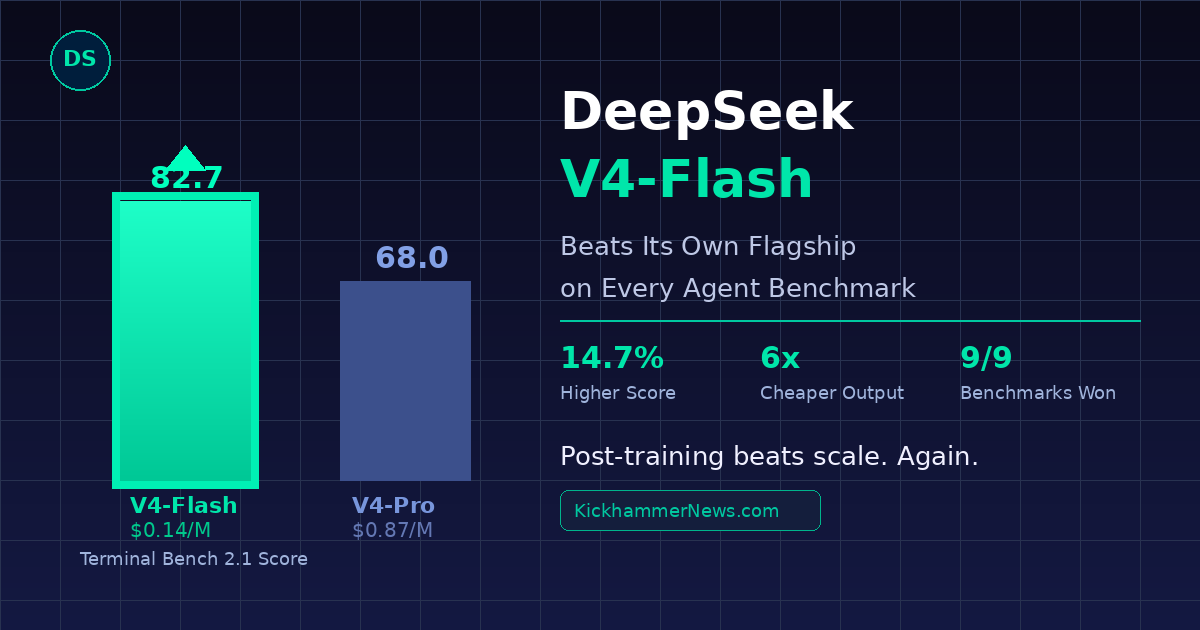
The numbers are stark. On Terminal Bench 2.1, the industry’s leading benchmark for autonomous coding agents operating in real terminal environments, V4-Flash scores 82.7. V4-Pro-Preview scores 68.0. That’s a 14.7% margin — not a rounding error, not statistical noise. On DeepSWE, a benchmark measuring how well AI models navigate realistic software engineering tasks, V4-Flash posted 54.4 — representing a 645% improvement over the previous Flash preview. The Pro model, which has not received a new post-training pass for this release cycle, sits well behind.
The pricing gap makes this even more striking. V4-Flash comes in at $0.14 per million input tokens and $0.28 per million output tokens. V4-Pro’s output pricing runs to roughly $0.87 per million tokens — more than three times the Flash output price. Developers running agent workloads at scale aren’t just getting better performance with Flash; they’re getting it at a substantial discount.
Post-Training Is the New Moat
The obvious question raised by this result is: how did it happen? V4-Flash-0731 keeps the exact structure and parameter count of the V4-Flash preview. The 284-billion parameter architecture is unchanged. DeepSeek made no claims about architectural breakthroughs or a new training data mixture. What changed was post-training — the phase of model development that occurs after the initial large-scale pretraining run, where a model is refined through techniques like reinforcement learning from human feedback, reinforcement learning from verifiable rewards, and targeted fine-tuning on specific task distributions.
DeepSeek’s release notes confirm that V4-Flash-0731 represents “a fresh post-training run aimed at exactly the agentic task class.” In other words, someone decided to spend engineering effort optimizing the model specifically for the kinds of multi-step, tool-using, environment-interacting tasks that define modern AI agents — and the result beat the unoptimized Pro model by double digits.
This matters enormously as a signal about where AI capability gains are actually coming from in 2026. For the past several years, the dominant narrative was that raw scale — more parameters, more training compute, more data — was the primary driver of capability improvements. That narrative produced models that grew from billions to hundreds of billions of parameters, and computing clusters that cost in the tens of billions of dollars. But the V4-Flash result is a data point in a growing body of evidence that targeted post-training can outperform raw scale, at a fraction of the cost.
It’s worth being precise about what “post-training” means here. Modern AI post-training encompasses several stages: instruction tuning (training the model to follow instructions), reinforcement learning from human feedback or AI feedback (teaching the model to prefer responses that score higher on some reward signal), and increasingly, reinforcement learning from verifiable rewards — where the model is trained on tasks with objectively checkable answers, like code that either runs correctly or doesn’t, mathematical proofs that either verify or fail, and agent tasks that either complete successfully or terminate in error. This last category — RL from verifiable rewards — has been particularly impactful for agent performance because the reward signal is clear and dense: did the agent finish the task?
The Implications for Agent Development
The practical implications for developers building with AI agents are significant and immediate.
For teams choosing a model for agent workloads, the calculus just shifted. Previously, the conventional wisdom was to use the best (typically most expensive) model your budget allowed, on the theory that agent tasks require the deepest reasoning and the fewest mistakes per step. A single wrong tool call or misread of a terminal output can cascade into a failed task, so the premium for frontier reasoning seemed justified. V4-Flash breaks that heuristic. When the budget model actually benchmarks higher on agentic tasks than the premium model, “use the best model” still applies — it just now points to Flash.
More broadly, the result raises pointed questions about how AI providers should structure their model tiers going forward. The intuition behind Pro/Flash/Mini distinctions was that bigger models serve sophisticated users and smaller models serve high-volume, lower-stakes applications. That intuition depended on capability scaling cleanly with model size. It increasingly does not. If a focused post-training run can lift a 284B model above a larger, less-specialized rival on agent benchmarks, then the future model tiers may be organized around task specialization rather than raw capability hierarchy.
Where Independent Verification Stands
One important caveat deserves mention. DeepSeek’s benchmark numbers are vendor-reported. The company evaluated V4-Flash-0731 using DeepSeek’s own evaluation harness, in minimal mode, at the max tier, with specific sampling parameters (top_p = 0.95, temperature = 1.0). Agent benchmark scores are notoriously sensitive to evaluation harness details — the same model can score very differently depending on how tool calls are scaffolded, how terminal environments are initialized, and how partial task completions are scored. The 82.7 on Terminal Bench 2.1 and 54.4 on DeepSWE should be treated as strong signals, but not gospel, until independent evaluators reproduce them.
That said, the developer community’s initial response has been broadly positive. Several AI engineering teams have begun posting their own informal replications on social media, and while early results vary, no one has published a credible refutation of the core finding. The model is available through DeepSeek’s API and through third-party inference providers, and independent benchmarking takes time. A more definitive picture should emerge over the next two to four weeks.
The Bigger Pattern: Cheap Performance Keeps Winning
DeepSeek has built its reputation on delivering competitive or superior performance at prices significantly below comparable Western frontier models. V4-Flash represents that pattern pushed to its logical extreme — a model that isn’t just cheaper than comparable competitors, but cheaper than its own manufacturer’s premium offering, while outperforming it on the specific task class most relevant to the agent-driven applications that developers are building today.
The AI industry has been grappling with this dynamic since DeepSeek’s R1 model surfaced in early 2025 and showed that a Chinese research lab could match OpenAI’s o1 on reasoning benchmarks at a dramatically lower inference cost. That release triggered a repricing event across the industry. V4-Flash may not create a comparably dramatic shock — the market has grown accustomed to DeepSeek’s cost efficiency — but it does crystallize a principle that is reshaping how AI development works.
Capability improvements no longer require more compute at training time. They require better ideas about how to train. Post-training, alignment research, and task-specific optimization have become the decisive frontier. The labs that figure out how to target their training effort most precisely — not the ones with the biggest clusters — may increasingly determine which models end up in production.
For developers, the immediate takeaway is straightforward: run your own agent benchmarks against V4-Flash-0731 before assuming the Pro tier is worth the price premium. The data suggests it may not be.
DeepSeek V4-Flash-0731 is available via DeepSeek’s API at $0.14/$0.28 per million input/output tokens. The model’s official release blog post and benchmark methodology are published at deepseek.ai.


