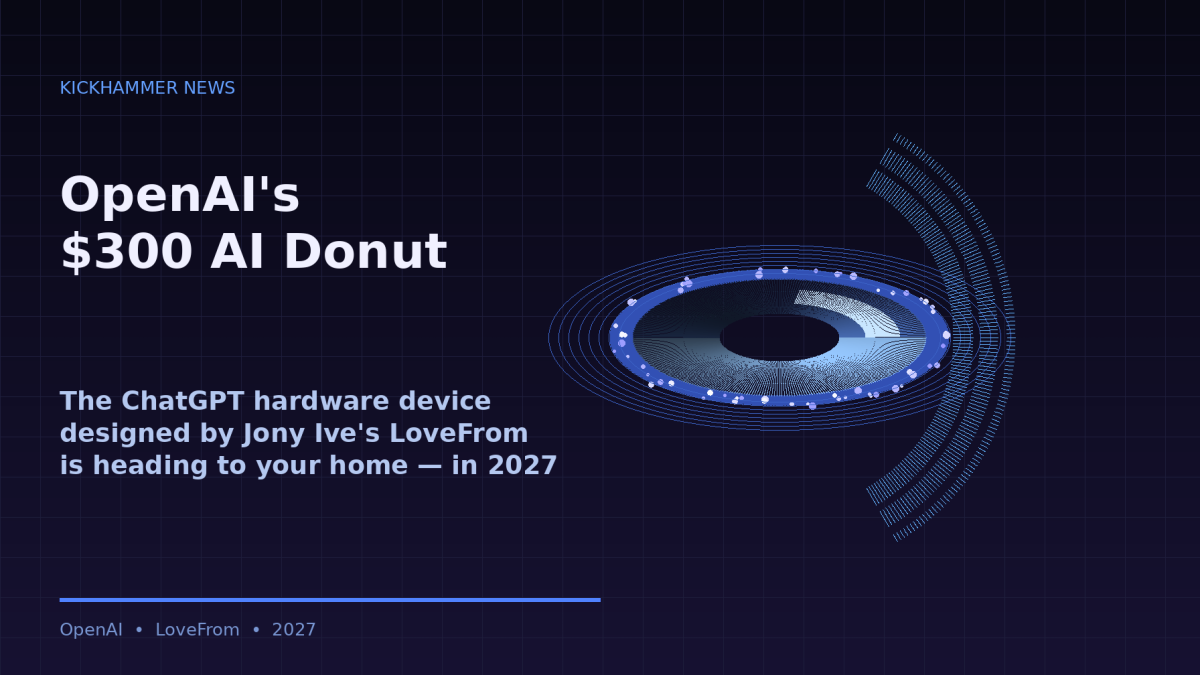
A Bloomberg report reveals OpenAI’s first consumer device is a premium, donut-shaped AI speaker designed by Jony Ive’s LoveFrom studio — and it comes loaded with mysteries, including “moving parts” no one has explained yet.
OpenAI has spent the better part of three years dominating the AI software conversation. Now, the company is coming for your kitchen counter.
New details emerged this week about OpenAI’s first consumer hardware device, and they paint a picture far more ambitious — and unusual — than anyone expected. According to Bloomberg, the product is donut-shaped, constructed from high-quality metal, priced between $300 and $400, and features “moving parts” that sources have declined to explain. It’s designed in partnership with LoveFrom, the design studio founded by Jony Ive, the legendary former Apple designer responsible for the iMac, the iPhone, and the iPod. And it is slated for release sometime in 2027.
It is, in short, an expensive talking AI donut. And it might be one of the most significant technology products in years.
The “Physical Manifestation” of ChatGPT
OpenAI has been publicly cagey about its hardware ambitions, but Bloomberg first reported in July that the company’s first device would be a screenless, moveable speaker designed as an “AI companion” — essentially a physical embodiment of ChatGPT. The donut shape, revealed in this week’s report, is a deliberate design choice: the form factor allows users to carry the device between rooms, setting it on a bedside table at night, moving it to the kitchen counter in the morning, or placing it on a desk during work hours. Portability and presence are core to the concept.
The device is battery-powered, built from premium materials, and reportedly includes camera sensors and dynamic lighting alongside its audio capabilities. The “moving parts” remain the product’s most intriguing mystery — sources confirmed their existence to Bloomberg without explaining their function, leaving room for speculation ranging from rotating microphone arrays to mechanical visual displays.
OpenAI CEO Sam Altman has described the broader hardware project as an attempt to build a device people will want to have with them at all times — a more intimate relationship with AI than a smartphone allows. If the donut speaker is the home-based version of that vision, it suggests OpenAI is thinking about AI presence as something ambient and persistent, woven into the physical spaces where people live rather than accessed through a screen.
Why Jony Ive Matters
The involvement of Jony Ive and LoveFrom is not a cosmetic detail. Ive spent 27 years at Apple reshaping how the world relates to technology through design. His fingerprints are on some of the most commercially successful and culturally influential consumer products ever built. After leaving Apple in 2019 to found LoveFrom, he has been selective about partnerships — the OpenAI collaboration is among his most prominent since departing Cupertino.
Ive’s philosophy has always centered on the idea that great hardware disappears: the user shouldn’t be aware of the device, only of what it allows them to do. A donut-shaped AI speaker designed under his direction would presumably try to make the experience of talking to an AI feel natural rather than transactional — the goal being not a gadget you interact with, but an ambient intelligence you simply live alongside.
The price point, $300 to $400, puts the device in an unusual tier for smart speakers. Amazon’s Echo lineup tops out around $240 for its premium units, and Google’s Nest speakers are similarly priced. Apple’s HomePod sits at $299. OpenAI’s device would compete at or above the premium end of that market — a bet that consumers will pay significantly more for the quality of the AI experience rather than just the hardware.
The Smart Speaker Market Is a Graveyard
OpenAI is entering a hardware category that has historically resisted profitability. Amazon reportedly lost billions building out its Echo and Alexa ecosystem, treating the devices as loss leaders designed to embed the company’s services into users’ daily routines. Google’s speaker strategy has been similarly expensive and strategically murky. Apple’s HomePod, despite critical praise, struggled for years to find a mass audience.
The conventional critique of smart speakers is that they’re capable enough to be useful but not remarkable enough to be indispensable. Users ask for weather updates and set timers; they rarely use the full scope of what these devices can do. The question for OpenAI is whether ChatGPT, with its dramatically more capable conversational AI, changes that equation.
The argument in OpenAI’s favor is that the gap between what Amazon’s Alexa can do and what ChatGPT can do is enormous. Earlier AI assistants were pattern-matching systems that excelled at lookup tasks and fell apart on anything requiring context, nuance, or sustained conversation. ChatGPT-class models handle complex multi-turn dialogue, generate creative content on demand, reason through ambiguous problems, and remember context across a conversation in ways that prior smart speaker assistants simply couldn’t. If OpenAI can deliver that experience through room-filling audio hardware that feels beautiful and intentional in the home, the market dynamics could genuinely be different.
Legal Turbulence
OpenAI’s hardware push has not been without friction. Apple filed a trade secrets lawsuit against OpenAI in July, alleging that the company improperly obtained confidential information related to Apple’s hardware development programs. OpenAI has denied wrongdoing, and this week released internal communications it says demonstrate the accusations are unfounded. The lawsuit adds a layer of tension to a competitive dynamic that was already unusual: Apple’s former chief design officer is now building a product that may directly compete with Apple’s own home AI hardware efforts.
Whether the lawsuit represents genuine legal exposure for OpenAI or a tactical move by Apple to complicate a rival’s hardware launch, it underscores how seriously the incumbent consumer tech industry is taking OpenAI’s hardware ambitions.
What Comes Next
With a 2027 release target, the donut speaker is still roughly a year from hitting shelves. OpenAI has not announced pricing officially, confirmed the “moving parts” function, or provided hands-on demos to press. What Bloomberg’s reporting establishes is a picture of a company spending serious resources on premium consumer hardware, partnering with one of the world’s most celebrated designers, and betting that the AI capabilities it has built in software are powerful enough to justify reinventing what a home speaker can be.
For consumers who have grown accustomed to asking Alexa to set a timer or telling Siri to play a song, an always-present, context-aware ChatGPT companion — one that remembers your preferences, manages your schedule, answers complex questions in real time, and does so through a beautifully designed object sitting on your kitchen counter — would represent a genuine leap forward.
The smart home has been waiting for an AI capable of actually being smart. OpenAI’s donut may be the first real attempt to deliver one.


