The AI safety startup founded just five years ago has quietly become one of the most valuable and now profitable companies in Silicon Valley—and it’s gunning for a public listing before OpenAI gets there first.
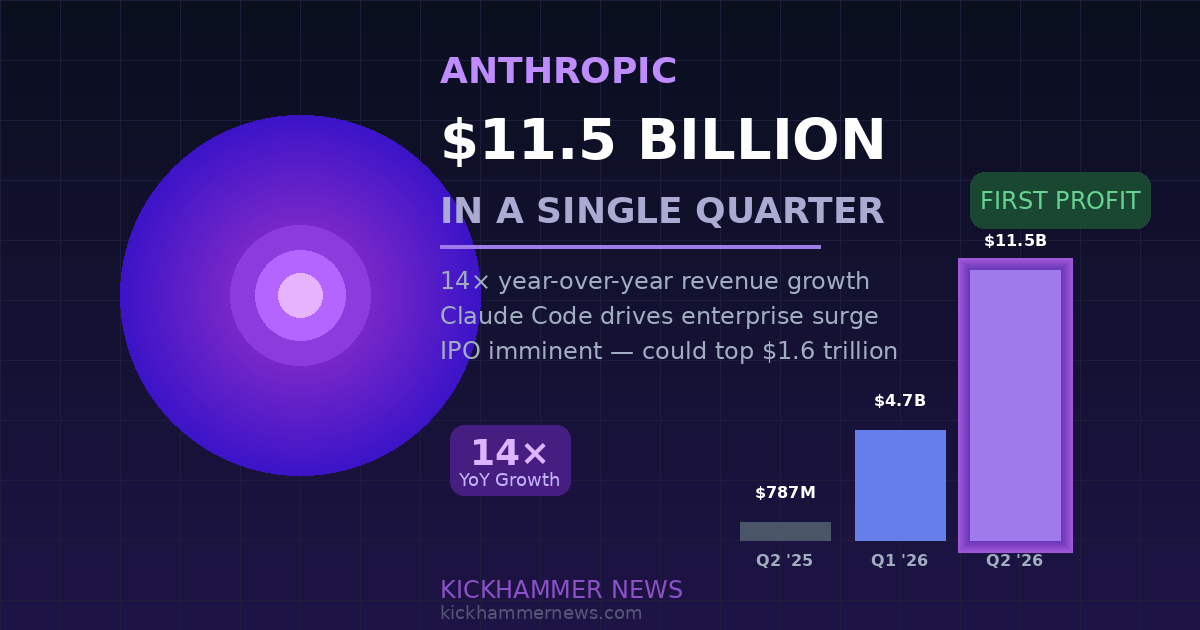
Anthropic just rewrote the AI industry’s business narrative. The company behind the Claude family of models reported preliminary second-quarter 2026 revenue exceeding $11.5 billion—a figure that represents a fourteen-fold increase over the same period just one year ago. More striking still: for the first time in the company’s history, Anthropic posted positive adjusted operating income. The era of the unprofitable AI lab may be ending, and Anthropic is leading the charge.
From Underdog to Juggernaut
When Dario and Daniela Amodei left OpenAI in 2021 to found Anthropic with a handful of colleagues, the company was positioned squarely as the “safe” AI lab—a research-first organization that would take a measured, principled approach to building frontier models. The messaging was important. But so was the business.
Fast-forward to mid-2026, and the financials are staggering. In Q2 2025, Anthropic generated $787 million in revenue. In Q1 2026, that number had climbed to $4.73 billion. Then came Q2 2026: $11.5 billion in a single quarter, more than doubling the previous three months. The first half of 2026 alone generated roughly $16.2 billion in revenue, making Anthropic one of the fastest-growing enterprise software companies in history—if you can even still call it that.
These figures emerged from documents shown to prospective investors, first reported by Bloomberg. Anthropic declined to comment on the numbers, but they align closely with the company’s $47 billion annualized run rate disclosed in May during its $65 billion Series H funding round—a round that valued the company at $965 billion post-money and drew in a who’s who of global capital: Altimeter Capital, Dragoneer, Greenoaks, Sequoia, Blackstone, Fidelity, and Temasek, among others.
The Engine Behind the Numbers: Claude Code
So what’s actually driving this explosive growth? The answer isn’t casual consumer chatbot usage. It’s enterprise adoption of Claude’s coding capabilities.
Claude Code, Anthropic’s agentic coding tool aimed squarely at software developers and engineering teams, crossed $1 billion in annualized revenue within just six months of its launch. Analysts at FutureSearch project Claude Code alone could contribute more than $20 billion in annualized revenue by next May if current trends hold.
This matters because coding workloads are fundamentally different from simple chat interactions. They’re longer, more complex, and more computationally intensive—which means customers pay significantly more, and the business model scales differently. Rather than millions of users asking chatbots to write emails, Anthropic is capturing large enterprise contracts where teams are offloading entire software development workflows to Claude. This creates sticky, recurring revenue that looks more like enterprise SaaS than consumer internet.
The shift underscores a broader pattern across the AI industry: the real money isn’t in general-purpose chatbots. It’s in purpose-built agents that replace or augment high-value professional tasks. Anthropic happened to build the right tool at the right time.
First-Ever Operating Profit—with Caveats
The headline figure of positive adjusted operating income is significant, but the qualifier matters. “Adjusted” operating income typically excludes items like stock-based compensation, restructuring charges, and other one-time expenses. Anthropic’s GAAP results—which would include the full cost of equity compensation for its highly paid AI researchers—will likely tell a different story.
Critics, including analyst Ed Zitron, have pointed out that calling this milestone a true “profitability” moment requires some optimism about accounting. The company still burns enormous amounts of capital on compute infrastructure, frontier model training (which can cost hundreds of millions per run), and the talent war for top AI researchers. Total capital raised now exceeds $130 billion. The adjusted metric is a signal, not a verdict.
Still, even adjusted profitability at this scale is meaningful. It demonstrates that unit economics can work at frontier-model scale when enterprise demand is strong enough. Anthropic’s competitors are watching closely.
IPO Race: Anthropic vs. OpenAI vs. DeepSeek
The financial results are landing at a pivotal moment. Anthropic has confidentially filed for a public listing and is working with Morgan Stanley, Goldman Sachs, and JPMorgan Chase on the offering. Market discussions suggest an IPO could arrive as soon as this fall—potentially before both OpenAI and DeepSeek, which are also eyeing public markets.
That sequencing matters enormously. The first major AI lab to IPO will almost certainly set the valuation benchmark for the others. Prediction market traders have priced Anthropic at valuations approaching $1.6 trillion, with some speculation pushing toward $2 trillion. If Anthropic can get out first and the market receives it warmly, OpenAI and DeepSeek will face intense scrutiny to justify similar or higher valuations with their own numbers.
OpenAI, for its part, is not standing still. The company reported an annualized run rate exceeding $40 billion earlier this month, and its S-1 filing has been a topic of significant investor discussion. But Anthropic’s Q2 figure of $11.5 billion actually exceeds OpenAI’s implied quarterly run rate based on publicly reported annual figures—a remarkable reversal for a company that entered the market as a second mover.
DeepSeek, meanwhile, is preparing for an IPO filing of its own, potentially this year. The Chinese AI firm’s presence in the market has already forced industry pricing adjustments, and its open-source model releases have pressured Western labs on cost. An IPO would give DeepSeek access to capital that could accelerate that pressure further.
The Amazon Factor—and the Risk of Partner Dependence
Anthropic’s revenue surge owes much to its cloud partnerships, most notably with Amazon. AWS has integrated Claude deeply across its services and made major investment commitments totaling over $4 billion (with an additional commitment of up to $4 billion more). Google Cloud has made similar investments. These hyperscalers don’t just write checks—they distribute Claude to their massive enterprise customer bases and provide the compute infrastructure that makes inference at scale possible.
This is both a strength and a vulnerability. On the upside, Anthropic gains distribution and compute without bearing the full infrastructure burden. On the downside, a significant portion of Anthropic’s revenue flows through or alongside partners who are also building their own competing AI products. AWS has its own AI ambitions. Google is competing directly with Gemini. The partnerships are symbiotic today, but the incentives could diverge.
Anthropic has taken steps to diversify, building its own direct enterprise sales motion and expanding its API business. But investors will need to assess how much of that $11.5 billion is attributable to partner channels versus direct sales, and what happens if the dynamics of those relationships shift.
Safety, Scale, and the Tension Ahead
Dario Amodei has been notably measured in his public communications even as the financial headlines scream. Anthropic continues to publish safety reports and has maintained its policy of withholding certain advanced internal models from public release. Its Constitutional AI training approach and internal Responsible Scaling Policy remain core to the company’s identity.
But commercial success creates pressure. When you’re generating $11.5 billion in a quarter and racing toward a trillion-dollar IPO, the competitive environment demands faster deployment, broader access, and more aggressive capability development. Anthropic has so far managed the tension between caution and velocity better than many expected. Whether that continues under the scrutiny of public markets is an open question.
What This Means for the Industry
Anthropic’s Q2 results are a data point the entire AI industry will cite for years. They demonstrate that frontier AI can generate enterprise revenue at extraordinary scale and that, at sufficient volume, the economics can work even with massive compute costs. The “AI is a money pit” narrative has taken a serious blow.
For enterprise technology buyers, the numbers confirm that AI spending is real, durable, and producing outcomes that justify continued investment. For competitors, they signal that the window to compete in the frontier model tier is narrowing fast. For regulators and policymakers, the speed of growth—14x in a year—underscores how quickly the landscape is changing and why governance frameworks struggle to keep pace.
And for Anthropic itself, the moment marks a transition. The safety-focused research lab has become a commercial juggernaut. Its next chapter—life as a public company, under quarterly earnings pressure, with retail shareholders as well as mission-aligned investors—will test whether the principles that defined its early years can survive the demands of Wall Street.
If the numbers from Q2 are any guide, the market is ready to bet they can.
*Sources: Bloomberg, Fortune, WebProNews, CNBC, Fortune (August 15, 2026)*


