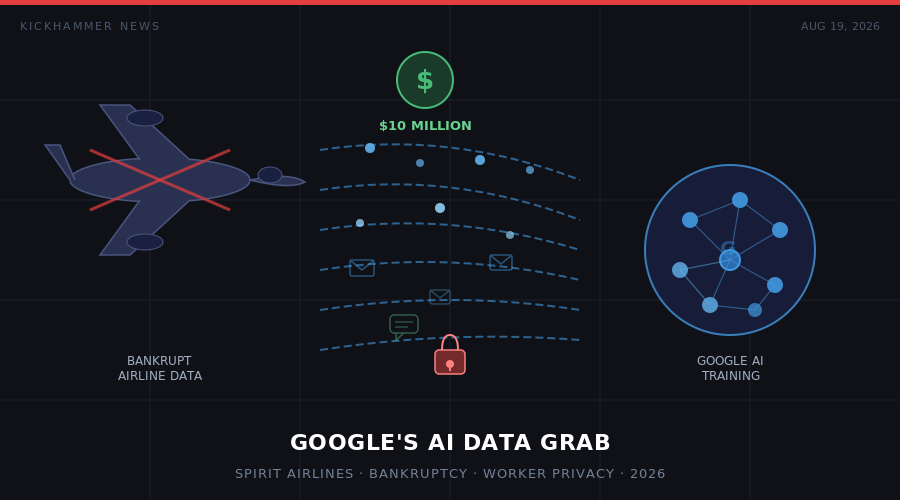
A bankrupt airline’s internal archives — 100 million emails, 500 million Teams chats, decades of operational data — are headed to one of the world’s most powerful AI labs. Workers never saw it coming.
When Spirit Airlines filed for bankruptcy in late 2024 and finally ceased operations earlier this year, its roughly 11,000 employees lost their jobs. What they didn’t know was that their professional digital lives — every internal email, every Microsoft Teams message venting frustration about a delayed flight, every candid conversation about management decisions — would become the property of Google, to be used to train artificial intelligence.
On August 14, 2026, Google won a virtual bankruptcy auction, outbidding AI recruitment firm Mercor.io with a $10 million offer — $2.5 million more than the runner-up — to acquire the entirety of Spirit Airlines’ internal corporate data archive. The purchase is pending approval in the U.S. Bankruptcy Court for the Southern District of New York. A scheduled hearing on August 19 was postponed after a labor union representing former Spirit workers objected and asked for more time to review the proposal.
The deal has ignited a fierce debate about who actually owns workplace data, what rights employees have over their digital communications, and whether bankruptcy law has become an unexpected backdoor for AI companies to acquire training data at bargain prices.
What Google Is Getting
The scope of the dataset is staggering. According to court filings, the Spirit Airlines archive includes approximately 100 million employee emails, 500 million Microsoft Teams messages, calendar entries, documents, spreadsheets, operational logs, marketing materials, and more than 30 million lines of software code that powered the airline’s operations.
Google says it plans to use the data for “product development and artificial intelligence training.” The potential applications are broad: training models on real-world workplace communication, airline operations logistics, dynamic pricing strategies, and complex organizational workflows. The dataset spans nearly two decades of operations — a uniquely rich corpus of authentic professional communication at a major U.S. carrier.
Critically, Google will not receive customer-facing data. The 97.5 million passenger profiles and 50.2 million customer records from the Free Spirit loyalty program are excluded. All data handed over will, according to court documents, be “rigorously scrubbed of any personally identifiable information by a third party before receipt.” Names, addresses, and other direct identifiers will be stripped before Google takes possession.
That safeguard sounds reassuring. Many privacy researchers say it isn’t enough.
The Limits of Anonymization
The concept of de-identification — removing names and other direct identifiers from a dataset — has been a cornerstone of data-sharing frameworks for decades. But researchers who study data protection have long warned that de-identification has practical limits, particularly with rich, contextual datasets like multi-year email archives.
Even with names removed, a combination of dates, job titles, distinctive operational events, and specific turn-of-phrase can allow sophisticated systems to infer the identities of individuals or reconstruct sensitive situations. A 2019 study famously demonstrated that 99.98% of Americans could be re-identified from anonymized datasets using just fifteen demographic attributes. That study used far simpler data than a decade of internal airline communications.
For a large language model being trained on the Spirit dataset, the problem is compounded. These systems are explicitly designed to identify patterns in language — to learn how people talk, in what contexts, and about what subjects. Whether or not a name is attached to a message, the model can learn from the substance of what was said.
“The de-identification promise is often made in good faith,” says one privacy researcher familiar with such acquisitions. “But the people making that promise frequently underestimate how much information is embedded in communication patterns themselves.”
Workers Never Consented
Perhaps the most uncomfortable aspect of the Google-Spirit deal is the question of consent. When Spirit’s employees sent emails and Teams messages during their working hours, they operated under assumptions common to most workplaces: their communications were property of the company, stored for business purposes, subject to legal discovery in litigation. Very few would have anticipated those messages being sold to an AI company to train commercial products.
“This should be outrageous to every working person in America,” said Sara Nelson, president of the Association of Flight Attendants, in a statement reported by Forbes. “Workers’ private communications are being auctioned off to a tech giant without their knowledge or consent. This is an abuse of the bankruptcy process.”
The union’s objection triggered the court delay, buying workers more time to understand what’s happening — but not necessarily to stop it. Under U.S. bankruptcy law, corporate assets including data archives are fair game for liquidation to satisfy creditors. The legal framework was built long before AI training data became a multi-billion-dollar commodity.
This is not a hypothetical concern limited to Spirit Airlines. As a wave of retail, hospitality, and airline bankruptcies has swept through the U.S. economy in recent years, the data archives of these companies have become increasingly attractive assets. Every defunct company carries years of authentic human communication — a resource that AI labs have struggled to assemble at scale amid growing copyright challenges to internet-scraped training data.
A New Frontier in AI Data Acquisition
The Spirit Airlines deal represents a maturing of what might be called “bankruptcy data mining” — the systematic acquisition of rich datasets from companies in financial distress, at prices that would have seemed absurdly low just a few years ago. Ten million dollars for 600 million internal communications and decades of operational records is, by any measure, a remarkable transaction.
For Google, the calculus is straightforward. Training data is the oil of the AI era, and authentic, domain-specific data is increasingly scarce. Spirit’s archive offers something that no web scrape can provide: real conversations between real professionals, navigating real operational challenges, in a domain — aviation and travel — where Google has significant product interests, from Google Flights to Google Maps to potential future travel planning agents.
The company also gains a massive dataset of internal enterprise communication — Microsoft Teams messages at scale — which could be invaluable for training AI models aimed at the enterprise productivity market, where Google competes aggressively with Microsoft and others.
The Bigger Picture
The Spirit Airlines situation is a preview of disputes that will almost certainly intensify as AI labs continue to hunt for training data and as more companies enter financial distress in an economy still adjusting to rapid technological change. Current U.S. law provides no specific framework for protecting employee communications when a company goes bankrupt and its data is sold for AI training purposes. The European Union’s AI Act and GDPR provide stronger — though not absolute — protections for EU citizens in similar situations, but American workers have no equivalent federal shield.
Consumer advocates and labor organizations are now pushing for legislative action. Proposed frameworks include requirements for explicit worker consent before communications data can be sold to AI companies, mandatory data deletion timelines for bankrupt employers, and minimum protections for workplace communications under federal privacy law. None have advanced far in Congress, though the Spirit-Google deal may provide the catalyst advocates have been waiting for.
For now, the bankruptcy court in New York will decide whether the deal proceeds. If Judge Sean H. Lane approves it — as is widely expected, given existing legal standards — the question becomes not whether this kind of transaction happens again, but how often, and who will be next.
The employees of Spirit Airlines took to the skies every day for years, keeping a budget carrier aloft through pandemic-era turbulence and a brutal competitive market. In the end, their company failed. Now, the record of their working lives — their emails, their arguments, their late-night messages about operational crises — is being offered up to train the next generation of AI. They were never asked.
Sources: Tom’s Hardware, Forbes, 9to5Google, The Traveler, Decrypt, TechSpot, Yahoo Finance


