When Cloudflare unveiled Kitesurf in early August 2026, it wasn’t just launching another developer tool. It was making a quiet but pointed argument: the web browser — that architectural relic of the human-first internet — is no longer fit for purpose when the user isn’t human.
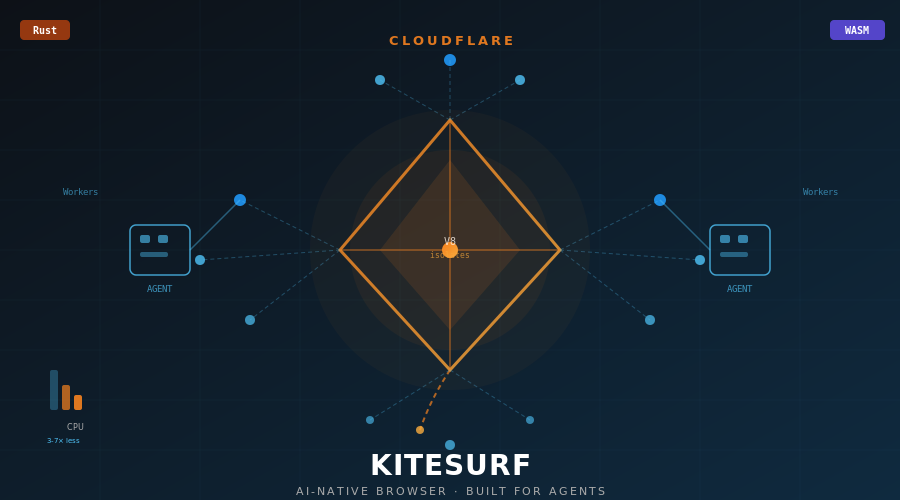
Kitesurf is Cloudflare’s new agent-first browser, built from scratch in Rust, compiled to WebAssembly, and designed to run entirely on Cloudflare Workers at the edge. It strips away everything that exists to serve human sensory experience — pixel-perfect rendering, tab management, 60-frames-per-second animation — and replaces it with a lean, purpose-built runtime optimized for exactly what AI agents actually need: machine-readable content, low overhead, massive parallelism, and robust isolation against prompt injection and related adversarial threats.
Why Chromium Falls Short for AI Agents
For the better part of two years, developers building web-browsing AI agents have faced a familiar compromise: use a full Chromium browser wrapped in tools like Puppeteer or Playwright, pay the enormous resource cost, and move on. Chromium was never designed to run hundreds of simultaneous headless instances. It carries decades of complexity — a JavaScript engine, a full layout renderer, a PDF viewer, a media stack — none of which an AI agent interrogating a webpage for structured data actually uses.
The numbers tell the story clearly. Cloudflare’s own benchmarks show Kitesurf using three to seven times less CPU and memory than Chromium for the agentic workloads that dominate modern AI pipelines: HTML extraction, DOM querying, screenshot capture, and form interaction. For anyone running AI agents at scale — whether in customer service automation, competitive intelligence, or research pipelines — that efficiency gap translates directly into cost and latency.
A Browser Built From Scratch on Workers
The architecture of Kitesurf is what makes it genuinely different rather than merely incremental. Instead of shipping a trimmed-down Chromium variant, Cloudflare rebuilt the browser abstraction from first principles using V8 isolates on Workers — the same foundation that handles a significant share of the world’s serverless compute traffic today.
Each agent session gets its own isolated V8 context. There’s no shared state between sessions, which means the security model is fundamentally better than spawning Chromium processes that share memory or operating-system resources. The stateless design also makes horizontal scaling trivial: spin up thousands of browser sessions with the latency profile of a Workers invocation, not a cold boot of a full browser process.
What Kitesurf does support is the Chrome DevTools Protocol (CDP), which means developers don’t need to rewrite their tooling. Code already using Puppeteer or Playwright can switch to Kitesurf by changing a single parameter — `browser=kitesurf` — and immediately benefit from the efficiency gains. That backward compatibility is a deliberate migration strategy: Cloudflare is betting that once teams experience the resource savings, adoption follows naturally.
The Rise of Agentic Infrastructure
Kitesurf’s launch arrives at an inflection point. The AI industry in 2026 has shifted from asking “can AI agents browse the web?” to “how do we run ten million agent browsing sessions affordably and securely?” Major enterprises across every sector are deploying autonomous agents that fetch live data, fill forms, navigate multi-step workflows, and interact with web-based software. The limiting factor is no longer model capability — it’s infrastructure economics.
Cloudflare is positioning Kitesurf squarely within that gap. By running on the same global edge network that already serves content to billions of users, Kitesurf sessions spin up with latency measured in milliseconds rather than seconds. The edge deployment also means agent workloads run geographically close to the web services they’re interacting with, reducing round-trip times for data-intensive scraping or navigation tasks.
The timing is also significant in the context of security. As AI agents have proliferated, so have attacks designed to manipulate them. Prompt injection — where malicious content embedded in a webpage attempts to hijack an agent’s instructions — has become one of the defining security challenges of the agentic web. Kitesurf’s isolation model, where each session is a clean V8 context with no persistent state, is a structural defense against a class of attacks that Chromium’s shared-process architecture makes much harder to contain.
What This Means for Developers
For developers, Kitesurf’s immediate appeal is obvious: lower cloud bills and faster agent execution. But the longer-term implications run deeper. A browser designed specifically for machines, rather than adapted from one designed for humans, creates room for capabilities that Chromium-based approaches simply can’t offer efficiently.
Consider token overhead — the amount of HTML, CSS, and JavaScript noise an agent must process to extract the information it actually wants. Human browsers optimize for visual rendering; they don’t particularly care if the DOM is cluttered with tracking scripts and ad-serving infrastructure. An agent-first browser can apply aggressive content filtering and structure normalization before the payload ever reaches the model, reducing the token cost of web-based tasks significantly.
Cloudflare has launched Kitesurf as a free beta feature within its Browser Run product. The open-beta positioning suggests the company is as interested in developer feedback and ecosystem adoption as in immediate revenue — a familiar pattern for Cloudflare, which has consistently used generous developer tiers to build dominant positions in adjacent infrastructure markets.
The Bigger Picture
Kitesurf is one piece of a broader infrastructure layer that 2026 is assembling around AI agents. Edge compute, agent-native browsers, lightweight model serving, and secure sandboxing are all converging into what looks increasingly like a distinct stack — separate from both the traditional web stack and the cloud compute stack — purpose-built for the requirements of autonomous AI systems.
Cloudflare didn’t invent this trend, but Kitesurf is a clear signal that the company intends to own a meaningful part of it. The browser has always been the primary interface between users and the web. As agents become users in their own right, the browser has to evolve — or be replaced entirely.
With Kitesurf, Cloudflare is betting that replacement is already here.
*Sources: TechCrunch | Cloudflare Changelog | MarkTechPost*


