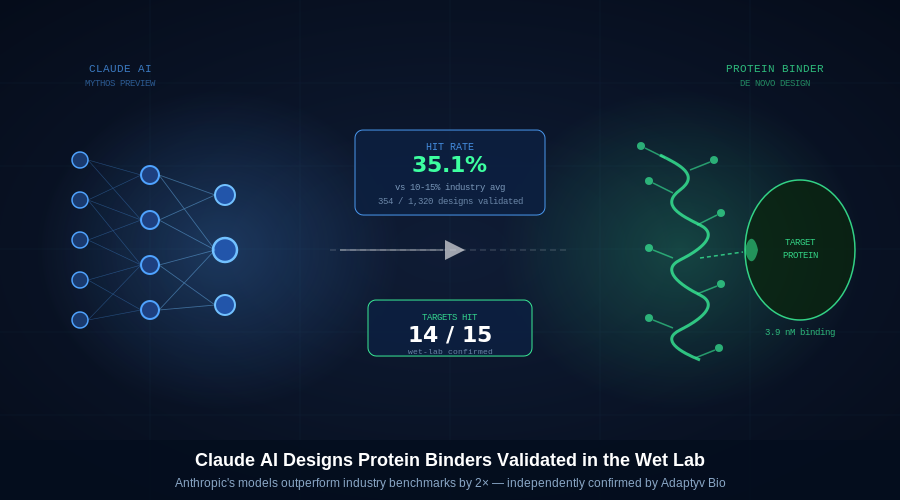
Anthropic’s models hit 14 of 15 biological targets with success rates more than double the industry average — validated by independent laboratory testing.
In what researchers are calling one of the most significant demonstrations of AI’s potential in life sciences, Anthropic has published results showing that its Claude AI models autonomously designed functional protein binders that were independently verified in a physical laboratory setting. The results, validated by protein engineering firm Adaptyv Bio and Twist Bioscience, mark a decisive step toward AI-driven drug discovery becoming a mainstream reality.
What Happened
Anthropic ran its Claude models — specifically Opus 4.8 and a preview build of its unreleased Mythos model — inside a platform called Claude Science, described as a research workbench designed for autonomous scientific workflows. The models were given 15 biological targets and tasked with designing protein binders: molecules engineered to physically attach to a specific protein, which is the foundational step in developing many drugs, diagnostics, and therapeutics.
The models produced 1,320 candidate binder designs across those 15 targets. Those designs were not simulations or paper predictions — they were handed to Adaptyv Bio and Twist Bioscience, who synthesized and physically tested them in a wet lab. The results came back confirming that 354 designs successfully bound to their intended targets, hitting 14 of the 15 proteins on the list.
Why the Numbers Matter
To understand how significant this is, it helps to know the baseline. A typical industry protein design campaign — using established computational tools and human expert judgment — achieves a hit rate somewhere between 10% and 15%. That means if you design 100 protein binders, you expect roughly 10 to 15 of them to actually work.
Claude’s results came in at 22.6% to 35.1% depending on the operational configuration. That’s more than double the standard industry rate. And for certain targets, the gap was even wider. On the target RBX1, Mythos Preview hit a 40% success rate — compared to just 3.7% among other competition participants in Adaptyv Bio’s independent benchmarking events.
There was also a binding affinity story. Claude’s best-performing design bound to its target at approximately 3.9 nM. The next-best design from competing participants bound at roughly 45 nM. Lower nanomolar numbers mean tighter binding, and tighter binding often means a more potent and selective molecule. In drug development terms, that difference can determine whether something becomes a candidate drug or gets dropped.
A New Kind of Scientific Process
What makes this demonstration unusual isn’t just the numbers — it’s the degree of autonomy involved. The models weren’t simply asked to score a pre-existing list of candidate molecules. They proposed designs, iterated, and generated novel sequences using de novo design approaches, meaning they weren’t constrained to variations of known binders. The process is sometimes called an “experimental loop”: propose, evaluate, refine, repeat.
This is the same cycle that governs scientific discovery more broadly, and the fact that an AI system can run it faster, cheaper, and at larger scale than a team of human researchers is precisely what the life sciences industry has been waiting for. Drug discovery programs that currently take years and hundreds of millions of dollars to advance from target identification to clinical candidates could, if these results hold at scale, be compressed significantly.
Claude Science, the platform used in this work, is Anthropic’s attempt to build a structured environment where AI can run these kinds of iterative research workflows reliably. It is not yet publicly available, but Anthropic has indicated that elements of it will eventually roll out to research customers.
The Models Behind the Results
Opus 4.8 is a version of Anthropic’s heavyweight reasoning model, known for strong performance on complex scientific and mathematical tasks. Mythos is less publicly known — the name has surfaced in a handful of disclosures and is understood to be a next-generation model that Anthropic is preparing for release. The protein binder work appears to serve in part as a real-world scientific benchmark for what Mythos can do, distinct from conventional AI capability evaluations.
The combination of a mature reasoning model and a preview of a more capable successor, running inside a purpose-built research environment, suggests Anthropic is building toward making Claude a routine tool in laboratory settings rather than just a writing or coding assistant.
Reactions and Context
The results were published alongside a technical paper and have circulated quickly through the computational biology and drug discovery communities. Researchers have noted that independent wet lab validation is the critical piece — many AI biology claims of recent years have relied on computational metrics, predicted binding scores, or in silico benchmarks that didn’t translate cleanly to physical experiments. The Adaptyv Bio involvement, which runs an ongoing competitive protein design challenge with rigorous experimental verification, lends unusual credibility to these numbers.
The timing is also notable. Anthropic is not the only player pursuing AI-driven biology. DeepMind’s AlphaFold has already reshaped structural biology. A number of biotech startups, including Inceptive, EvolutionaryScale, and Generate:Biomedicines, are building models specifically for protein and molecule design. The entry of a general-purpose reasoning model — not a specialized biology model — into this space at competitive or superior performance levels changes the competitive landscape.
If a general AI assistant can be directed toward protein engineering with results that outperform specialized approaches, the moat that purpose-built biology models have relied on becomes narrower. And for pharmaceutical companies, it raises the question of whether the next generation of drug discovery infrastructure gets built around specialized models at all, or around general reasoning systems that can be steered toward any scientific domain.
What’s Next
Anthropic has not published a commercial roadmap for Claude Science, but the protein binder work clearly functions as a proof of concept — both externally, to attract partnership interest from life science companies, and internally, as a benchmark for how far its models can be pushed in autonomous scientific settings.
For now, the results stand as one of the most concrete demonstrations that AI-designed molecules can survive contact with the physical world. In science, that’s the test that matters.


