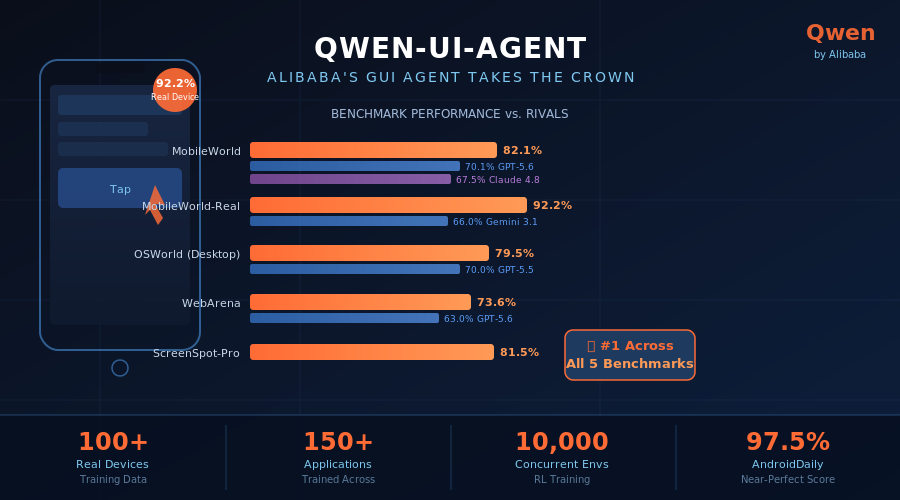
Alibaba has quietly dropped one of the most significant AI benchmarks of the year, and it didn’t involve writing essays or solving math proofs. Qwen-UI-Agent, the company’s new GUI-focused intelligent agent, can navigate real phones, desktop applications, and web browsers with a level of fluency that puts OpenAI’s GPT-5.6, Google’s Gemini 3.1 Pro, and Anthropic’s Claude Opus 4.8 firmly in second place.
The launch — formally announced on August 20th — signals a major inflection point in how AI companies are defining “intelligence.” It’s no longer just about what a model knows. Increasingly, it’s about what a model can do on your screen without being told each step.
What Qwen-UI-Agent Actually Is
Unlike most frontier AI models that communicate through text, Qwen-UI-Agent is built from the ground up to see and interact with graphical interfaces — the kind of software humans use every day. Give it a goal, and it will click, scroll, type, and navigate its way to completing it across mobile apps, desktop environments, and web browsers.
The model was trained on data collected from over 100 physical mobile devices running more than 150 real-world applications. That’s not a simulation. That’s the messy, inconsistent, constantly-updating software stack that actual users face, and Alibaba deliberately built toward it.
To validate real-world performance, Alibaba also constructed a new benchmark called MobileWorld-Real, encompassing over 400 tasks across 100+ apps. The distinction between simulated and real-device benchmarks matters enormously in this domain — many GUI agents that look impressive in controlled environments collapse when confronted with actual hardware quirks, notification popups, and app version inconsistencies.
The Numbers Are Hard to Ignore
Benchmark scores in AI are routinely oversold, but the gaps Qwen-UI-Agent is posting are large enough to be meaningful.
On the standard MobileWorld benchmark, it scored 82.1% — outperforming GPT-5.6 Sol by 12 percentage points and Claude Opus 4.8 by 14.6 points. On the more demanding MobileWorld-Real (actual device tests), the score climbed to 92.2%, again beating all competitors. The AndroidDaily evaluation — another real-device test — saw it reach 97.5%, which is close to human-level reliability on the tasks evaluated.
Desktop performance is equally strong. On OSWorld-Verified, the benchmark used to test computer-use ability across operating systems, Qwen-UI-Agent hit 79.5%, beating both GPT-5.5 and Gemini 3.1 Pro. For web browsing and deep search tasks, it topped the field on WebArena with a score of 73.6%. The ScreenSpot-Pro benchmark for GUI grounding — essentially testing whether a model can correctly identify which element on a screen corresponds to a described action — returned 81.5%, another state-of-the-art result.
Five benchmarks. Five top scores.
Why GUI Agents Are the Next Battlefield
For years, the primary interface between AI models and the world has been text. You write a prompt, the model writes a response. That’s been transformative, but it’s also inherently limited — the vast majority of software doesn’t have a text API. Legacy enterprise systems, mobile apps, desktop tools, e-commerce platforms, government portals: most of the digital world was built for human hands and eyes, not for API calls.
GUI agents crack that problem open. A model that can see and operate a screen can, in principle, do almost anything a human with a computer can do. No custom integration required. No waiting for a vendor to build an API. If the interface exists, the agent can use it.
This is precisely why companies like Anthropic (with Computer Use), Google (with Project Mariner), and OpenAI (with Operator) have all been racing to build viable computer-operating agents over the past year. Alibaba’s results suggest its Qwen team has now pulled ahead of all of them on at least the raw accuracy dimension.
The Architecture Behind the Numbers
Several design choices distinguish Qwen-UI-Agent from earlier approaches.
First, the training data foundation: by collecting from real devices rather than synthetic environments, the model learned to handle edge cases — permission dialogs, unexpected loading states, slightly different UI layouts across app versions — that trip up agents trained on clean simulations.
Second, batch action output: approximately 40% of the model’s desktop tasks involve outputting multiple actions in a single decision step, including direct command-line operations. This makes it substantially faster in practice, since it doesn’t need to pause and evaluate after every individual click.
Third, online reinforcement learning for long sequences: the model was trained with RL on sequences exceeding 100 steps, using roughly 10,000 concurrent environments to generate training signal. This matters because most real-world tasks — booking travel, processing an invoice, filing a report — involve far more steps than the short demos that dominate benchmark demonstrations.
Safety Guardrails Built In
Alibaba was notably deliberate about publishing safety information alongside the performance numbers. Qwen-UI-Agent is programmed to refuse tasks involving illegal or high-risk activities. More importantly, it is designed to pause and notify users at critical junctures: payment confirmations, data deletion requests, and privacy authorization steps. The model won’t autonomously complete sensitive operations without explicit human confirmation.
This is a meaningful design choice. As agents become more capable of doing things on your behalf, the question of what they’re allowed to do without asking becomes urgent. Baking in checkpoints at high-stakes moments — rather than assuming the user’s original prompt was sufficient authorization — reflects a more mature approach to autonomous operation than many early computer-use demos displayed.
What This Means for the Industry
Qwen-UI-Agent’s release lands at a moment when the GUI agent space is crowding fast. Alibaba’s own benchmark dominance arrives as AWS is deploying Bedrock AgentCore, Google is consolidating its enterprise agent platforms, and Cloudflare’s Kitesurf browser runtime is making it cheaper to run fleets of browser-operating agents.
For Chinese AI development specifically, this is another high-water mark. DeepSeek reshaped the conversation around model efficiency earlier this year. Qwen-UI-Agent suggests Alibaba’s research arm is equally competitive on the agent capability frontier — and unlike DeepSeek, which operates somewhat independently, Qwen is backed by the resources of one of the world’s largest technology companies.
For enterprises, the practical implication is straightforward: the cost of automating screen-based workflows is about to drop sharply. Any process that today requires a human to click through software — expense reporting, HR workflows, data entry across legacy systems — becomes a viable candidate for agent automation at scale.
For the AI labs that got beaten on these benchmarks, the message is equally clear. Benchmark leadership in language tasks no longer automatically translates to benchmark leadership in action tasks. That’s a different capability, it requires different training, and Alibaba just demonstrated it’s pulling ahead in the race.
The screen is the new frontier, and Qwen just staked a very large flag on it.
Sources: Alibaba Research, Digital Phablet, AI Agent Store Weekly Digest, MobileWorld-Real benchmark documentation


