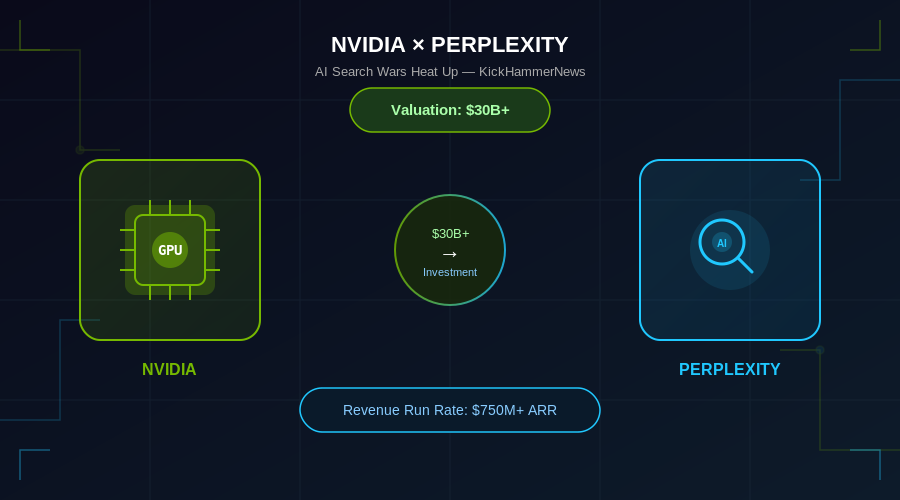
Chip giant’s potential investment signals a new front in the battle for AI search dominance — and a massive payoff for a startup that barely existed three years ago.
Just two years after most people had never heard of it, Perplexity AI is reportedly being valued at more than $30 billion in a new funding round that would have Nvidia as a lead investor. According to reporting from The Information on August 23, 2026, the chip giant is in active discussions to participate in an equity round that would boost Perplexity’s valuation by more than 50% from its previous financing — a remarkable leap for a company that was valued at roughly $20 billion just a year ago.
The talks underscore how dramatically the AI search landscape has shifted, and how aggressively Nvidia is moving to stake its influence not just in the hardware layer of AI infrastructure, but in the applications built on top of it.
A Revenue Engine Running Hot
The numbers behind Perplexity’s ascent are striking. The company’s annualized revenue has climbed past $750 million — up from less than $250 million at the start of 2026. That represents a tripling of the revenue run rate in under eight months, a pace of growth that almost no software company sustains once it’s past the early zero-to-one stage.
A significant part of that acceleration comes from Perplexity Computer, the company’s cloud-based AI agent product aimed at professionals who want to automate repetitive computer-based tasks. While Perplexity made its name as an AI-powered search engine that provides sourced, conversational answers rather than a list of blue links, the Computer product marks its ambitions to move deeper into the workflow automation market — a space heating up across the industry.
That dual identity — search engine and AI agent platform — gives Perplexity a story that goes beyond being “a smarter Google.” It positions the company as an early-stage operating system for knowledge workers, and investors are clearly buying it.
Why Nvidia Is Writing the Check
Nvidia’s interest in Perplexity is not entirely surprising. The chipmaker has had money in the startup since 2023, when Perplexity was still an early-stage bet on a fundamentally different model for how people find information online. What makes the current discussions notable is the scale: a deal at a $30 billion-plus valuation would make Perplexity one of the most valuable AI companies in the world outside of the handful of frontier labs.
For Nvidia, this is strategic as much as financial. The company has spent the last three years becoming the indispensable backbone of the AI boom, supplying the H100s, H200s, and Blackwell chips that power everything from model training at OpenAI to inference at every major cloud provider. But hardware margins eventually compress, and the smartest players in tech have always known that controlling the application layer is where durable value lives.
By backing Perplexity at scale, Nvidia deepens its footprint in the consumer and enterprise AI application market without the complexity of building or acquiring a product company. It also gives Nvidia a vested interest in Perplexity’s success at a moment when AI search is one of the most active competitive battlegrounds in the industry.
The AI Search Wars Intensify
Perplexity’s growth is happening against a backdrop of intensifying competition in AI-powered search and information retrieval. Google, for its part, has spent the past two years defending its core search business with AI Overviews, then AI Mode — adding conversational, summarized answers directly in Search results. The company has invested heavily in Gemini and integrated it deeply into the search experience.
Meanwhile, OpenAI has taken direct aim at the search market with ChatGPT’s search features and its acquisition of targeted web browsing capabilities. Microsoft, through its continued integration of AI into Bing and the Copilot suite, has also staked a major claim.
In this crowded field, Perplexity has survived by being early, being focused, and building an experience that power users tend to describe with unusual loyalty. Where ChatGPT and Google compete on breadth — enormous general-purpose tools that do everything — Perplexity has leaned into the specific act of research: answering questions with cited sources, tracking follow-up threads, and now automating multi-step workflows through its agent product.
That niche has proven worth $750 million in annual revenue and counting.
Perplexity’s Path From Scrappy Startup to AI Heavyweight
Founded in 2022 by Aravind Srinivas, Denis Yarats, Johnny Ho, and Andy Konwinski, Perplexity spent its first year as a well-regarded but relatively obscure tool among AI researchers and tech enthusiasts. Its rise to mainstream awareness accelerated through 2024 and 2025 as the AI productivity wave went from niche interest to widespread adoption across knowledge industries.
The company raised at increasingly aggressive valuations through each funding round, backed at various points by Jeff Bezos, Nvidia, SoftBank, and a roster of institutional investors drawn to the confluence of rapid growth and a clear product differentiation story.
But for all that momentum, Perplexity has also faced scrutiny. The company weathered criticism from publishers and news organizations who argued its summarization model pulled content without adequate attribution or compensation. It has navigated those tensions with a mix of partnership deals, source attribution improvements, and publisher agreements — imperfect resolutions to a structural tension in the AI content economy that remains unresolved industry-wide.
What a $30 Billion Valuation Means for the Market
If the deal closes at the reported terms, it will set a new benchmark for where the AI search category is valued by sophisticated investors. For comparison, Perplexity’s $30 billion valuation would put it above most established media companies, above many traditional software businesses with far longer operating histories, and in striking distance of some of the largest legacy search and advertising players outside of Google and Meta.
It also signals something broader: the market now believes that AI-native information retrieval is not a feature bolted onto existing platforms but a standalone product category worth tens of billions of dollars in its own right.
For Nvidia, the strategic logic compounds with each investment it makes in the application layer. The more users rely on Perplexity — whether for search, for research, or for agent-assisted workflows — the more inference compute gets consumed, and the more demand there is for the chips Nvidia sells. The investment is both a bet on Perplexity specifically and a hedge against any future where AI application success doesn’t flow back through Nvidia hardware.
What Comes Next
The discussions between Nvidia and Perplexity are ongoing, and no deal has been officially confirmed. Reuters noted it could not independently verify The Information’s reporting, and neither company has made a public statement.
But the fact that these discussions are happening at all — at this scale, at this valuation — captures where we are in the AI cycle. Three years ago, Perplexity was a side project. Today it’s a company that the most powerful chip maker in the world is considering backing at a valuation that would have seemed fantastical in 2022.
The AI search wars are real, they’re expensive, and the stakes have never been higher. Nvidia, it seems, has decided to bet on the search engine that started a fight it was never supposed to win.
Sources: The Information (August 23, 2026), Reuters, Yahoo Finance, Seeking Alpha, PYMNTS


