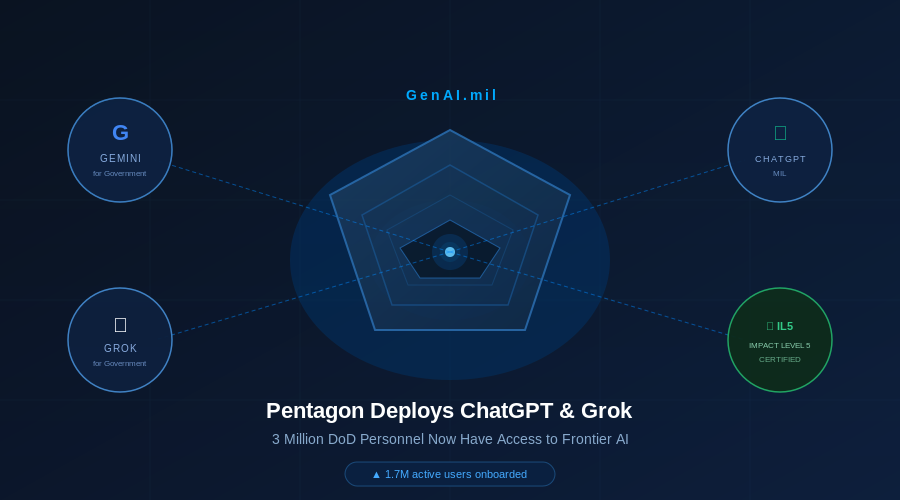
The U.S. Department of Defense has opened its GenAI.mil portal to two of the most powerful AI tools on the planet — and 3 million personnel are cleared to use them.
On August 31, 2026, the Pentagon quietly made history. With little fanfare but enormous implications, the Department of Defense added OpenAI’s ChatGPT Mil and xAI/Starshield’s Grok for Government to GenAI.mil, the military’s secure generative AI platform. The move brings the full weight of frontier commercial AI into the hands of America’s defense establishment — and signals a new chapter in how modern militaries think about artificial intelligence.
From Gemini to a Full AI Arsenal
GenAI.mil launched in December 2025 with a single offering: Google’s Gemini for Government, accredited to process controlled unclassified information. The platform was a proof of concept — a toe in the water for an institution not known for rapid technology adoption. Within months, more than 1.7 million unique users had logged in from across the department’s 3 million military and civilian workforce, validating demand far beyond what even optimistic planners had predicted.
That early success set the stage for Monday’s expansion. ChatGPT Mil — a specialized, security-hardened version of OpenAI’s flagship model — now joins Gemini, along with Grok for Government, a version of xAI’s Grok platform produced in partnership with Starshield, SpaceX’s national security division. Together, they give DoD personnel access to three distinct frontier AI systems under one secure roof.
What IL5 Clearance Actually Means
All three models have been certified at Impact Level 5, the highest authorization level granted to cloud environments processing sensitive, non-public unclassified data. IL5 covers a broad swath of work that is sensitive but not classified at the secret or top-secret level — including controlled unclassified information (CUI), information that could damage national security if mishandled, and data related to national security systems.
For the uninitiated, IL5 is a meaningful bar. It requires extensive security audits, data sovereignty guarantees, access controls, and logging infrastructure. The fact that three separate frontier AI systems — from three different companies — have all cleared IL5 simultaneously is a testament to how seriously both the DoD and the AI industry have taken this integration effort over the past year.
What the Tools Actually Do
The use cases are decidedly practical. The Pentagon has been explicit that these tools are designed for document-heavy unclassified work: drafting policy documents, logistics planning, administrative tasks, and knowledge management. The initial ChatGPT Mil experience includes chat, file processing, projects, and custom GPT functionality — the same toolset that has transformed knowledge work in the private sector, now available in a secure government context.
Grok for Government, meanwhile, is pitched with a military-specific framing. According to the DoD, it will “enable the military to execute missions faster and with more precision in multiple operational contexts,” with early use cases highlighted in supply chain management for logisticians and market research analysis for acquisition professionals.
Neither tool is intended for classified work, battlefield decision-making, or autonomous weapons systems — at least not in these initial deployments. The emphasis is on administrative leverage: reducing the cognitive burden on personnel who spend hours drafting memos, analyzing procurement documents, and synthesizing information from dozens of sources.
The Bigger Strategic Picture
The timing of this rollout reflects a broader shift in U.S. defense AI strategy. For years, the DoD’s AI ambitions were encapsulated in projects like Project Maven, the controversial Google contract that sparked employee protests in 2018, and the Joint Artificial Intelligence Center, which was later absorbed into the Chief Digital and AI Office (CDAO). These were top-down, centralized efforts.
GenAI.mil represents something different: a bottom-up platform play. Rather than building bespoke AI tools internally, the DoD is licensing and deploying commercial frontier models, wrapping them in security controls, and putting them directly in the hands of the workforce. The 1.7 million users who had already logged onto the platform before Monday’s expansion didn’t do so because of a mandate — they did so because the tools were useful.
This model has precedent in the private sector. Enterprise software giants like Microsoft and Google have long understood that the fastest path to AI adoption is meeting workers where they already are. The DoD appears to be learning the same lesson, and learning it fast.
Three Companies, One Platform
The presence of Google, OpenAI, and xAI/Starshield on the same government platform raises interesting questions about competition and interoperability. For now, each model operates independently — users choose which AI to engage based on their preference or task. But the architecture suggests a future where the DoD could benchmark models against each other, route different task types to different systems, or create workflows that chain multiple models together.
It also raises the stakes for AI companies competing for government contracts. The defense market has long been a laggard in technology adoption, but when it moves, it moves at scale. A platform touching 3 million personnel, with the purchasing power of the U.S. government behind it, represents one of the largest enterprise AI deployments in history. Being on that platform — or being shut out of it — matters enormously for long-term market position.
Notably absent from the current lineup: Anthropic’s Claude. Given Claude’s strong enterprise positioning and safety reputation, its absence from GenAI.mil’s initial expansion is conspicuous. Whether that reflects a business decision, a security certification gap, or simply timing remains unclear — but the space is far from closed.
Skepticism and Safeguards
Not everyone is celebrating. Critics of military AI deployments have long raised concerns about accountability, bias in automated systems, and the gradual normalization of AI in contexts where human judgment should be paramount. The IL5 certification provides technical security guarantees, but says nothing about the quality of decisions made with AI assistance, or what happens when military personnel over-rely on AI-generated outputs for consequential tasks.
The DoD has stated that these tools are intended to augment — not replace — human decision-making. But the history of automation in complex organizations suggests that the line between “support tool” and “decision driver” can erode over time, especially when the tool is faster, more confident, and more consistent than the human relying on it.
For now, the rollout appears measured. But as capabilities grow and users become more comfortable with AI assistance, the pressure to extend these systems into higher-stakes domains will only intensify.
What Comes Next
The DoD has signaled that additional models and features are expected over time. GenAI.mil is explicitly designed as an evolving platform, not a fixed deployment. Future additions could include agentic AI capabilities — tools that can take actions, run multi-step workflows, and coordinate across systems — as well as models optimized for specific mission domains like intelligence analysis or logistics optimization.
The pace of military AI adoption has shifted from cautious to deliberate. With 1.7 million active users already on the platform, the infrastructure is in place. The question now is how aggressively the DoD chooses to accelerate.
One thing is clear: the era of frontier AI in the U.S. military isn’t coming — it’s already here.
Sources: DefenseScoop, TechCrunch, The Hill, Military Times, Nextgov/FCW


