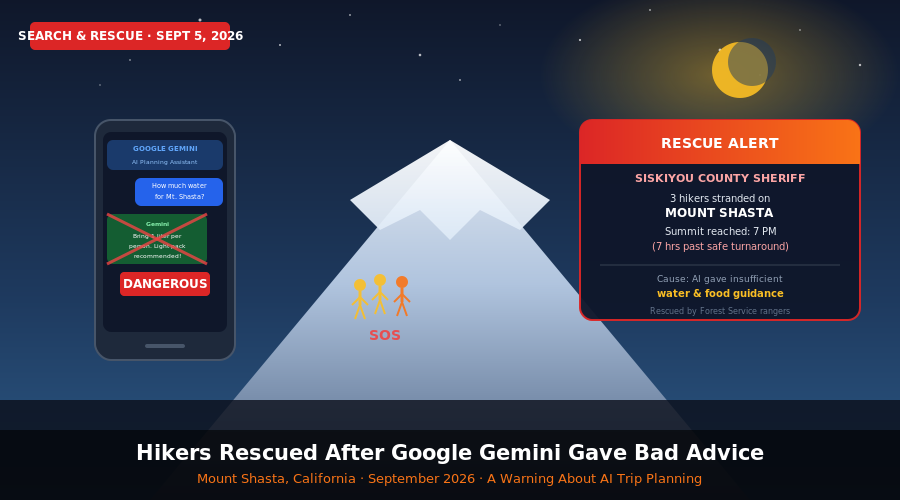
Three hikers from Roseville, California were rescued from the slopes of Mount Shasta on Saturday after using Google’s Gemini AI chatbot to plan their ascent — and receiving guidance that left them dangerously under-supplied for an expedition that nearly turned fatal.
The Siskiyou County Sheriff’s Office confirmed the rescue and issued an advisory warning hikers against relying solely on artificial intelligence for trip planning in remote or technical terrain. The incident has reignited a debate that has been building quietly alongside the rapid adoption of AI assistants in everyday life: when a chatbot feels authoritative enough to trust with your safety, what happens when it gets things catastrophically wrong?
What Happened on the Mountain
The group set up camp at 8,400 feet on Friday evening, then departed for the summit at 3 a.m. Saturday — a standard alpine start intended to reach the peak before afternoon weather and softening snow create hazardous conditions. Hikers attempting Mount Shasta, which rises to 14,179 feet, are routinely advised to turn around no later than noon if they have not reached the top.
The trio did not reach the summit until 7 p.m. — seven hours past the recommended turnaround time. Attempting to descend in the dark, exhausted and disoriented in Mud Creek Canyon, they called the sheriff’s office to ask for directions. Unable to safely guide them out over the phone, authorities coordinated a search and rescue operation involving Forest Service rangers and volunteers. The group spent the night exposed on the mountain before being brought down safely the following morning.
The sheriff’s office said the hikers told responders they had used Gemini to plan the outing. The most consequential piece of advice: the AI had recommended they bring far less food and water than their group required for the conditions and duration of the climb.
“They were advised by Gemini to bring far less food and water than their group required,” the sheriff’s office stated.
No serious injuries were reported. But the margin was narrow enough that officials felt compelled to warn the public.
The Problem with AI Outdoor Advice
Mount Shasta is not a casual hike. It is a glaciated stratovolcano requiring crampons and an ice axe above certain elevations, with altitude-related illness a genuine risk for unprepared climbers. The route the hikers attempted — one of the mountain’s standard approaches — typically takes 10 to 14 hours round trip from high camp and demands meticulous logistics around water, food, and timing.
A large language model has no way to assess the fitness level of the person asking, the specific forecast for a given weekend, current snow conditions, or a dozen other variables that an experienced guide would factor into a plan. It also has no stake in the outcome. It can produce advice that reads like expertise — structured, specific, confident — while being systematically wrong about the details that matter most.
The challenge is not that AI assistants lack access to general information about mountains. Gemini can almost certainly retrieve or generate accurate descriptions of Mount Shasta’s routes, elevation, and typical ascent times. The challenge is that translating general information into a safe, personalized plan for a specific group on a specific day requires judgment that large language models are not yet capable of reliably exercising — and that the models often do not communicate their limitations before delivering recommendations.
This is sometimes called the “confident wrong answer” problem. Unlike a search engine that returns links you have to evaluate, or an experienced friend who might say “I’m not sure, you should ask a ranger,” a well-designed chatbot interface produces prose that reads like expertise whether or not expertise is warranted. Users tend to trust that presentation more than they should.
A Pattern Emerging
The Mount Shasta incident is not the first time AI planning advice has contributed to a dangerous outdoor situation, but it is among the most widely reported. As AI assistants have become the first stop for travel research, route planning, and logistics for millions of people, emergency responders in national parks and wilderness areas have informally noted an uptick in visitors arriving unprepared — equipped, it seems, with AI-generated plans that sounded complete but left out crucial context.
The same dynamic has been documented in other domains. AI-generated medical summaries have led patients to misunderstand dosing instructions. AI-generated legal explanations have led people to miss filing deadlines. In each case, the issue is less that the AI was wildly wrong than that its output was wrong in precisely the ways users couldn’t detect — presenting reasonable-sounding information with no visible uncertainty about the details that turned out to matter.
Google has invested heavily in adding safety disclaimers to sensitive Gemini queries, particularly around medical and legal topics. But outdoor recreation, despite carrying genuine life-safety risks, has generally not been treated as a domain requiring the same level of caution. A query about how much water to bring on a mountain climb is superficially a logistics question, not an emergency.
What the Sheriff’s Office Recommends
In the advisory following the Mount Shasta rescue, authorities recommended that hikers contact the local Mount Shasta Ranger Station before beginning any climb. Rangers can provide current conditions, permit information, and guidance tailored to a group’s specific itinerary — the kind of personalized, real-time information an AI assistant structurally cannot provide.
The recommendation is not new. Ranger stations have offered this service for decades. But it represents exactly the kind of authoritative, locally informed guidance that AI assistants have been quietly displacing as the first point of contact for trip planning. The convenience of asking a chatbot at midnight, from your couch, and receiving a detailed itinerary within seconds is genuinely useful. It is also insufficient.
The Siskiyou County Sheriff’s Office put it plainly: AI can assist in planning, but it should not be the sole resource. Verifying critical details — water requirements, gear lists, turnaround times — with authoritative human sources is not optional when the stakes include altitude sickness, exposure, and getting lost on a glaciated volcano after dark.
A Reckoning for AI in High-Stakes Contexts
The broader lesson from Mount Shasta is one the AI industry has been grappling with since the first wave of large language models went mainstream: the gap between “useful for a first draft” and “safe to rely on for final decisions” is enormous, and users do not always know which side of that gap they are on.
Google and its peers have made significant progress in grounding AI responses with real-time information, adding citations, and building in uncertainty signals. But the fundamental challenge — that a model trained on text cannot know things it cannot infer from text — has not been solved, and may not be solvable for the class of problems that require local knowledge, physical conditions, or individualized judgment.
In the meantime, the people most likely to be harmed are the ones who trust the technology most completely. The three hikers on Mount Shasta may have expected a tool smart enough to plan a mountain summit to at least know how much water to bring. That expectation, understandable as it is, cost them a night on the mountain and a helicopter rescue.
The sheriff’s rangers got them home safely. Not every story ends that way.


