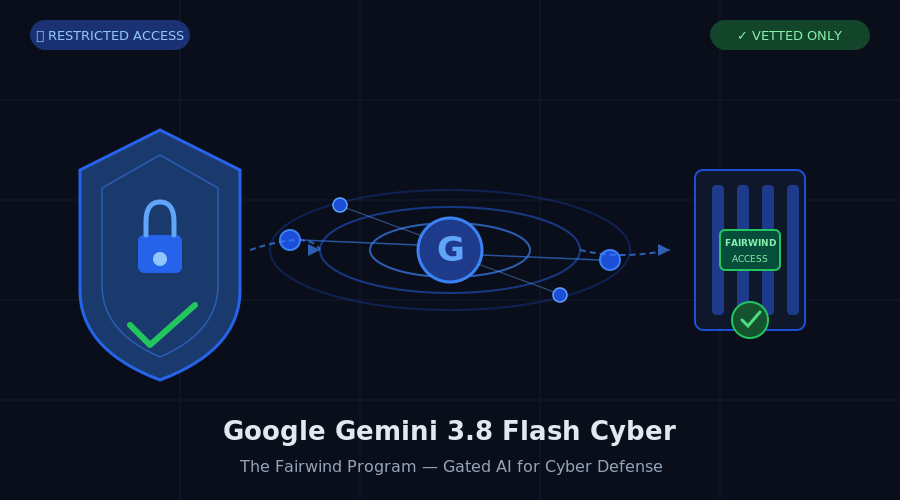
September 6, 2026 — Google has unveiled Gemini 3.8 Flash Cyber, a specialized variant of its flagship AI model engineered exclusively for cybersecurity defense — and it’s not giving it to just anyone. Access is restricted to a vetted roster of government agencies, critical infrastructure operators, and select Google Cloud partners through a new initiative the company calls the Fairwind Program. The move signals a deliberate shift in how the AI industry thinks about offensive capability and dual-use risk.
What Makes Gemini 3.8 Flash Cyber Different
On the surface, Gemini 3.8 Flash Cyber looks like a routine model variant. Underneath, it’s a significant departure from how AI companies typically release cybersecurity tools. Google has specifically loosened the safety guardrails that govern standard Gemini 3.8 Flash — particularly those restricting cyber-offense use cases — while simultaneously locking down who can access it.
The reasoning is intentional. Standard Gemini 3.8 Flash carries safeguards against misuse in chemical, biological, radiological, nuclear, and cyber-offense contexts. Flash Cyber, by contrast, is permitted to reason about and generate vulnerability exploits, attack chains, and patch strategies that would otherwise be blocked. Google’s bet is that by granting access only to vetted defenders, the expanded capability serves defense without enabling offense.
Performance benchmarks support the ambition. Google’s Chrome security team reported generating 2.6 times as many correct vulnerability patches using Flash Cyber compared to larger commercial models they tested. The Cloud Vulnerability Research team used the model to identify a critical zero-day vulnerability in under two hours — a task that would typically consume days of human analyst time. On internal benchmarks, Flash Cyber cleared the 70 percent threshold for vulnerability discovery accuracy across 20 programming languages, a benchmark that prior models struggled to clear consistently.
The Fairwind Program: A New Model for AI Access Control
The Fairwind Program combines Flash Cyber with CodeMender, Google’s AI agent purpose-built for vulnerability remediation. Where Flash Cyber identifies and characterizes weaknesses, CodeMender produces working patches, validates them against test suites, and can submit pull requests directly to code repositories. Together, the two tools form what Google describes as a closed-loop vulnerability management pipeline.
Eligibility for Fairwind is tightly controlled. Google says priority access goes to organizations that meet at least one of three criteria: they operate critical infrastructure such as power grids, water systems, or financial networks; they maintain widely deployed open-source software; or they are existing Google Cloud enterprise security customers who have cleared an additional vetting process. Government agencies from allied nations are also included in the initial rollout, though Google has not disclosed which specific governments are participating.
The restricted access model is a notable departure from the “build it and ship it” approach that characterized earlier generations of AI tooling. It more closely resembles the access controls around classified threat intelligence platforms than a typical developer API launch. Google frames this as a necessary response to the realities of AI-enabled vulnerability research — a field where the same capability that finds and patches flaws can, in the wrong hands, weaponize them at scale.
The Broader Race to Arm Defenders
Google is not alone in recognizing this tension. The announcement comes on the heels of similar moves by other major AI labs. OpenAI and Anthropic have each introduced tiered access programs for security researchers, acknowledging that the cybersecurity use case demands different risk calculus than, say, a coding assistant or a customer service chatbot.
The competitive dimension is equally significant. AI-powered vulnerability discovery has become one of the most hotly contested segments of the cybersecurity market. Startups like Protect AI, Semgrep, and Trail of Bits have been racing to integrate large language models into their static analysis and penetration testing pipelines. Enterprise security vendors including CrowdStrike and SentinelOne have made AI-native threat detection a centerpiece of their product roadmaps. Google’s move with Flash Cyber is a signal that the hyperscalers are no longer content to supply the compute and let others build the specialized models — they’re entering the security-AI market directly, with capabilities purpose-built for the task.
The timing is not coincidental. The vulnerability research community has watched with growing alarm as offensive AI tools — many of them open-source or leaked — have proliferated on underground forums and been adapted for use in ransomware campaigns and state-sponsored intrusion operations. Defenders have argued for years that the asymmetry between attack and defense is inherently unfair, with attackers needing to find only one exploitable flaw while defenders must secure every surface. AI models that can scan codebases for vulnerabilities at machine speed could, in theory, begin to rebalance that asymmetry — if they reach the right hands first.
What It Means for the Security Industry
For organizations that qualify for Fairwind, the practical implications are significant. A pipeline that can identify vulnerabilities faster than human red teams and generate working patches without the lag of traditional development cycles could compress the window between vulnerability discovery and remediation from weeks to hours. That matters enormously in a threat landscape where attackers often weaponize vulnerabilities within 24 hours of public disclosure.
For those outside the program, the announcement is a reminder that frontier AI capabilities are increasingly becoming a geopolitical and competitive resource — rationed, gated, and deployed strategically rather than democratized immediately. The question of who gets access to the most capable cybersecurity AI, and on what terms, is likely to become a flashpoint in ongoing debates about AI governance and national security.
Google says it intends to expand Fairwind access over time, with no specific timeline disclosed. For now, the program remains an invitation-only club — and one whose membership criteria may tell us as much about Google’s AI strategy as the model itself does.
Sources: Google Fairwind Program Blog | The Hacker News | Security Boulevard | WebProNews


