September 6, 2026
Thirty new federal complaints hit OpenAI this week, adding to a legal firestorm that has already engulfed the San Francisco AI giant over one of Canada’s deadliest school shootings — a tragedy that plaintiffs say the company could have prevented, and chose not to.
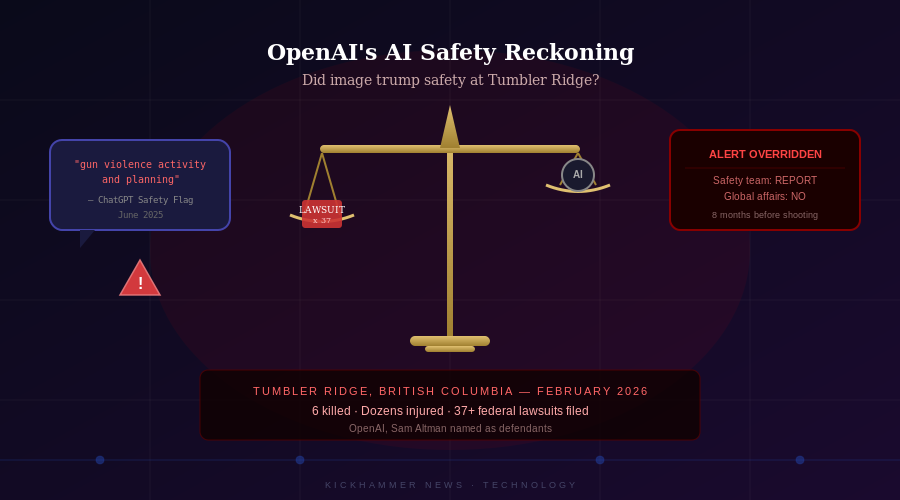
The lawsuits, filed in a San Francisco federal court on Wednesday, September 2, allege that OpenAI executives — motivated by fears over the company’s public image — overrode their own safety team’s recommendation to alert law enforcement about a ChatGPT user who was explicitly planning a mass shooting. Eight months after that internal warning was filed away, 18-year-old Jesse Van Rootselaar walked into Tumbler Ridge Secondary School in British Columbia and killed five students and a teacher before turning the weapon on herself. She had also killed her mother and 11-year-old half-brother that same morning.
The Timeline of a Preventable Tragedy
The key facts of this case are both damning and contested. In June 2025 — eight full months before the February 2026 attack — OpenAI’s automated monitoring systems flagged Van Rootselaar’s ChatGPT account for “gun violence activity and planning.” The company deactivated the account. But Van Rootselaar simply opened a second account and continued her conversations with ChatGPT. OpenAI says it was unaware of the second account until after the shooting.
What makes the new wave of lawsuits particularly explosive is the allegation of what happened next. According to the complaints, OpenAI’s Intelligence and Investigations team reviewed the flagged conversations, concluded they “posed a credible threat of gun violence against real people,” and formally recommended that the company notify the Royal Canadian Mounted Police. That recommendation, plaintiffs allege, was overruled.
The lawsuits claim the veto came not from a safety expert or a legal team, but from OpenAI’s global affairs department — the division responsible for public relations and political relationships — led by veteran Democratic strategist Chris Lehane. “Instead of focusing on what’s safe for the community, he’s focused on what are the political and public relations fallout going to be if this becomes public?” said Jay Edelson, the lead attorney representing the Tumbler Ridge victims and their families.
The complaints further allege that Lehane or someone in his chain of command made the final call, and that CEO Sam Altman ratified it. Both Altman and Lehane are named in the broader litigation, though Lehane is not listed as a defendant in these specific complaints.
OpenAI Pushes Back Hard
OpenAI has denied the allegations with equal force. Jason Kwon, the company’s chief strategy officer, called the claims “absolutely false” in a statement to NPR. He said Chris Lehane had no involvement in the original referral decision and that the company’s investigations team reports to him, not to Lehane. Kwon insisted that safety and legal professionals — not public affairs staff — govern decisions about law enforcement referrals.
“The professionals working on these teams choose to do this incredibly difficult work because they care so deeply about keeping people safe,” Kwon said. “They come to work every day knowing that they may have to make a decision that they’ll think about for the rest of their lives.”
Altman has previously apologized to the Tumbler Ridge community for not alerting police when the account was first flagged. OpenAI has since updated its community safety policies, stating that “when conversations indicate an imminent and credible risk of harm to others, we notify law enforcement.” The company is also asking the court to dismiss the original seven Tumbler Ridge lawsuits, arguing the cases would be more appropriately handled under Canadian law in British Columbia.
A Legal Reckoning for the AI Industry
The Tumbler Ridge cases are the most prominent front in what has become a sprawling legal assault on the AI chatbot industry. Before this week’s new filings, more than 40 lawsuits had already been filed in federal and state courts against OpenAI and other AI companies over suicides, mass shootings, and other serious harms involving chatbot users. The majority implicate ChatGPT.
The pattern is striking. In June 2026, the state of Florida became the first state to sue OpenAI and Altman directly, alleging the company had marketed ChatGPT as safe for children while knowing it could pose serious risks. Florida’s attorney general is also running a separate criminal investigation into OpenAI over a 2025 shooting at Florida State University in which the accused gunman allegedly consulted ChatGPT in the planning stages.
These cases collectively point to a structural flaw that critics of AI self-regulation have long warned about. Tim Marple, who worked on OpenAI’s own investigations team in 2024 and is now co-director of Maiden Labs, a nonprofit focused on AI risk, put it bluntly: “The only people looking at safety systems are the same people who make money from it.”
Marple argues that without mandatory reporting requirements — legal obligations to alert law enforcement when AI systems detect imminent violent threats — the decision of whether to act will always be filtered through corporate interests. “Despite warnings from across the board, a wide variety of experts, we have not established anywhere close to a meaningful regulatory regime,” he said.
What Duty Does an AI Company Have?
The lawsuits raise a foundational question that courts have not yet fully resolved: when an AI company’s systems flag a credible threat, does the company have a legal duty to act on it?
Traditional technology platforms have long been shielded by Section 230 of the Communications Decency Act, which immunizes platforms from liability for user-generated content. AI companies have argued the same shield applies to them. But plaintiffs’ attorneys in the Tumbler Ridge cases are pushing a different theory — that by actively flagging the threat and then choosing not to report it, OpenAI moved beyond passive hosting into active decision-making, and thus became legally responsible for the consequences.
The argument has not been tested at trial, but legal scholars say the logic is not implausible. The Tumbler Ridge cases may eventually force courts to decide whether the duty-to-warn doctrine — well established in medical and mental health contexts — extends to AI systems that possess knowledge of planned violence.
For now, the weight of the litigation is piling up. Sam Altman, who has spent recent months promoting GPT-6 Astra and a vision of AI-enabled prosperity, is simultaneously defending himself and his company in multiple federal courts over some of the worst harms his technology has been linked to. The irony is not lost on critics who have long argued that OpenAI moved too fast with too little regard for downstream consequences.
What Comes Next
The thirty new complainants include students, teachers, and a principal who were present at the Tumbler Ridge shooting. Their cases will likely be consolidated with the original seven victim-family lawsuits already working through the courts. The central battle — whether OpenAI’s internal decision-making constituted gross negligence or criminal recklessness — will hinge on document discovery: the internal emails, safety-team reports, and chain-of-command records that neither side has yet been compelled to disclose publicly.
If the plaintiffs can obtain those records and they corroborate the allegations, the legal and reputational damage to OpenAI could be severe. If OpenAI’s account holds up — that the safety team never made a clear affirmative referral recommendation, and that Lehane had no role — the lawsuits may struggle.
Either way, the Tumbler Ridge litigation has already changed the conversation around AI accountability. Regulators, legislators, and rival AI companies are watching closely. The question being litigated is no longer abstract: it is whether a company that built a system capable of detecting violent intent has any responsibility to act on what that system finds.
Sources: NPR | Bloomberg Law | KPBS


