September 6, 2026
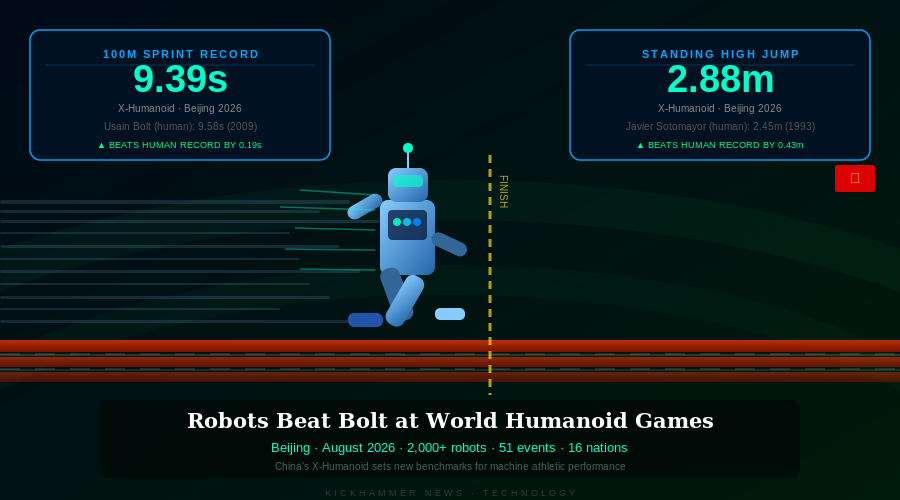
Usain Bolt’s 100-meter world record stood for 17 years before a machine in Beijing made it look slow. On the opening day of the second annual World Humanoid Robot Games, held at Beijing’s National Speed Skating Oval on August 22, a humanoid robot built by Beijing-based firm X-Humanoid completed the 100-meter sprint in 9.39 seconds — clearing Bolt’s legendary 9.58-second mark by nearly two-tenths of a second.
That was not the only record to fall. In the standing high jump, another X-Humanoid robot cleared 2.88 meters, well above the 2.45-meter human record set by Cuba’s Javier Sotomayor in 1993 — and more than three times the 0.95-meter best recorded at last year’s inaugural games. A robot from Chinese smartphone maker Honor ran the 100 meters in an even faster 9.32 seconds during pre-event trials, reaching a peak speed of 14.5 meters per second.
The five-day games, featuring more than 2,000 humanoid robots, 51 events, and over 1,000 individual competitions, have become the most dramatic showcase yet of how quickly China’s robotics industry is closing the gap between machine performance and human physical limits — and in some dimensions, leaving human capability behind entirely.
An Olympics for Machines
The World Humanoid Robot Games were designed from the start as a spectacle. Held in the same venue that hosted speed skating at the 2022 Winter Olympics, the event opened with hundreds of humanoid robots marching in synchronized formation onto the competition floor — a display that looked less like a technology demo and more like a choreographed military parade.
Sixteen countries sent robots to compete, including Germany, Japan, and the United States. The event ran alongside the 2026 World Robot Conference, held the same week in Beijing, where companies showcased approximately 3,000 products including industrial and consumer-facing humanoid robots.
The spectacle drew crowds who came with a mix of wonder and ambivalence. “These sports are perfectly normal for humans, but now robots can do them. I find it amazing,” said Yang Shangzheng, a Beijing spectator. Li Yanfeng, an education worker, said she had been resistant to AI at first but changed her view after seeing how fast the technology was developing. “I decided to come and take a look,” she said. “This development is unstoppable.”
Events at the games went well beyond running and jumping. Competitors also contested weightlifting, table tennis, soccer, and tug of war — a range designed to test the breadth of humanoid physical capability, not just peak speed or power.
China’s Robotics Ambition on Full Display
The World Humanoid Robot Games are not just a sporting event. They are a geopolitical statement. China manufactures the majority of the world’s humanoid robots, and Beijing has made the industry a national priority, pouring investment into robotics startups and positioning the sector as a successor to its manufacturing dominance in smartphones and electric vehicles.
The timing of these records comes against a charged backdrop. Just weeks before the games, the U.S. Federal Communications Commission announced a ban on imports of new foreign-made humanoid robots, citing national security concerns in a move explicitly targeting Chinese manufacturers. The Pentagon has separately added Unitree Robotics — one of China’s leading humanoid robot makers — to its list of companies with alleged ties to the Chinese military. Beijing has strongly denied the allegations.
The robot games, with their international field and Olympic-scale ambition, are partly a response to this pressure — a public demonstration that Chinese robotics is too advanced and too globally integrated to be easily contained. The records set on opening day reinforced that message with numbers that are difficult to dispute.
From Demonstrations to Deployment
The records are real, but context matters. Sports events are carefully controlled environments, optimized for performance in single tasks. Experts are quick to point out that a robot running 100 meters on a track is a very different challenge from navigating a factory floor, a hospital corridor, or a home.
“Humanoid robots are still mostly used for demonstrations, performances and research — at least for now,” noted analysts tracking the industry. Real-world mass deployment remains years away, they argue, pending advances in energy density, balance under load, sensor reliability in variable conditions, and the software systems that allow robots to adapt to unpredictable environments.
Still, the trajectory is striking. At last year’s inaugural World Humanoid Robot Games, the standing high jump record was 0.95 meters. This year it is 2.88 — a threefold improvement in 12 months. The pace of progress in humanoid robot capability is beginning to rhyme with the early years of large language model development, where performance benchmarks that seemed years away were suddenly cleared in months.
The companies behind these records are moving fast. X-Humanoid, which claimed both the 100-meter and high-jump records, is part of a cohort of well-funded Beijing-based robotics startups that have attracted significant state and private investment. Honor’s pre-event record of 9.32 seconds was set during a sanctioned trial, suggesting that the performance seen publicly may already be behind what these companies can achieve in controlled conditions.
What the Records Actually Mean
It is worth pausing on what the numbers represent. Usain Bolt’s 9.58 seconds in Berlin in 2009 was the result of years of training, optimized biomechanics, and extraordinary natural talent. The robot that cleared 9.39 seconds in Beijing had none of those constraints — and will continue to improve with each software update and hardware iteration, while human athletic records approach their physiological ceiling.
The high jump comparison is even more striking. Javier Sotomayor’s 2.45-meter record has stood since 1993. The human body’s ability to jump is bounded by bone density, muscle fiber composition, and the physics of the standing leap. A robot running on actuators, carbon-fiber joints, and real-time balance algorithms faces none of those constraints in the same way.
The philosophical question lurking beneath the statistics is one that the crowd at the Beijing games seemed to sense. For generations, athletic records have represented the outer boundary of human capability — symbols of what bodies can do when pushed to their absolute limits. When machines cross those lines, it raises a question the games’ organizers are content to leave unanswered: what does human athletic achievement mean in a world where machines do it faster, higher, and stronger?
The Road Ahead
The geopolitical and technological trajectory suggests these games will continue to attract attention, controversy, and ever-more-impressive results. U.S. restrictions on Chinese robot imports may slow the commercial deployment of these machines in Western markets, but they cannot slow the pace of research and development happening in Chinese labs and on competition floors.
Meanwhile, American and Japanese competitors — Boston Dynamics, Figure AI, Agility Robotics, and others — are watching closely. The World Humanoid Robot Games have created a public benchmark that every competitor in the humanoid robot space now has to reckon with. If a Chinese robot can run the 100 meters in 9.32 seconds today, what can it do in 2027?
The sprint has begun. The question is who — or what — is still keeping up.
Sources: ABC News / AP | CTV News | NBC News


