Training a capable AI agent has always required two things money can’t easily buy: good data and a standard way to use it. Most teams building autonomous agents from scratch spent six months or more just assembling and cleaning the datasets they needed before they could write a single line of model code. Hugging Face and NVIDIA have decided to fix that problem at the infrastructure level, and what they’ve built may become the ImageNet moment for agentic AI.
The two companies have jointly launched the Open Data for Agents initiative, releasing more than 50,000 curated task trajectories under the CC-BY-4.0 license — meaning any developer or company can use the data for commercial purposes without royalty fees. Alongside the dataset, the initiative introduces a new open standard called AgentData v1.0, which defines a universal format for capturing the multi-step interactions, tool calls, and environmental states that autonomous agents navigate in the real world.
The Data Problem That Held Agents Back
Large language models improved dramatically once researchers figured out how to train them at scale on internet text. Agent training is harder because the relevant data doesn’t exist on the web in a convenient form. An agent executing a task — searching a database, booking travel, querying an API, filling out a form — does so across multiple steps, each of which depends on the state of the environment at that moment. Capturing those multi-step sequences with enough fidelity for training requires specialized collection infrastructure most teams don’t have.
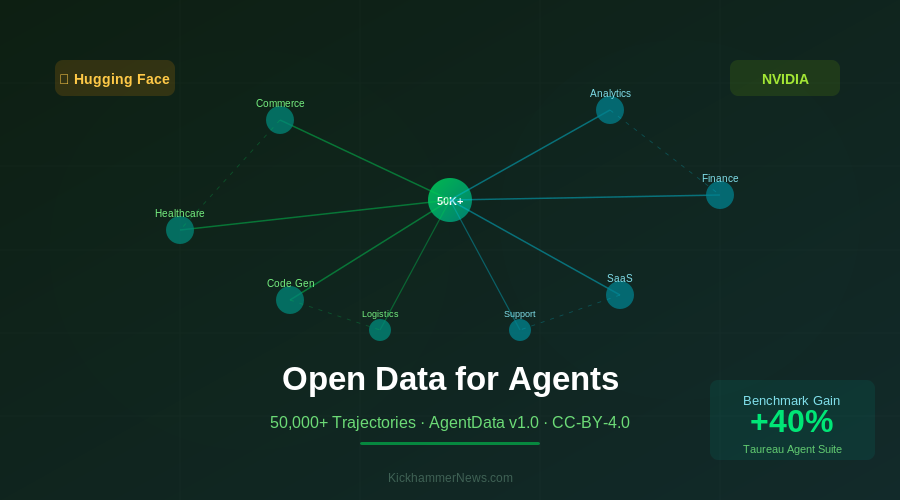
The Open Data for Agents initiative solves this by doing the collection work once and making the result available to everyone. The 50,000+ trajectories span eight major domains: e-commerce, data analysis, enterprise SaaS, healthcare scheduling, financial services, code generation, logistics, and customer support. Each trajectory includes timestamped action logs, tool call graphs, user intent labels, and snapshots of the environment state at each decision point.
Early results are striking. Models fine-tuned on the Open Data for Agents dataset outperform generic baselines by up to 40% on the Taureau agent benchmark, a widely used evaluation suite developed by Stanford. That gap is large enough to matter in production — the difference between an agent that reliably completes tasks and one that frequently stalls or requires human intervention.
AgentData v1.0: A Common Language for Agents
The accompanying data standard, AgentData v1.0, may prove to be as important as the dataset itself. Before this release, agent training data from different organizations was structured in incompatible ways. One lab might log tool calls as free-form text. Another might encode them as nested JSON with different field names. A third might not capture error recovery steps at all. The result was a fragmented landscape where research findings were difficult to reproduce and datasets were nearly impossible to combine.
AgentData v1.0 establishes a consistent JSON schema with four top-level fields: user_intent, initial_state, action_sequence, and final_state. Every action in the sequence is typed — api_call, tool_invoke, thought_chain — and includes a success flag and parameter record. The schema is natively compatible with Hugging Face Datasets and PyTorch DataLoaders, meaning developers can load it directly into training pipelines without custom parsing code.
One particularly sophisticated feature is what the initiative calls “contingency planning” annotations. For each action in a trajectory, the dataset records not just what the agent did, but what alternative actions were available and what would have happened if the agent had chosen them. This enables counterfactual reasoning during training — teaching models to evaluate options before committing, rather than executing the first plausible action they identify. For safety-critical applications, this kind of risk-aware decision-making is not a nice-to-have. It is a requirement.
NVIDIA’s Contribution: Training Without a Supercomputer
The data and the format are valuable, but the initiative also needed to be accessible to teams that don’t have access to hundred-million-dollar compute clusters. NVIDIA addressed this directly by contributing a set of NeMo-based fine-tuning scripts optimized for the AgentData v1.0 format. Using these scripts, a team can fine-tune a 7-billion-parameter agent model on a single A100 GPU in under six hours.
That benchmark matters because it puts production-grade agent development within reach of mid-size engineering teams, research groups at universities, and startups that cannot afford to rent time on massive clusters. It also gives the initiative a practical on-ramp: rather than simply releasing data and hoping developers figure out what to do with it, Hugging Face and NVIDIA have packaged an end-to-end pipeline that goes from raw trajectories to a deployable model.
NVIDIA has also published a companion tutorial series on its developer blog covering data preprocessing, model evaluation, and deployment on Triton Inference Server. A community leaderboard launched alongside the release, inviting developers to contribute new trajectory data and compete on benchmark performance — a mechanism designed to expand the dataset over time without requiring Hugging Face or NVIDIA to do all the collection themselves.
Why Reproducibility Is the Hidden Headline
The SHA-256 hashing feature buried in the technical documentation may turn out to be the most consequential detail in the entire release. Each trajectory entry in the dataset includes a cryptographic hash of the environment state at the start and end of the task. This means that any training run using the dataset can be independently verified: a researcher can confirm that the data they used matches exactly what was released, with no undisclosed modifications.
In AI research, reproducibility has been a persistent problem. Teams report results that others cannot replicate because training details, data versions, and environment configurations differ. For agent safety research specifically, the inability to reproduce results creates a dangerous gap: if you can’t confirm that an agent’s safe behavior in one environment carries over to another, you can’t make meaningful safety claims. The hashing mechanism doesn’t solve the entire reproducibility problem, but it eliminates one of the most common sources of undetected variation.
The Business Case for Open Infrastructure
Enterprise buyers often approach open-source AI data initiatives with suspicion, assuming that freely available training data implies inferior quality. The Open Data for Agents release challenges that assumption in a concrete way. The CC-BY-4.0 license removes licensing risk entirely. The quality benchmarks are published and independently verifiable. And the practical result — a 40% improvement over generic baselines on a well-regarded benchmark — is the kind of number that justifies a procurement decision.
Hugging Face estimates the initiative reduces the time-to-first-agent from six months to two or three months for most enterprise use cases. For companies in competitive markets, that timeline compression is commercially significant. The first mover advantage in deploying capable agents — in customer service, financial analysis, software development, or supply chain management — may determine which players dominate their categories in the next two years.
The dataset is available now through the Hugging Face hub under the organization “OpenDataForAgents.” The multimodal extension, which will add screen captures, audio cues, and full API response payloads to the trajectory format, is on track for release in the coming months. If the core dataset raised the floor for agent training, the multimodal extension may raise it again — and this time, the entire industry will have access from day one.


