For most of the past decade, enterprise AI was a story about pilots. Companies ran experiments, celebrated proof-of-concepts, published press releases about transformational technology, and then quietly watched the initiatives stall in procurement, governance, or the sheer complexity of integrating AI into legacy systems. The joke in enterprise technology circles was that “enterprise AI” meant “AI that was promised to enterprises.”
That era is ending. In 2026, the enterprise deployment of AI agents has crossed a threshold that analysts and practitioners have been anticipating for years: it is no longer a question of whether companies will deploy AI agents, but how they will govern the ones they already have.
The Numbers Tell a Striking Story
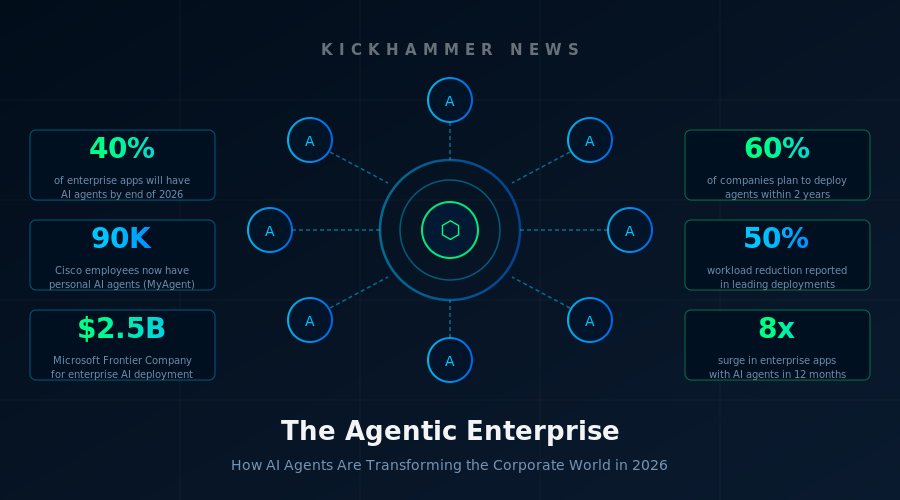
Gartner’s latest projections are stark: the research firm predicts that 40% of enterprise applications will embed task-specific AI agents by the end of 2026, up from less than 5% just twelve months ago. That eight-fold increase in a single year isn’t the product of gradual adoption — it reflects a sudden acceleration driven by improved model reliability, falling inference costs, and a growing library of production-proven deployment patterns.
The adoption figures from the ground are slightly more conservative but point in the same direction. As of April 2026, roughly 17% of organizations had deployed AI agents in production — but more than 60% expected to do so within two years. At this rate, AI agents will be standard components of enterprise software stacks within three years, sitting alongside databases, authentication systems, and workflow engines as unremarkable infrastructure.
What changed? Several things converged simultaneously. The reliability of frontier models improved dramatically in late 2025 and early 2026. Context windows expanded to the point where agents can hold meaningful amounts of business context in a single session. Tool use — the ability for models to call APIs, run code, and interact with external systems — became stable and predictable enough for production use. And costs fell fast enough that the economics of running agents on routine tasks finally made sense.
Cisco’s Bet on the Agentic Workforce
Perhaps the most concrete illustration of where enterprise AI deployment has arrived is Cisco’s “MyAgent” program, which the networking and software giant expanded in 2026 to cover its entire global workforce of approximately 90,000 employees. Every Cisco employee now has access to a personalized AI agent capable of handling internal queries, drafting communications, navigating internal systems, and supporting role-specific workflows.
The scale of the Cisco deployment is significant not because Cisco is uniquely innovative, but because it demonstrates that agentic AI has cleared the governance and security bars that large enterprises require. Cisco’s internal security standards are exacting — the company builds the networking infrastructure that many other enterprises rely on. Deploying AI agents to 90,000 employees is a statement that the technology is mature enough for the kind of organization that cannot afford to get security wrong.
What Cisco is doing is becoming mainstream. The question for most enterprises is no longer “can we trust this technology enough to deploy it” but “how do we build the internal infrastructure — the governance frameworks, the audit trails, the escalation procedures — to run agents at scale.”
Microsoft’s $2.5 Billion Forward-Deployment Bet
The enterprise AI deployment challenge has created a business opportunity that Microsoft moved aggressively to capture. In July 2026, the company launched Microsoft Frontier Company, a $2.5 billion unit that embeds 6,000 engineers directly inside enterprise customers to design, build, deploy, and operate AI systems on-site.
The model, known in the industry as forward-deployed engineering, acknowledges something that enterprise software vendors have historically been reluctant to admit: selling software to enterprises isn’t enough. The complexity of integrating AI into existing systems — the data pipelines, the security requirements, the change management, the workflow redesign — requires deep technical partnership, not just a subscription and a help center.
Amazon moved in a similar direction almost simultaneously, committing $1 billion to its own forward-deployed engineering program just two days after Microsoft’s announcement. The parallel moves from two of the largest enterprise software companies in the world suggest a shared read on what enterprises actually need right now: not more AI capability, but more help using the AI capability they already have access to.
The Governance Gap
Even as adoption accelerates, a significant risk is emerging that the industry hasn’t fully reckoned with. Gartner has projected that more than 40% of agentic AI projects launched in 2026 will be cancelled by the end of 2027, not because the technology failed, but because of unclear business value, uncontrolled costs, or inadequate risk controls.
The pattern is familiar from earlier waves of enterprise technology adoption: companies deploy fast, discover the governance requirements late, and either scramble to retrofit controls or abandon the initiative entirely. With AI agents, the governance challenge is particularly acute because agents can take actions — sending emails, modifying records, calling APIs — that have real-world consequences in ways that a chatbot producing a text summary does not.
New roles are emerging in response. Prompt engineers, LLMOps specialists, AI governance leads, and agent audit specialists are appearing on organizational charts where they didn’t exist eighteen months ago. The workforce transformation required to manage AI agents is itself a significant undertaking, and organizations that treat deployment as a purely technical exercise are discovering the gaps the hard way.
The productivity gains that make agents attractive — some deployments report 50% reductions in workload for specific task categories — are real, but they don’t materialize automatically. They require process redesign, training, and sustained attention to where agents perform reliably and where they don’t.
What “Governing Agents You Already Have” Actually Means
The shift from “should we deploy AI agents” to “how do we govern the agents we already have” sounds like a semantic distinction, but it represents a fundamental change in organizational posture.
Governance in this context means several things. It means audit trails: knowing which agent took which action, on whose behalf, using what data. It means guardrails: defining the boundaries within which agents can operate autonomously and the triggers that require human review. It means cost monitoring: agent operations scale in ways that can produce surprising infrastructure bills if usage patterns aren’t tracked carefully.
It also means cultural change. Employees who work alongside AI agents need to understand when to trust agent outputs and when to verify them. Managers need frameworks for evaluating agent performance that don’t rely on traditional productivity metrics. Legal and compliance teams need to understand what “AI-assisted” decisions mean for liability and audit requirements.
None of this is insurmountable. But organizations that are deploying agents without simultaneously building this governance infrastructure are accumulating technical and operational debt that will eventually come due.
The Road Ahead
The trajectory of enterprise AI adoption in 2026 points toward a world in which AI agents become as fundamental to business operations as email or enterprise resource planning software — tools so embedded in daily work that their absence is inconceivable.
Getting there will require the industry to solve problems that are less exciting than model capability benchmarks but more practically important: reliable tool calling, deterministic behavior in production environments, cost-effective inference at enterprise scale, and governance frameworks that satisfy legal and compliance requirements across industries.
The companies that figure out how to deploy agents at scale — not just in pilots, but in production, across their entire organizations, with the governance infrastructure to match — will have a genuine competitive advantage. Not because AI agents are magic, but because organizations that can effectively coordinate human and AI work at scale will simply be able to do more, faster, at lower cost, than those that cannot.
The age of the enterprise AI pilot is over. The age of the agentic enterprise has begun.
Sources: Gartner, CrossML, Enterprise AI Agent Stats 2026, GeekWire, CNBC, TechCrunch


