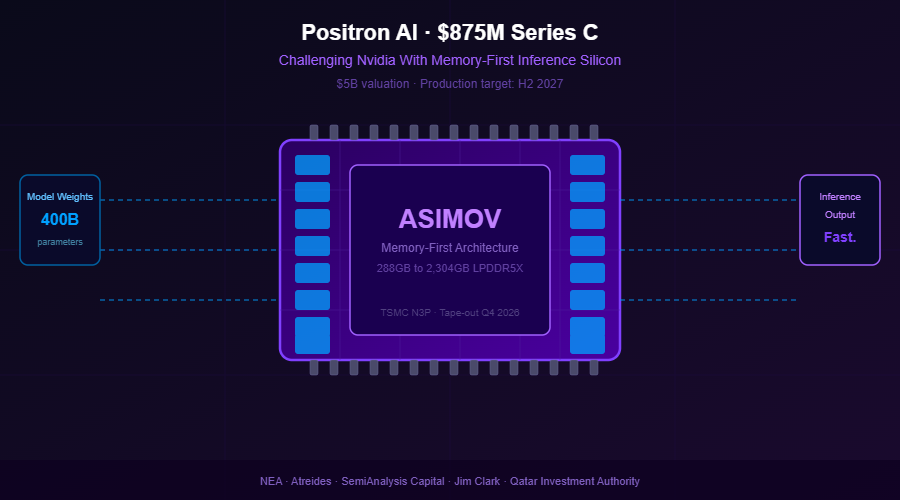
In February 2026, Positron AI was a $1 billion startup with an ambitious chip design and a crowded competitive landscape. By Thursday, September 10, 2026, it had raised another $875 million at a $5 billion valuation — five times higher in seven months — turning itself into one of the most formidably capitalized AI chip challengers in the world. The round signals that investors believe the inference chip market is large enough, and Nvidia’s dominance contestable enough, for a memory-first challenger architecture to find serious traction.
The Memory Problem at the Heart of AI Inference
To understand why Positron has attracted this level of capital, it helps to understand what the company is actually building — and why the problem it is solving matters so much right now.
The dominant AI chips of the current era, led by Nvidia’s H100 and B200 families, were designed primarily to accelerate training: the computationally intensive process of adjusting billions of model parameters on massive datasets. For training, raw compute throughput is king, and high-bandwidth memory (HBM) — a stacked memory technology produced almost exclusively by SK Hynix, Samsung, and Micron — provides the fast data access that training workloads demand.
But the industry’s center of gravity has shifted. Training clusters are still being built at enormous scale, but inference — running a trained model to generate responses for actual users — now accounts for a growing majority of AI compute spending. And inference has a different bottleneck than training.
When an AI model generates a response, the constraint is often not raw compute but memory bandwidth: how quickly the chip can move model weights from memory into compute units, and how much memory the chip can hold locally without expensive data fetches. For large language models with hundreds of billions of parameters, this constraint is acute. Nvidia’s HBM-based architecture handles it adequately but at significant cost — HBM is expensive, supply-constrained, and requires advanced packaging that only a handful of facilities worldwide can produce.
Positron’s Asimov chip takes a different approach. Rather than relying on HBM, Asimov pairs the company’s custom compute architecture with between 288 gigabytes and 2,304 gigabytes of memory per chip using commodity LPDDR5X memory — the same memory technology found in high-end smartphones and laptops. LPDDR5X is produced at scale by multiple manufacturers, is not supply-constrained, and does not require the advanced packaging that HBM demands. Positron calls this its “memory-first” architecture, and the bet is that for inference workloads, enormous amounts of cheap memory can outperform smaller amounts of expensive fast memory.
The Funding Round in Detail
The $875 million raise was structured in two tranches. The first, $375 million at a $3.5 billion pre-money valuation, was co-led by NEA, Atreides Management, Valor Equity Partners, Andra Capital, and SemiAnalysis Capital, the research firm founded by Dylan Patel. The second tranche — a Series C-1 of up to $500 million — was anchored by Jim Clark, the founder of Silicon Graphics and Netscape, whose track record of backing foundational infrastructure companies lent the round a certain historical weight. The Qatar Investment Authority also participated, continuing the Gulf sovereign wealth fund’s pattern of staking claims in AI hardware companies.
The capital will be deployed across three areas. First, it funds the Asimov tapeout — the process of finalizing the chip design and sending it to a semiconductor foundry for production. Asimov is slated to tape out on TSMC’s N3P process node at the end of 2026, with production targeted for the second half of 2027. Second, the funds will build out a two-megawatt engineering data center and emulation platform, giving Positron’s software teams the ability to test workloads at scale before the physical chips arrive. Third, the funds support the production ramp of Titan — the system-level product that combines four to eight Asimov chips into a single inference node, designed to be slotted into standard data center racks.
A Differentiated Bet in a Crowded Field
Positron is not alone in chasing the inference chip opportunity. AMD’s Instinct MI400 series, Qualcomm and Tenstorrent’s RISC-V chip announced in June, Google’s TPU v7, and a range of smaller startups including Groq, Cerebras, and d-Matrix are all competing for inference workloads. What distinguishes Positron, according to investors and the company itself, is the memory architecture.
The core insight is that for many inference workloads, particularly the large-batch, high-latency-tolerant jobs that power enterprise AI applications, the ratio of memory capacity to compute matters more than peak compute throughput. A model with 400 billion parameters needs roughly 800 gigabytes of memory just to hold its weights at standard precision. On a four-chip Titan node with Asimov’s maximum memory configuration, that entire model can reside in on-chip memory — eliminating the latency and power cost of repeated memory fetches. On a standard Nvidia system, the same model requires multiple chips connected by high-speed interconnects, adding cost, latency, and failure points.
Dylan Patel of SemiAnalysis, who co-led the round through his capital vehicle, has been publicly skeptical of many AI hardware startups. His participation here — as both a technical analyst who has scrutinized Positron’s architecture and an investor writing a check — is being read by the industry as a meaningful signal that the Asimov design is technically credible, not vaporware.
The Road Ahead
With a tape-out at end of 2026 and production in the second half of 2027, Positron faces the standard risks of any new semiconductor architecture. Chip designs that look compelling in simulation encounter unexpected failure modes in silicon. TSMC’s N3P process is in high demand, and production slot competition is fierce. Software is the deeper challenge: Nvidia’s CUDA ecosystem has a decade-plus head start, and customers evaluating a new inference chip have to weigh hardware performance against the real cost of porting and reoptimizing their model serving software.
Positron has been building its software stack — called Halo — in parallel with the hardware design, and the company says Halo is designed to support frameworks including PyTorch, JAX, and the growing ecosystem of inference-optimized libraries like vLLM and SGLang. How well that claim holds under production conditions, with diverse customer workloads, remains to be seen.
What is clear is that the market Positron is chasing is enormous and structurally open to challenge. Inference spending is growing faster than training spending. The memory constraints that Positron’s architecture addresses are real, not invented. And the supply chain fragility of HBM — made viscerally clear during the memory shortages of 2025 and early 2026 — has given enterprise buyers a strong motive to explore alternatives.
Whether Asimov can deliver on its architectural promise is a question that 2027 will answer. But the fact that NEA, Jim Clark, the Qatar Investment Authority, and Dylan Patel have all concluded the bet is worth taking is, by itself, a significant data point about where the AI hardware market is heading.


