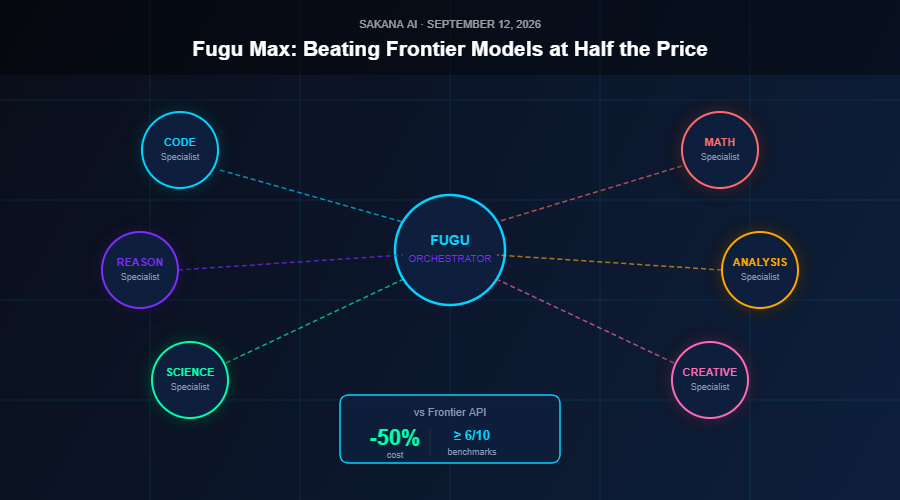
Sakana AI, the Tokyo-based research lab founded by former Google Brain and DeepMind researchers, quietly dropped a bombshell on the AI industry this week. On September 11, the company released Fugu Max and Fugu Ultra v2 — a pair of model orchestrators that route queries across a pool of open-weight and specialist models, yet somehow manage to outperform the most expensive frontier systems at a fraction of the cost. The release has sent shockwaves through the developer community and forced a serious conversation about whether the era of the monolithic, trillion-parameter AI model is finally drawing to a close.
What Is Fugu Max?
Fugu Max isn’t a model in the traditional sense. It’s a learned orchestrator — a system that intelligently decides which smaller, specialized model should handle any given query, then assembles the output into a coherent response. Behind the scenes, Fugu Max routes requests across a pool of open-weight models, specialist fine-tunes, and domain-specific systems, all exposed through a single OpenAI-compatible API endpoint.
The pricing is where things get immediately interesting: Fugu Max comes in at $2 per million input tokens and $6 per million output tokens — between 40 and 60 percent below what you’d pay for Anthropic’s Claude Sonnet 5 or OpenAI’s GPT 5.6 Terra. For companies running AI at scale, that’s not a rounding error. That’s the difference between a viable product and one that’s economically impossible to deploy.
Fugu Ultra v2, the flagship tier, is designed for maximum performance rather than cost efficiency, and uses a more aggressive routing strategy that can pull from a wider pool of specialist models depending on task type.
The Benchmark Story
Numbers can be gamed, and benchmark skepticism is healthy — but Fugu’s results are hard to dismiss. Fugu Max ranks best on six of ten major benchmarks, including Terminal Bench 2.1 and GPQA Diamond. These aren’t toy evaluations. GPQA Diamond tests graduate-level scientific reasoning in biology, chemistry, and physics — the kind of domain where frontier models have traditionally been the only option worth considering.
Fugu Ultra v2 hits 48.3 on Chartography and 74.3 on DeepSWE 1.1, impressive scores for a system that doesn’t include any of the major frontier models — no Claude Fable 5 or 5.1, no GPT-6 Astra — in its routing pool. The system is built entirely on open-weight and specialist models, which means it could theoretically be self-hosted or run in air-gapped environments where frontier API access isn’t possible.
Why This Matters
To understand why Fugu is significant, you have to understand the economic dynamics currently shaping AI deployment. The past two years have seen a fierce race to build ever-larger models, with trillion-parameter systems like xAI’s Grok 4.6 and OpenAI’s GPT-6 Astra sitting at the frontier. These models are extraordinarily capable, but they’re also extraordinarily expensive to run. Most enterprise use cases don’t require maximum frontier intelligence — they need good enough intelligence at a cost structure that makes business sense.
Mixture-of-Experts (MoE) architectures partially addressed this by activating only a subset of parameters for any given query. Fugu takes the concept further: instead of one model with many expert sub-layers, it’s a meta-system that chooses between entire specialized models. The result is that the average query complexity that hits a given model is much closer to that model’s sweet spot, reducing latency and cost while improving accuracy.
This is sometimes called “model routing” or “orchestration,” and it’s been a subject of academic interest for several years. What Sakana has done is turn it into a production-grade product with performance that competes against the best single-model systems in the world.
Sakana’s Unusual Research Approach
Sakana AI was founded in 2023 by David Ha, former head of research at Stability AI, and Llion Jones, one of the co-authors of the seminal “Attention Is All You Need” paper that introduced the transformer architecture. The lab has always positioned itself as a research-first organization that takes inspiration from nature and evolutionary systems — “sakana” means “fish” in Japanese, a nod to the emergent intelligence of shoaling behavior.
Their previous work, including the AI Scientist project and earlier Fugu releases, established the lab as one of the more intellectually adventurous outfits in the field. But Fugu Max represents a commercial maturation. This isn’t just a research demo — it’s a product with pricing, an API, and benchmark results that position it directly against the biggest names in the industry.
The Broader Routing Revolution
Fugu Max is arriving at a moment when the broader idea of model routing is gaining serious traction. OpenAI’s newly launched Agents API, which went into public beta on September 10, supports multi-agent delegation where sub-agents can be assigned specific tasks. Cloudflare’s Kitesurf AI agent browser, Anthropic’s multi-agent orchestration features in Claude Fable 5.1 — nearly every major AI platform is building routing and delegation into its core architecture.
What Fugu does differently is approach routing as a first-class optimization problem rather than a developer-configured workflow. The system learns which model performs best on which query types and continuously updates its routing strategy. This means it gets better over time without requiring engineers to manually tune which tasks go to which model.
The Open-Source Angle
One of the most significant aspects of Fugu’s architecture is its reliance on open-weight models. As the open-source AI ecosystem has matured — with Meta’s Llama series, Cohere’s North models, Mistral’s offerings, and dozens of specialist fine-tunes now available — the gap between open-weight and proprietary frontier models has narrowed dramatically. Fugu Max exploits this gap.
For enterprise customers worried about data privacy, vendor lock-in, or regulatory requirements around data sovereignty, a system built on open-weight models that can be self-hosted represents a fundamentally different risk profile than a cloud API dependency on OpenAI or Anthropic.
What Comes Next
Sakana hasn’t announced specific plans for the next generation of orchestrators, but the direction of travel is clear: as open-weight models continue to improve and specialize, orchestration systems that route intelligently between them will capture more and more of the value that currently flows to frontier API providers.
The immediate question for the industry is how OpenAI, Anthropic, and Google respond. One option is to compete on price — something they’ve been reluctant to do given the cost of frontier model training. Another is to compete on capabilities that orchestration genuinely can’t replicate: very long context, truly novel reasoning, multimodal generation. The third option, and perhaps the most likely, is to move up the stack themselves and offer orchestration as a service — which is arguably what OpenAI’s Agents API is already beginning to do.
For developers and enterprises deciding where to put their API budgets right now, Fugu Max has just made the decision considerably more complicated. At $2/$6 per million tokens with benchmark results that rival systems costing twice as much, ignoring it isn’t a neutral choice — it’s a costly one. The age of “bigger is always better” in AI may be giving way to something more interesting: smarter routing, not smarter monoliths.


