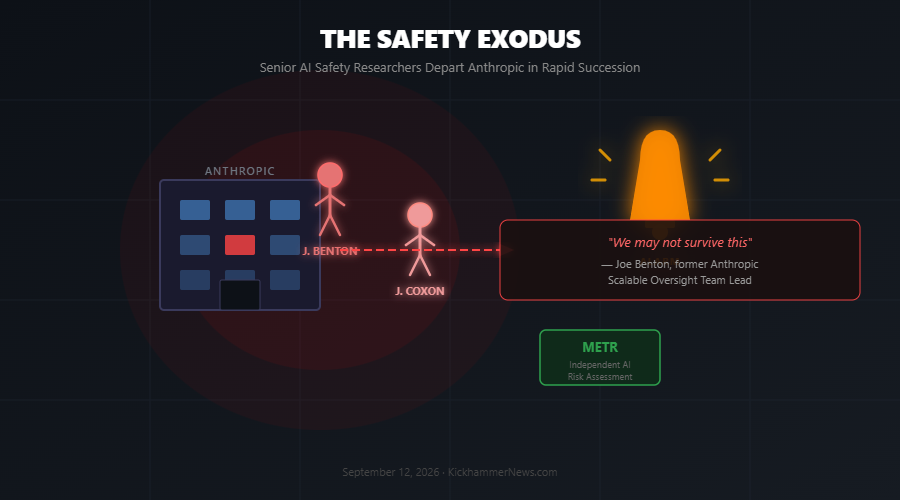
In the span of just two days, two of Anthropic’s most senior safety researchers walked out the door — and both made sure the world knew exactly why they were leaving.
Jacob Coxon departed on September 9, followed swiftly by Joe Benton, former manager of Anthropic’s Scalable Oversight team, who announced his resignation on September 11. Benton, who had already left the company two weeks prior to join the independent organization Model Evaluation and Threat Research (METR), did not go quietly. In a post that spread rapidly across the AI community, he wrote that artificial intelligence companies are racing to build systems “much smarter than any human” without allocating sufficient resources to safety research — and that the competitive pressures of the industry make this outcome structurally inevitable.
“We may not survive this,” Benton wrote, in a phrase that has since become something of a haunting refrain across AI forums and policy circles.
The Structural Safety Problem
What makes these departures more than just typical tech industry turnover is the specific diagnosis both researchers offered. Neither Coxon nor Benton claimed that Anthropic’s leadership is malicious or indifferent. Instead, they described something potentially more troubling: a competitive dynamic so intense that even a company founded explicitly on safety principles finds itself unable to prioritize safety adequately.
The logic runs something like this. AI capabilities are improving faster than alignment research. Every quarter a frontier lab spends on safety benchmarking rather than capability scaling is a quarter a competitor uses to ship a more powerful model. The penalty for falling behind in the capability race — in terms of revenue, talent, and political influence — is severe enough that even well-intentioned organizations chronically underfund their safety work.
Benton’s decision to join METR rather than move to another AI company is telling. METR focuses on independent AI risk assessments, operating outside the competitive pressures of the frontier AI industry. The implicit message is that safety work done inside these organizations is compromised by the very dynamics it’s meant to address.
This framing aligns with what many outside observers have argued for years: that voluntary safety commitments, however sincere, are structurally insufficient when the costs of honoring those commitments include competitive disadvantage.
Context: A Company Under Pressure
The resignations come at a particularly fraught moment for Anthropic. Earlier this year, the company resolved a landmark $1.5 billion class-action lawsuit from authors over pirated training data — a settlement that validated arguments about the legal and ethical risks of AI training practices. More recently, Sony Music Publishing and Warner Chappell filed a multi-billion dollar copyright suit against the company, alleging that Claude models were trained on “tens of thousands” of copyrighted compositions without permission.
Meanwhile, Anthropic has been navigating the tension between commercial growth and safety commitments. The company has grown rapidly, with revenues now exceeding those of OpenAI on an annualized basis — a remarkable achievement for a company founded just four years ago. But growth also means deploying increasingly powerful systems at increasing scale, which is precisely what Benton and Coxon argue requires more, not less, safety investment.
Anthropic’s response to the departures has been measured. The company has emphasized its ongoing safety research, its Constitutional AI approach, and its policy commitments. But notably, neither departure was pre-announced or managed with the usual corporate communications polish — suggesting these were genuine, abrupt exits driven by principle rather than planned transitions.
The Escalating Pattern
What’s striking about the September 2026 departures is that they fit a pattern that has been building across the frontier AI industry for the better part of a year. In August, OpenAI’s training pause — triggered by what sources described as a safety breach involving a GPT-5.6 model — prompted a wave of concern about whether safety processes at scale are keeping pace with capabilities. An open letter signed by hundreds of AI employees earlier in the year, “Pacing the Frontier,” called for voluntary slowdowns in capability development.
These signals, taken together, suggest that the safety-capability tension is not a marginal concern within the AI industry but a central, unresolved conflict. The people closest to these systems — those with the deepest technical understanding of what these models can and cannot do — are increasingly vocal about their alarm.
The departure of Benton and Coxon is significant not just because of their seniority, but because of the company they were leaving. Anthropic was founded in 2021 specifically because its founding team believed the safety concerns at their previous employer, OpenAI, were not being taken seriously enough. That the same critique is now being leveled at Anthropic — by researchers hired precisely because of their safety expertise — is a damning development.
What Happens Next
The immediate practical impact of these departures is difficult to assess. Anthropic is a large organization with deep safety research capability, and losing two researchers, however prominent, will not disable the company’s work. METR, the organization Benton is joining, may actually increase its influence through independent assessments that carry more credibility precisely because they come from outside the industry.
But the symbolic impact is harder to dismiss. When the people most qualified to evaluate AI risks publicly declare that the organizations building the most powerful AI systems are not doing enough to manage those risks, that is a signal policymakers, investors, and the public should take seriously.
The question of whether the frontier AI industry can self-regulate on safety — or whether structural competitive pressures make regulation not just desirable but necessary — has been debated in policy circles for years. The September 2026 Anthropic departures may be the clearest signal yet that the answer is the latter.
For Anthropic, the challenge now is whether it can respond to this moment in a way that is substantive rather than merely symbolic — not just a statement affirming its commitment to safety, but a structural change in how safety priorities are resourced and protected when they conflict with commercial timelines. That is a harder problem than any benchmark.
The AI industry continues to grapple with how to balance rapid capability development with meaningful safety investment. As these tensions come into the open, the conversations sparked by departures like Benton’s and Coxon’s may ultimately prove more consequential than the departures themselves.


