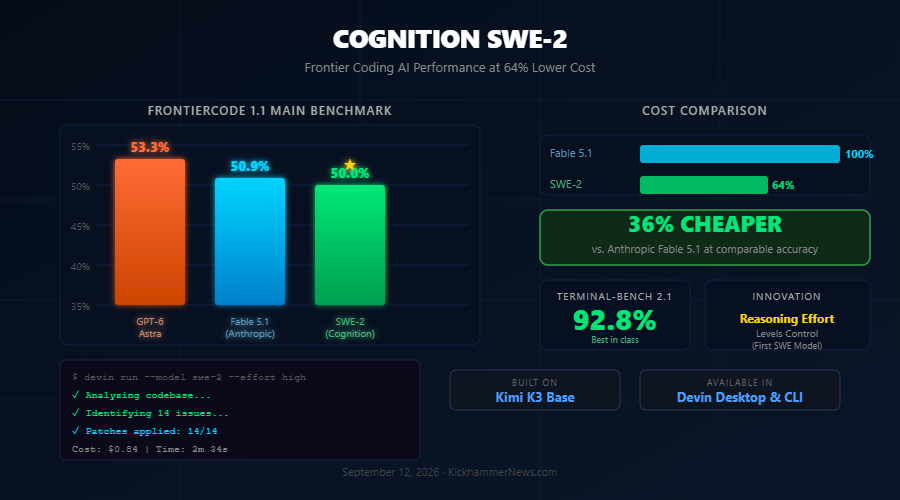
When Cognition released Devin to the public in 2024, it was celebrated as the world’s first AI software engineer. Two years later, the company is back with something more strategically interesting than a technical leap forward — a model that nearly matches the industry’s best coding AI at 64% lower cost, challenging the assumption that frontier-grade performance requires frontier-grade pricing.
SWE-2, released on September 10, 2026, scores 50.0% on the FrontierCode 1.1 Main benchmark, sitting just behind Anthropic’s Fable 5.1 at 50.9% and OpenAI’s GPT-6 Astra at 53.3%. Those numbers look like a close third-place finish until you factor in the price: Cognition claims SWE-2 delivers this performance at roughly 64% of the cost of Fable 5.1. For software teams deploying AI at scale, that differential can represent tens or hundreds of thousands of dollars per year.
What SWE-2 Actually Does
SWE-2 is described by Cognition as a “post-trained” model built on Kimi K3 Base, the large open-weight model from Chinese AI lab Moonshot that has become an increasingly popular foundation for specialized fine-tunes. The choice of foundation model is itself significant — it reflects both the rising quality of open-weight base models and the growing trend of building specialized, production-ready systems on top of them rather than training from scratch.
The model introduces reasoning effort levels, a feature borrowed from the wave of “thinking” models that have dominated benchmark tables over the past year. Users can dial up or down the amount of reasoning the model applies to a given task, trading inference speed and cost against accuracy — a practical concession to the reality that not every coding task requires the same depth of analysis.
On benchmarks beyond FrontierCode, SWE-2’s profile is mixed in instructive ways. It achieves 92.8% on Terminal-Bench 2.1, the best score in the comparison table — suggesting strong performance on terminal-based coding tasks. But on Terminal-Bench 4, a harder evaluation, it scores 27.3%, roughly half what Fable 5.1 and GPT-6 Astra achieve. This pattern — strong on some metrics, weaker on others — is characteristic of specialized fine-tunes that optimize for particular task distributions at the expense of generalization.
The Cost Argument
The framing around SWE-2 is deliberately commercial. Cognition is not claiming to have built a better AI than Anthropic or OpenAI; it’s claiming to have built a good enough AI that costs substantially less. This is a mature market argument — the kind made when a technology category transitions from cutting-edge differentiation to commodity pricing pressure.
It mirrors the dynamic that has played out repeatedly in the broader AI model market over the past two years. DeepSeek’s V4.1 Flash, released just days earlier on September 10, delivered comparable performance to frontier models at dramatically lower cost, exploiting efficiency innovations that undermined incumbents’ pricing power. The pattern is now familiar: a newer entrant achieves 90–95% of the performance at a fraction of the cost, capturing the majority of price-sensitive enterprise demand while frontier models retain customers for whom absolute capability matters.
For Cognition, this positioning makes strategic sense. The company’s Devin product has always been oriented toward production software engineering workflows — replacing or augmenting the work of human developers on real codebases, not just achieving impressive benchmark numbers. In production environments, cost efficiency is often as important as raw capability. A model that completes 50% of tasks correctly at 64% of the cost may deliver better economic outcomes than one that completes 51% of tasks at full price.
The Benchmark Caveat
It’s worth noting, as Cognition’s own critics have pointed out, that every number cited here comes from Cognition itself. No independent evaluation of SWE-2 existed at launch. The 64% cost claim requires knowing the exact task distribution and pricing assumptions Cognition used for the comparison. The 50.0% FrontierCode score is from Cognition’s own testing. This is not unusual for a new model release — independent evaluations typically lag launches by weeks or months — but it does mean the claims should be treated as provisional until corroborated.
The benchmark wars in AI have grown increasingly complex as companies have become sophisticated at optimizing for specific evaluations. FrontierCode 1.1 Main is widely used, but as the benchmark grows more familiar, the signal it provides about real-world performance degrades as models are increasingly trained on distributions that improve benchmark scores specifically.
Availability and Integration
SWE-2 launched immediately in Devin Desktop and Devin CLI, with Devin Web and Cognition’s Fusion multi-model workflow rolling out subsequently. This tight integration with Cognition’s own products signals that the company sees SWE-2 primarily as a driver of Devin adoption rather than a standalone model to be licensed externally — though that could change based on demand.
The Fusion workflow is particularly interesting: it allows users to combine SWE-2 with other models dynamically, routing tasks to different systems based on their requirements. This multi-model orchestration approach is becoming standard in enterprise AI deployments, where no single model is optimal for every subtask in a complex workflow.
The Bigger Picture
SWE-2’s release slots into a broader competitive landscape in which specialized coding AI is rapidly maturing. GitHub Copilot, Cursor, Devin, and a growing field of competitors are all targeting the same market: software development teams that want to accelerate output without proportionally increasing headcount.
The differentiation is increasingly economic and integrative rather than purely technical. In a world where multiple models can achieve 50% on the leading coding benchmark, the winning product is the one that fits most naturally into development workflows, offers the most favorable pricing for enterprise scale, and integrates with the tools developers already use.
Cognition is betting that Devin’s two-year head start in agentic software engineering — the experience of actually deploying AI in production coding environments — gives it an edge in building the right product around SWE-2, even if the model itself is not the undisputed technical leader.
Whether that bet pays off will depend on how enterprise software teams weigh capability against cost as they scale their AI usage. The early signals from the market suggest the answer is: more than most frontier AI companies initially expected.
SWE-2 is available now in Devin Desktop and Devin CLI. Enterprise pricing is available through Cognition’s website. Independent benchmark evaluations are expected in the coming weeks.


