September 15, 2026 — Inside the world’s largest AI data centers, a quiet crisis has been brewing. Billions of dollars’ worth of graphics processing units — the engines powering everything from large language models to real-time inference — spend nearly half their time doing nothing. Not because the workloads aren’t there, but because the data isn’t arriving fast enough. The network connecting all that expensive silicon has become the bottleneck that is quietly strangling AI’s potential.
Cornelis Networks believes it has the solution — and it now has $205 million to prove it.
The Santa Clara-based AI networking company announced on Monday a major funding round led by IAG Capital Partners, alongside the launch of a groundbreaking new architecture called Active Compute Fabric and a strategic collaboration with Qualcomm Technologies. The announcement, timed to coincide with the AI Infra Summit in Santa Clara, signals a turning point in how the industry thinks about the relationship between networks and the AI accelerators they connect.
The Hidden Tax on AI Performance
To understand why Cornelis’ announcement matters, it helps to understand just how badly modern AI networking falls short. In large-scale AI deployments — training massive models, running distributed inference across hundreds of accelerators — the compute cluster is only as fast as its weakest link. And increasingly, that link is the fabric that ties everything together.
“Accelerator utilization in large AI deployments commonly sits near half of installed capacity,” said Brandon Draeger, Cornelis’ Chief Marketing Officer. The culprit is a structural problem with how data center networks were designed. Traditional networking fabrics are what Draeger calls “passive pipes” — they move data packets from point A to point B and nothing else. Every synchronization step, every collective communication operation, every cache transfer eats into accelerator time that could otherwise be spent on actual computation.
The math is sobering. Network infrastructure typically represents about 15% of the total cost of an AI system. But that 15% determines how much value organizations get out of the other 85%. When accelerators sit idle waiting for data, that’s not just wasted capacity — it’s wasted capital investment at a scale that makes even small inefficiencies enormously costly.
A Network That Does the Work
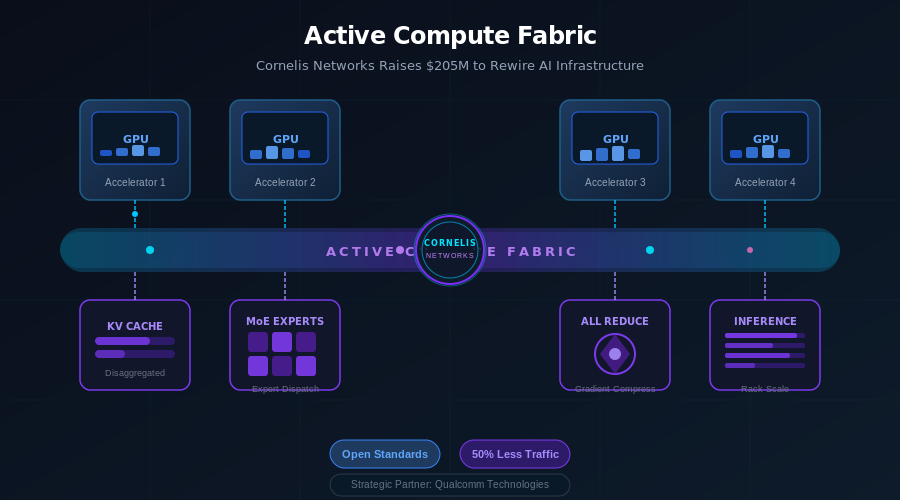
Active Compute Fabric is Cornelis’ answer to this problem. Rather than simply moving data, it integrates programmable compute directly into the network fabric itself — allowing the network to actively process data as it moves through the system, rather than passively forwarding packets.
The practical implications are significant. In a typical collective operation like AllReduce, used pervasively in distributed AI training, thousands of separate data contributions from multiple endpoints normally arrive at their destination individually, where they must then be aggregated. With Active Compute Fabric, those partial results are combined inside the fabric itself — so a single, already-reduced result lands at the destination rather than thousands of raw contributions.
The same principle applies to other bottlenecks. The fabric can assemble KV cache data for disaggregated inference workloads, coordinate expert dispatch for mixture-of-experts model architectures, compress gradients in transit, and adapt in real time to shifting workload patterns. “The payload does not arrive the way it left,” Draeger said. “The work happens once, in the path the data was already taking, instead of consuming accelerator cycles at both ends.”
According to Cornelis, this approach can reduce overall network traffic by up to 50% based on pre-production simulations, and meaningfully improve the accelerator utilization rates that currently hover around 50% in large-scale deployments.
Open Architecture vs. Nvidia’s Walled Garden
Cornelis’ strategy goes beyond technology. The company is explicitly positioning itself as an open alternative in a market that Nvidia has come to dominate through vertical integration. While Nvidia’s InfiniBand networking technology is technically compatible with other vendors’ hardware, in practice Nvidia’s full stack — GPUs, networking, and software — is heavily optimized to work together, creating powerful lock-in for customers.
Active Compute Fabric is built on open standards: Ethernet and UALink for scale-up environments, and Ultra Ethernet for scale-out. This means organizations can implement Cornelis’ networking alongside their existing compute architectures, whether those are built on Nvidia GPUs, AMD accelerators, or chips from Qualcomm or other vendors.
That last point is where the Qualcomm collaboration becomes important. The two companies share a view that the network should be treated as a “first-order design decision” — something designed alongside the accelerator from the start, not bolted on afterward. They are in advanced stages of joint technology evaluation focused on rack-scale inference across both scale-up and scale-out environments.
CEO Lisa Spelman framed the opportunity in stark terms: “AI infrastructure is reaching a point where faster endpoints alone are not enough. The fabric has to become an active part of the compute system. We’re seeing growing demand from customers for an open alternative that gives them more choice in how they build their AI infrastructure.”
Products Ready Now, More Coming
Cornelis already has hardware in the field. Its CN5000 switch, operating at 400 Gbps, is shipping today. The next-generation CN6000, running at 800 Gbps, is currently sampling with customers ahead of broader availability expected in Q4 2026. The $205 million in new capital will be used to scale production of both products and accelerate Active Compute Fabric deployments.
The company, which spun off from Intel in 2020, competes not just with Nvidia but with established networking giants like Cisco Systems and Arista Networks. But the AI-specific focus differentiates Cornelis: while Cisco and Arista have deep expertise in enterprise networking, neither has built their product from the ground up for the unique demands of massive AI compute clusters.
The Bigger Picture
Cornelis is part of a wave of companies — alongside Etched, Positron AI, and others — that are attacking specific components of Nvidia’s integrated AI stack. The thesis is that as AI infrastructure scales to gigawatt-class data centers and beyond, the economic case for open, specialized alternatives becomes overwhelming. Every percentage point of accelerator utilization reclaimed translates into hundreds of millions of dollars of effective capacity at hyperscale.
If Active Compute Fabric can deliver even half of its promised improvements at production scale, the implications for AI infrastructure economics are profound. The network, long treated as an afterthought in AI system design, may finally be getting the attention it deserves — and a $205 million vote of confidence suggests investors agree.
The race to build the AI factory of the future is increasingly being fought not just at the chip level, but in the connections between chips. Cornelis is betting that whoever wins the networking layer wins the data center.
Sources: TechCrunch, SiliconANGLE, Forbes


