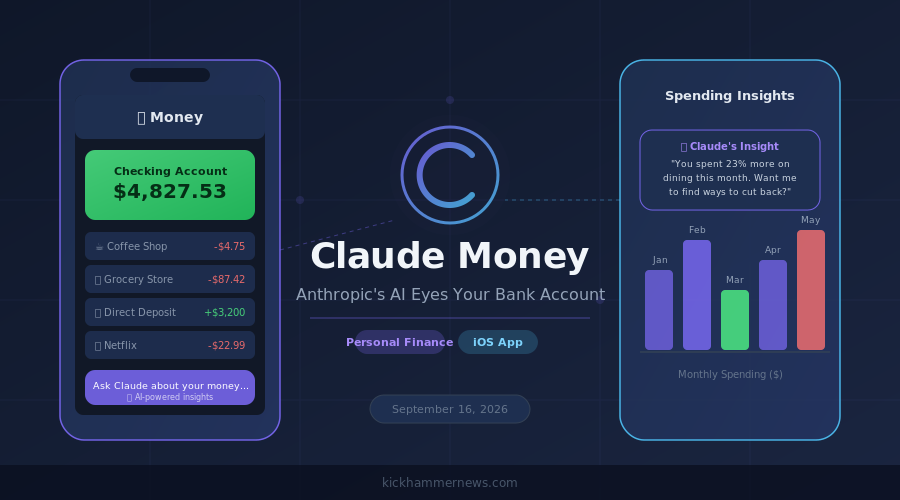
Anthropic is quietly building a feature that could make Claude your most intimate financial adviser yet — one that never forgets a transaction.
On September 14, 2026, a sharp-eyed app researcher discovered something unexpected tucked inside the Claude iOS app: an unreleased “Money” tab, complete with an onboarding screen reading “Understand your money with Claude” and a button to link your bank accounts. No press release. No product launch event. Just a quiet build surfacing in the wild — and suddenly the question on everyone’s lips is whether AI’s next great frontier isn’t coding or creativity, but cash.
From Chatbot to Financial Co-Pilot
Anthropic has spent three years positioning Claude as a thoughtful, safety-conscious AI assistant. The company’s models have earned top marks on reasoning benchmarks, powered enterprise coding workflows, and earned a loyal following among writers and researchers. But Claude Money signals something different: a pivot into one of the most personal, highest-stakes domains in everyday life.
What makes Claude Money distinct is not the idea itself — AI-assisted budgeting apps have existed for years — but the architecture behind it. Rather than asking users to manually upload bank statements or paste in transaction data, Claude Money is designed to give Claude persistent access to a linked bank account. That means Claude would see the running ledger of your financial life: every coffee, every rent payment, every subscription you forgot to cancel.
In theory, this transforms Claude from a tool you query into a system that knows your finances as well as you do — and arguably better, since it never forgets and never gets bored crunching numbers.
The Timing Is No Coincidence
The discovery of Claude Money came just one day after Anthropic launched Claude for Financial Advisors, a separate product connecting the Claude API to portfolio management and wealth-management platforms used by professional advisers. That product launched with partnerships at major custodians including BlackRock and Charles Schwab, with client data remaining on custodian servers rather than flowing through Anthropic’s infrastructure.
Taken together, the two moves paint a clear picture: Anthropic is building a full-stack financial intelligence layer, targeting both the affluent professional market (financial advisers) and the mass consumer market (anyone with a smartphone and a bank account). It’s a vertical integration play dressed up as a product launch.
Industry observers have noted that the timing also coincides with OpenAI’s rollout of GPT-Live 1, a full-duplex voice model now powering ChatGPT Voice, and Cognition’s launch of SWE-2, a coding agent claiming frontier-level performance. While competitors race to capture developer mindshare and enterprise contracts, Anthropic appears to be betting that the most defensible moat in consumer AI is not capability alone, but financial context.
What Claude Money Could Actually Do
Based on the leaked interface and industry analysis, Claude Money appears designed to offer a suite of capabilities that would make most dedicated personal finance apps look primitive.
Spending analysis would allow Claude to break down where your money goes each month, surfacing patterns that would take hours to identify manually — how much you’re spending at restaurants, how your grocery bill has crept up, whether your utility costs are seasonal or structural. Because Claude is a conversational AI, these insights wouldn’t live in a static dashboard: they’d be answers to questions you actually ask.
Recurring payment detection is another natural fit. Claude would be positioned to identify subscriptions, memberships, and recurring charges — and flag ones that might be worth canceling based on actual usage patterns it could infer from contextual clues. Rather than a list of transactions, users would get a smart analysis.
Balance summaries and cash flow forecasting could eliminate the need to open five different banking apps. A user could simply ask Claude “Do I have enough to cover rent next week?” and receive an answer grounded in real account data, taking into account upcoming scheduled payments.
Budgeting and goal tracking would become automatic. If a user sets a savings goal, Claude could monitor progress and surface alerts when spending threatens to derail it — without requiring the user to remember to check a separate app. And conversational financial planning — “Can I afford a vacation in November?” — could yield answers grounded in actual financial data rather than generic advice.
The Privacy Elephant in the Room
Every story about giving an AI persistent access to your bank account has to grapple with the obvious question: what could go wrong?
Linking a bank account to Claude means trusting Anthropic with a level of financial intimacy that goes beyond what most users share with any technology company. While Anthropic has not announced how Claude Money will handle data — which financial data provider it will use, how long transaction data is retained, whether it flows through Anthropic’s servers at all — the privacy stakes are significant.
The consumer finance AI space has a complicated history. Mint, one of the early champions of account aggregation, shut down in 2023 after years of struggling to monetize data while maintaining user trust. Plaid, the infrastructure layer powering much of the open banking ecosystem in the US, faced a major class-action lawsuit over data practices. Users have grown more sophisticated about what it means to share financial access.
Anthropic will need to answer hard questions about data sovereignty, retention policies, breach liability, and whether Claude’s financial reasoning ever influences product recommendations — before the feature goes live, not after. Given that Anthropic has made AI safety a core part of its public identity, the way it handles these questions will be watched closely.
The Bigger Picture: AI and Financial Services
Claude Money is one node in a much larger transformation underway across financial services. Visa and Mastercard, alongside Ant Group, unveiled a “Know Your Agent” (KYA) framework in early September, designed to help banks identify and authenticate AI agents conducting transactions on behalf of humans. The implication: the age of AI wallets and AI-mediated financial decisions is arriving faster than most institutions had planned for.
Revolut, Europe’s largest neobank by valuation, launched its own AI banking assistant this month, offering personalized financial insights and automated savings nudges. Goldman Sachs published a research note projecting that AI-native financial advisory services could capture $4.2 trillion in assets under management by 2030. The race is on — and Anthropic just entered it from an unexpected angle.
Where most fintech incumbents are bolting AI onto existing banking rails, Anthropic is doing the reverse: starting with a powerful general-purpose AI and building banking capabilities into it. The question is whether users will trust a chatbot company with their bank login before they trust a bank to build a smart chatbot.
What Comes Next
Claude Money has no announced launch date, no confirmed data provider, and no price. It remains an unreleased feature discovered in a beta build. Anthropic has not commented publicly.
But the feature’s architecture — a dedicated Money tab, persistent account linkage, natural language queries over financial data — suggests this is not a prototype. It’s a product that is close to ready, waiting for the right moment to ship.
If Anthropic’s track record holds, Claude Money won’t just be another budgeting tool. It will be an attempt to make Claude the most financially aware AI on the market — a digital CFO for everyday people who never had one. Whether that vision succeeds will depend as much on the fine print of its privacy policy as on the quality of Claude’s financial reasoning.
In the meantime, if you have the latest Claude iOS app installed, it might be worth checking for a new tab. Your money might be about to meet its most attentive analyst yet.
Sources: Android Authority, Testing Catalog, Crypto Briefing, Progressive Robot, TechTimes, US News Money


