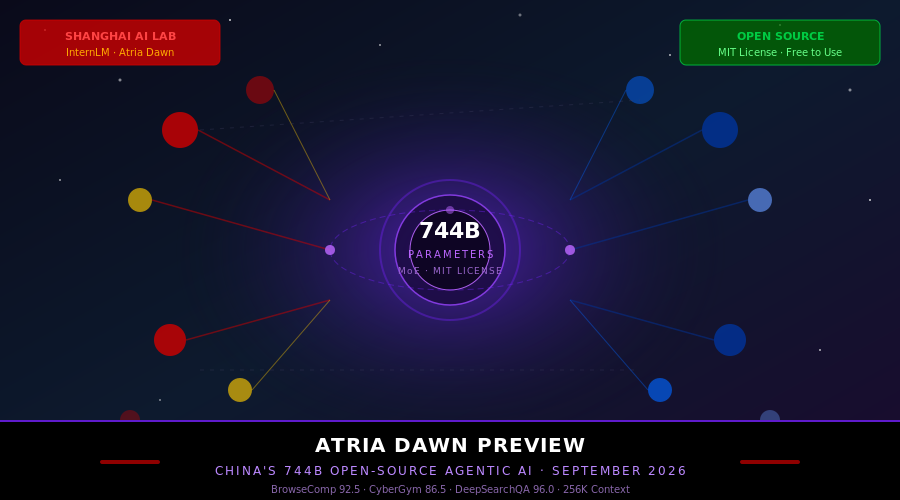
On the morning of September 11, 2026, a GitHub repository called Atria-Dawn-Preview quietly appeared on the internet. No press release. No launch event. No CEO on stage in a darkened theater. Just a repo, a README, and the name of its creator tucked into the organization field: Shanghai Artificial Intelligence Laboratory.
Within days, the AI community began to realize what had been quietly dropped into the world: a free, open-source, 744-billion-parameter agentic AI model — one of the most capable systems ever released to the public — built by one of China’s flagship state-backed research institutions.
What Is Atria Dawn Preview?
Atria Dawn Preview is the latest model from InternLM, the AI research division of the Shanghai Artificial Intelligence Laboratory (Shanghai AI Lab). It is built on top of GLM-5.2, a massive Mixture-of-Experts (MoE) foundation model developed by Zhipu AI and released under a permissive MIT license back in June 2026. While the model carries 744 billion parameters in total, the MoE architecture means that only around 40 billion parameters are active during any given inference pass — making it more computationally efficient than its headline number suggests.
The model supports a context window of up to 262,144 tokens (256K), enabling it to reason over entire codebases, research documents, or long multi-step workflows in a single pass.
A 140-author technical report was posted to arXiv on September 14, two days after the GitHub drop. Even then, there was no accompanying blog post, no pricing announcement, no API waitlist. Just a paper, and a model that anyone with sufficient GPU resources could download and run.
The Case for Calling It an Agent
What separates Atria Dawn from a conventional large language model is its explicit design as an agentic system. Rather than generating text responses to prompts, Atria Dawn is built to execute multi-step workflows in real environments. Its technical report describes a “Verifiable Experience Pipeline” — a training methodology that grounds the model’s tool use in executable environments rather than synthetic demonstrations.
In practice, this means Atria Dawn is capable of supporting the full research and engineering loop: problem analysis, solution design, tool use, code implementation, experiment execution, result analysis, and failure recovery. The model can call external functions, browse the web, write and execute code, recover from errors mid-task, and iterate — behaving less like a chatbot and more like an autonomous AI co-worker.
On industry benchmarks, the results are striking. Atria Dawn Preview claims the top spot on BrowseComp with a score of 92.5, leads on CyberGym at 86.5, and scores 96.0 on DeepSearchQA. Across 16 benchmarks spanning real-world research, engineering, and digital work tasks, it places in the top five across the board. The vendor acknowledges that these figures are self-reported and have not yet been independently verified by third-party evaluators like Artificial Analysis.
Silence as Strategy
The model’s stealth release is itself a story. In an era where AI model launches are increasingly theatrical — live demos, streamed keynotes, waiting lists that stretch for weeks — Atria Dawn’s quiet debut looks almost contrarian.
But the pattern is familiar from China’s AI labs. DeepSeek V3, released in late 2025, emerged from near-silence to upend the global model rankings within weeks. Qwen 3, from Alibaba, accumulated more than three billion downloads before most Western observers had processed the announcement. Tencent’s HY4 MoE preview arrived last week with similarly muted fanfare.
The strategy, whether deliberate or simply cultural, works: let the benchmarks speak, let the community distribute, let the capabilities surface organically. By the time the formal press cycle catches up, the model is already deployed across research groups, startups, and enterprises worldwide.
Timing: One Week Before Trump and Xi Meet
Atria Dawn’s release lands at a politically charged moment. Chinese President Xi Jinping is scheduled to visit Washington on September 24, just eight days from now, for a high-stakes summit with President Donald Trump. AI is expected to dominate the agenda.
In the days leading up to that meeting, the US AI industry has been unusually vocal. In a rare show of unity, Anthropic CEO Dario Amodei, OpenAI’s Sam Altman, and Elon Musk all publicly called for a slowdown in frontier AI development, citing safety concerns and the risks of an unchecked arms race. Trump rejected the idea bluntly. “Whoever wins AI wins,” he told reporters on Sunday.
Into this atmosphere drops a 744-billion-parameter open-source model from one of China’s leading government-backed research institutions, released without ceremony and available to anyone who wants it.
The irony is not lost on observers. While Washington debates whether to slow down, Beijing is shipping.
Open Source and the Power of Free
One detail that deserves emphasis is the license: MIT. Atria Dawn Preview is not merely available for academic research or non-commercial use. It is available for commercial deployment, modification, and redistribution by anyone. That places it in the same open-source tier as Meta’s Llama family and Alibaba’s Qwen series — a tier that has increasingly defined the competitive frontier of accessible AI.
The FP8-quantized version of the model, hosted on Hugging Face under the internlm organization, allows researchers and developers with less hardware to run the model at reduced precision while preserving most of its capabilities. For startups unable to afford frontier API access, models like Atria Dawn represent a potentially transformative resource.
What It Means for the AI Race
The release of Atria Dawn Preview crystallizes something that has been building throughout 2026: the gap between frontier closed models and the open-source ecosystem is narrowing faster than most Western AI executives predicted.
A year ago, the prevailing assumption was that truly capable agentic AI would remain the exclusive province of a handful of well-funded labs. That assumption is being stress-tested every week. Shanghai AI Lab, operating with deep state support but also genuine research excellence, has now demonstrated the ability to ship a model that competes on benchmark after benchmark with the best offerings from OpenAI, Anthropic, and Google.
Whether Atria Dawn’s reported performance holds up under independent evaluation remains to be seen. The AI community has grown rightly skeptical of vendor-reported figures, and 16 top-five finishes is a claim that deserves rigorous scrutiny. But the infrastructure is there — the model is live, the weights are downloadable, and the community will stress-test it quickly.
The Bigger Picture
Atria Dawn Preview is not just a model release. It is a data point in a larger argument about who gets to lead the agentic AI era — and how that leadership is built.
The US approach, shaped by a volatile policy environment and competing commercial interests, has oscillated between acceleration and calls for restraint. China’s approach, at least as evidenced by Shanghai AI Lab, appears to be: build quietly, release openly, let adoption do the rest.
As Trump and Xi prepare to sit across from each other in Washington next week with AI on the agenda, one of China’s flagship labs just handed the world a 744-billion-parameter reason to take that conversation very seriously.
Sources: AI Weekly, Startup Fortune, OrcaRouter, arXiv (2609.15818), Hugging Face/internlm, GitHub/atria-asi, BenchLM


