September 16, 2026 — The voice AI market shifted decisively on Monday when Google DeepMind released Gemini 3.8 Live and Gemini 3.8 Live Extended Thinking, two production-grade conversational models that simultaneously claim the top spot on the leading voice quality benchmark and undercut OpenAI’s competing GPT-Live-1 Astra by as much as 83 percent on price. For enterprises building the next generation of voice agents — customer service bots, in-car assistants, real-time medical transcription, multilingual call centers — the launch changes the calculus on which platform to build on almost overnight.
What Google Actually Shipped
Gemini 3.8 Live is a full-duplex voice model, meaning it can listen and speak at the same time, interrupt and be interrupted, and handle the natural overlap and crosstalk that makes a conversation feel human rather than transactional. Google’s earlier Gemini 2.5 Live offered the same basic capability, but 3.8 brings a substantially lower latency profile and a new reasoning mode — called Extended Thinking — that allows the model to pause before answering complex questions, run through intermediate steps internally, and produce a more considered response without forcing the user to wait in an unnatural silence.
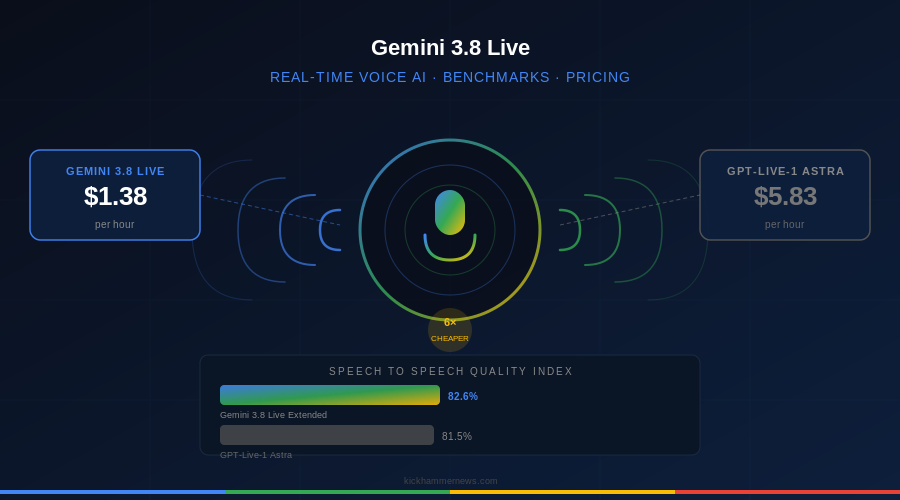
The standard Gemini 3.8 Live is priced at $0.005 per minute for audio input and $0.018 per minute for audio output via the Live API, which works out to roughly $1.38 per hour of active conversation. The Extended Thinking variant, which demands more compute, comes in at approximately $3.50 per hour. For comparison, OpenAI’s GPT-Live-1 Astra — the incumbent leader in premium voice AI — runs at around $5.83 per hour. Even the more capable Gemini variant costs 40 percent less.
The Benchmark Battle
Price alone would not be enough to make the release remarkable. What elevates it is the performance claim. On Artificial Analysis’ Speech to Speech Quality Index — currently the most widely cited independent benchmark for evaluating real-time voice models — Gemini 3.8 Live Extended Thinking scores 82.6 percent, edging past GPT-Live-1 Astra (Medium) at 81.5 percent and Grok Voice Think Fast 2.0 at 79.3 percent.
Google is careful to note that benchmark rankings can shift quickly as OpenAI and others update their models, and independent researchers have not yet fully replicated all of Google’s internal numbers. But the overall direction is clear: at the time of release, Gemini 3.8 Live Extended Thinking is leading the field on quality while costing considerably less than the competition.
The standard 3.8 Live — not the extended thinking version — occupies a different position. At $1.38 per hour, it is roughly one-sixth the price of GPT-Live-1 Astra, and while it does not top the quality rankings, it is competitive enough for many production workloads that do not require deep reasoning. For companies running high-volume voice operations where inference cost is the primary constraint, the difference between $1.38 and $5.83 per hour is not a nuance — it is a business model question.
Full-Duplex vs. Turn-Based: Why Architecture Matters
To understand why the Gemini 3.8 Live design is significant, it helps to understand what full-duplex actually means in practice. Most early AI voice systems — and many current ones — are turn-based: the user speaks, the model waits for the user to stop, transcribes the audio, processes the text, generates a response, converts it back to speech, and then plays it. Each step adds latency. The total round-trip can be anywhere from 800 milliseconds to several seconds, which is long enough for users to notice and find awkward.
Full-duplex voice models collapse that pipeline. Audio goes in and comes out simultaneously, the way a telephone call works between two humans. The model does not need to wait for silence before it begins forming a response; it can track conversation in real time, anticipate what the user is likely to say, and begin shaping an answer before the question is finished. Interruptions — one of the clearest signals that a conversation feels natural — become possible.
OpenAI launched GPT-Live-1 with full-duplex capability earlier this year to considerable fanfare, and Anthropic’s Claude 4 Sonnet Voice followed with its own real-time audio pipeline. Google’s earlier Gemini 2.5 Live was also full-duplex. What distinguishes 3.8 is not the architecture itself but the combination of lower latency, the addition of Extended Thinking as an optional mode, and the dramatic price reduction — all shipped simultaneously.
What This Means for Developers and Enterprises
The practical implications depend heavily on use case. At the high end — medical documentation, legal intake, financial advisory — Extended Thinking at $3.50 per hour offers a reasoning-capable voice model that did not exist at this price point six months ago. Healthcare companies building AI scribes, for example, have historically had to choose between cheaper models that miss clinical nuance and expensive models that strain billing margins. Gemini 3.8 Live Extended Thinking begins to dissolve that trade-off.
At the volume end — contact centers handling millions of calls per month, language learning apps running continuous conversation sessions, automotive voice assistants — the standard 3.8 Live at $1.38 per hour creates room for margins that were previously impossible with premium-tier voice AI. Several enterprise AI vendors were reportedly in early access for the 3.8 Live models before Monday’s launch and are expected to announce integrations in the coming weeks.
For developers building on the API directly, Google has also expanded the Live API’s streaming capabilities and added support for video input alongside audio, which means Gemini 3.8 Live Extended Thinking can, in principle, see what a user is looking at through a phone camera while maintaining a voice conversation — a capability that could prove significant for accessibility applications, remote technical support, and ambient computing interfaces.
The Competitive Context
Google’s release arrives at a moment of unusual turbulence in the frontier AI market. Anthropic CEO Dario Amodei’s essay calling for a deliberate slowdown in capability development — published just days ago — has triggered a public debate among the chief executives of every major AI lab. Amid that philosophical argument, Google has shipped a concrete capability improvement at a lower price, which is precisely the opposite of slowing down.
OpenAI has not yet commented on the Gemini 3.8 Live announcement, but GPT-Live-1 has been its primary revenue driver in the enterprise segment since its launch earlier this year. A pricing gap of this magnitude from a credible competitor is unlikely to go unanswered for long.
The broader context is a market that is moving faster on voice AI than almost anyone predicted even twelve months ago. Apple’s Gemini-powered Siri went live on iOS 27 earlier this week, bringing real-time voice AI to hundreds of millions of consumer devices. ByteDance is reportedly building its own voice AI pipeline funded in part by a $29.6 billion syndicated loan closed this week. And Google itself has now staked out a position as the value leader in enterprise voice AI while simultaneously claiming the quality crown.
What Comes Next
Google has not announced a timeline for Gemini 3.8 Live becoming available in its consumer products — Gemini for Workspace, Google Assistant, or the Gemini app itself. The Monday launch was explicitly targeted at the developer and enterprise API market. Consumer availability is expected but not yet confirmed.
What is certain is that the voice AI competitive landscape looks different today than it did last Friday. A model that leads on quality benchmarks while costing a fraction of the incumbent’s price is a structural challenge, not a temporary promotional offer. If the benchmarks hold and the latency numbers are confirmed by independent testing, Gemini 3.8 Live Extended Thinking will be difficult to ignore for any new voice AI project starting in the fourth quarter of 2026.
For developers, the window to evaluate alternatives before committing to a platform is now. For OpenAI, the response — whether in the form of a price cut, a new model, or both — will likely come sooner than its usual release cadence would suggest.
Gemini 3.8 Live and Gemini 3.8 Live Extended Thinking are available now through the Google AI Studio and the Gemini API. Pricing is $0.005/min audio input and $0.018/min audio output for the standard model; Extended Thinking pricing is approximately 2.5x higher.


