September 16, 2026 | By KickHammer Tech
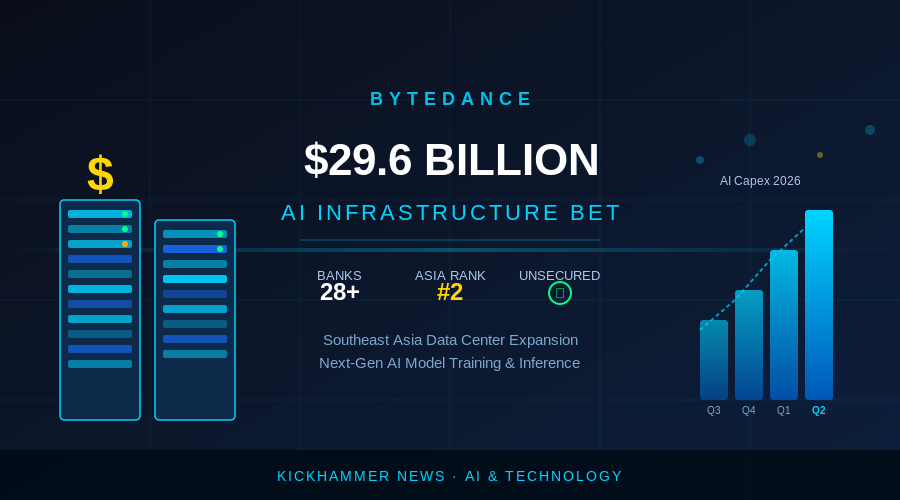
In a move that stunned even the most seasoned observers of the AI financing landscape, ByteDance — the Chinese tech giant behind TikTok, CapCut, and Doubao — has secured a staggering $29.6 billion syndicated loan from nearly 30 global banks. It is the second-largest USD-denominated borrowing in Asia this year, trailing only the $40 billion SoftBank raised in March to deepen its stake in OpenAI. But unlike SoftBank’s bet on a single company, ByteDance is betting on itself — and the scale of that wager is only growing more dramatic.
From $20 Billion to $29.6 Billion: Banks Cannot Say No Fast Enough
ByteDance initially approached markets with a $20 billion target. What happened next speaks volumes about how global finance views AI infrastructure right now: lenders oversubscribed the deal so quickly that ByteDance upsized to $29.6 billion without breaking a sweat. More than 28 banks joined the facility, including HSBC and the Industrial and Commercial Bank of China. Citigroup and JPMorgan led coordination efforts.
What makes the loan doubly remarkable is that it is entirely unsecured. ByteDance has put up no collateral. The banks are counting purely on the company’s reputation and earnings power. “It is very rare to see such a mega loan unsecured,” one source familiar with the matter told Reuters. “The banks practically are counting purely on ByteDance’s name.”
That name carries considerable weight. ByteDance was valued at approximately $550 billion as of early 2026, making it one of the most valuable private companies on the planet. The three-year loan — extendable to five years — carries an interest rate just 0.68 percentage points above benchmark, a favorable spread that reflects lender confidence in ByteDance’s long-term cash generation.
The Profit Paradox: Spending More, Earning Less
Here is the tension at the heart of ByteDance’s AI strategy: even as it commands billions in fresh capital, its core profitability is under real pressure. Reports emerged on September 16 that ByteDance’s first-half 2026 net profit fell to approximately $20 billion — a significant decline compared to recent periods — driven by surging AI investment and data center construction costs.
The company has signaled it may spend as much as $70 billion in 2026 alone on AI infrastructure, data centers, and related buildout. That figure eclipses the entire annual revenue of many of its tech peers. ByteDance is essentially running an aggressive growth-at-cost strategy, choosing to sacrifice near-term margins for what it hopes will be dominant positioning in the next era of AI-powered applications.
This is not a unique posture among the world’s largest tech companies in 2026. Meta, Microsoft, Google, and Amazon have all dramatically increased capital expenditure on AI infrastructure, often at the expense of short-term profitability. What distinguishes ByteDance is the sheer speed and scale of the commitment — and the geopolitical complexity layered on top of it.
Southeast Asia Is the Frontline
The $29.6 billion loan is earmarked specifically for projects outside China. ByteDance has pledged to purchase capacity at data centers across Southeast Asia, a region that has emerged as a critical battleground for AI infrastructure investment. The rationale is partly strategic and partly pragmatic.
Strategically, ByteDance needs to establish a credible AI footprint outside China to serve its hundreds of millions of global users — including TikTok’s enormous international audience — without routing sensitive data through mainland Chinese infrastructure. Regulators in Europe, the United States, and parts of Southeast Asia have all scrutinized ByteDance’s data practices, and building local compute capacity is one way to address those concerns proactively.
Practically, Southeast Asia offers a combination of growing energy infrastructure, relatively favorable regulatory environments, and enormous young populations hungry for AI-driven apps. Countries like Singapore, Malaysia, Indonesia, and Thailand are actively courting AI investment with tax incentives and streamlined permitting for data center construction.
“ByteDance is competing with local hyperscalers on AI data centers and with global hyperscalers on multimodal AI model,” noted Lian Jye Su, chief analyst at research firm Omdia. That two-front competition — against regional players for physical infrastructure and against OpenAI, Google, and Anthropic for model dominance — is precisely what makes ByteDance’s situation both bold and precarious.
Doubao and the Race for AI Model Leadership
ByteDance is not merely building pipes — it is training serious models. The company’s Doubao AI assistant has racked up hundreds of millions of users in China and is rapidly expanding internationally. ByteDance has invested heavily in its own large language model research, and the loan is expected to fund next-generation training runs and inference infrastructure at a scale that could allow it to compete with frontier models from the West.
In China’s intensely competitive AI landscape, ByteDance faces domestic rivals including Alibaba’s Qwen, which recently surpassed three billion downloads for its open-source models, Baidu’s ERNIE, and a host of well-funded startups. On the global stage, it is one of the few non-American companies with the resources and distribution to plausibly challenge OpenAI’s market position — though that challenge remains more aspiration than current reality.
The timing of ByteDance’s loan is also notable: it was secured just weeks after US intelligence agencies — the NSA, FBI, and CISA — issued a joint advisory accusing several Chinese AI companies of conducting “industrial-scale model distillation,” effectively extracting capabilities from advanced American models at enormous scale. ByteDance was not among the companies named in that particular advisory, but the geopolitical environment surrounding Chinese AI investment has never been more fraught.
What $29.6 Billion Actually Buys
To put this number in perspective, $29.6 billion is roughly equal to the total venture capital invested in AI startups globally during all of 2023. It could fund approximately 60 new state-of-the-art AI training clusters at today’s prices. It is enough to build two or three hyperscale data center campuses of the kind that currently host the world’s most powerful AI systems.
For ByteDance, it represents a calculated wager that the AI infrastructure built over the next 24 to 36 months will determine the competitive landscape for a decade. The company is betting that being late — or under-built — is more existential than being over-leveraged.
Whether that bet pays off depends on several variables that no balance sheet can capture: whether ByteDance’s AI models prove compelling enough to retain users against fierce competition, whether regulators in key markets continue to permit the company to operate, and whether the global AI investment bubble sustains itself long enough for these data centers to generate meaningful returns.
The Bigger Picture
ByteDance’s $29.6 billion move is a data point in a pattern that has defined 2026: the AI infrastructure spending race has become self-reinforcing. Each new mega-investment announcement from a large player puts pressure on rivals to match it. SoftBank’s $40 billion OpenAI bet raised the ante. ByteDance’s loan raises it further.
The question hanging over all of it is whether the world can actually absorb this much compute — and whether the models trained on it will generate the revenue needed to justify the financing. ByteDance’s falling profits suggest the near-term math is uncomfortable. But if Doubao and the company’s other AI products can achieve meaningful monetization at scale, the long-term arithmetic might look very different.
For now, ByteDance has made its position unmistakably clear: it is all in on AI, and it expects the global banking system to fund the bet. So far, 28 banks have obliged.
Sources: Reuters, PYMNTS.com, TechNode, Omdia Research


