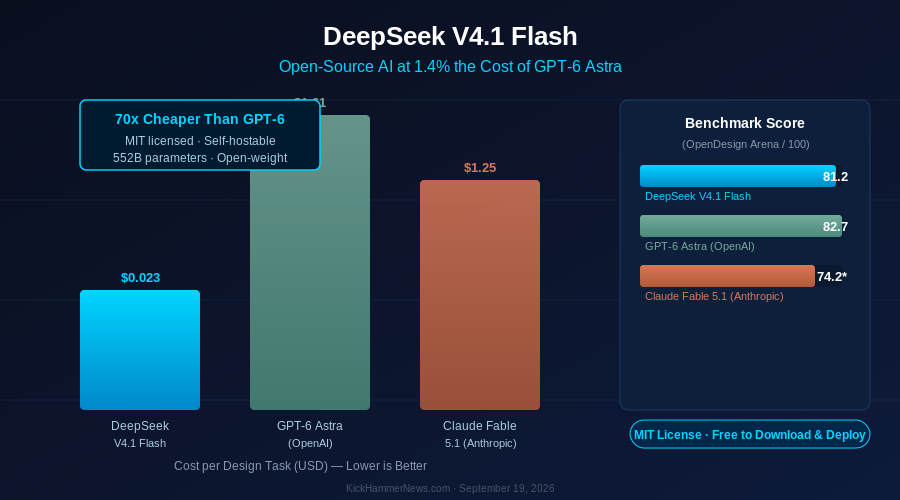
In a move that is shaking the foundations of the premium AI model industry, DeepSeek’s latest open-weight model — V4.1 Flash — is delivering benchmark scores that rival or beat the most expensive frontier models on the market, at a fraction of the price. Released in early September 2026, the 552-billion-parameter model is licensed under the MIT license and can be downloaded and run on your own hardware — making it not just a pricing disruption but an architecture one too.
The Numbers That Are Turning Heads
The cost comparison is jarring. GPT-6 Astra and Claude Fable 5.1 both charge $10 per million input tokens and $50 per million output tokens — pricing typical of top-tier frontier models. DeepSeek V4.1 Flash sits at $0.15 per million input tokens and $0.60 per million output tokens in off-peak hours. At peak pricing, that’s $0.30 input / $1.20 output — still dramatically cheaper than either closed model.
In a real-world design benchmark called OpenDesign Arena, V4.1 Flash scored 81.2 out of 100 compared with 82.7 for GPT-6 Astra. The cost per finished design? $0.023 for DeepSeek against $1.61 for GPT-6 Astra. That is approximately 1.4 percent of OpenAI’s premium model, for near-identical output quality.
Beating the Giants on Agentic Tasks
Perhaps even more striking than cost is V4.1 Flash’s performance on agentic coding and automation benchmarks — the frontier tasks that enterprise AI buyers care about most. On the DeepSWE v1.1 benchmark, V4.1 Flash scored 74.2, compared with OpenAI GPT-5.6 Sol at 73.0 and Google Gemini 3.8 Flash in the same range. On AutomationBench, it posted 54.8 against Sol’s 45.8 — a lead of almost ten points. On Agent’s Last Exam, it scored 31.8 versus Sol’s 26.7, and on the CyberGym benchmark it clocked 88.1 against 84.5.
These are not marginal improvements. For organizations running AI agent fleets at scale — where millions of tokens flow through inference pipelines every day — the cost differential is not academic. A company spending $1 million per month on frontier model inference could, in theory, achieve comparable or better agentic task completion for $14,000 per month using DeepSeek V4.1 Flash.
A Pattern China Has Repeated
This is not the first time DeepSeek has sent shockwaves through Silicon Valley. In early 2025, the release of DeepSeek R1 — a reasoning model trained for a fraction of what comparable OpenAI models cost — triggered a market selloff in AI-adjacent stocks and forced a rethink of assumptions about the cost of frontier AI. V4.1 Flash is the continuation of that trend: a Chinese lab, backed by the quantitative trading firm High-Flyer Capital Management, systematically closing the gap with American AI labs while operating under vastly different cost and regulatory constraints.
The model is open-weight under an MIT license, meaning developers can download, fine-tune, and deploy it without licensing fees. This is a stark contrast to GPT-6 Astra and Claude Fable 5.1, which exist only as API products. For enterprise teams or government agencies that need to run inference on-premises for security or compliance reasons, V4.1 Flash is currently the only frontier-quality option with that flexibility.
Where the Closed Models Still Win
V4.1 Flash is not universally superior. On the most demanding reasoning tasks and multi-step planning benchmarks, GPT-6 Astra and Claude Fable 5.1 maintain meaningful edges. Anthropic’s Mythos 5.1 variant — the safeguard-tuned version of Fable released specifically for vetted enterprise and government clients — retains leads on safety and reliability benchmarks that open-weight models have historically struggled with.
OpenAI’s GPT-6 Astra also benefits from deep integrations across Microsoft 365 Copilot, Azure AI, and developer toolchains built up over years. For enterprises already embedded in that ecosystem, switching inference providers carries hidden costs that a raw price-per-token comparison can’t capture. Similarly, Google DeepMind’s Gemini 3.8 Flash Cyber variant — a cybersecurity-tuned model released alongside the standard Flash — targets security operations use cases that require specialized post-training that open-weight models may not replicate.
But for the majority of enterprise AI workloads that don’t require the last few percentage points of benchmark performance, the value proposition of V4.1 Flash is hard to argue with.
The Business Implications Are Enormous
The AI industry has spent the past two years racing to demonstrate capability: who has the highest scores on MMLU, who passes the Bar exam, who can write better code. V4.1 Flash signals that a second phase of competition has arrived — one defined not by raw capability but by cost per capability unit.
For startups and smaller enterprises that have been priced out of heavy frontier model usage, this changes the calculus significantly. AI-powered products that previously required $50,000 per month in inference costs to run viably could now be rebuilt around V4.1 Flash for under $1,000. That has downstream implications for the entire AI application layer.
It also creates pressure on OpenAI and Anthropic to respond — either through their own price cuts, the release of smaller efficient models, or by accelerating the performance gap with their next flagship releases. OpenAI already offers tiered access including its earlier GPT-5.6 Sol at lower price points; Anthropic has Claude Haiku 4.5 for cost-sensitive use cases. But neither currently offers a sub-$1 per million token option that matches the agentic performance V4.1 Flash delivers.
What Comes Next
DeepSeek’s roadmap has not been publicly announced, but the pattern of releases suggests V4.1 Pro — a full-size, presumably more capable variant — may follow in the months ahead, as the company has done with previous model generations. If the Pro variant maintains similar cost advantages at even higher benchmark levels, the pressure on the closed frontier labs will intensify further.
For now, V4.1 Flash stands as the clearest evidence yet that the economics of frontier AI are not as stable as they might appear. The gap between what the best open-weight models can deliver and what the premium closed models offer is narrowing faster than most analysts predicted.
In the AI industry’s race for dominance, DeepSeek has once again changed the scoreboard.


