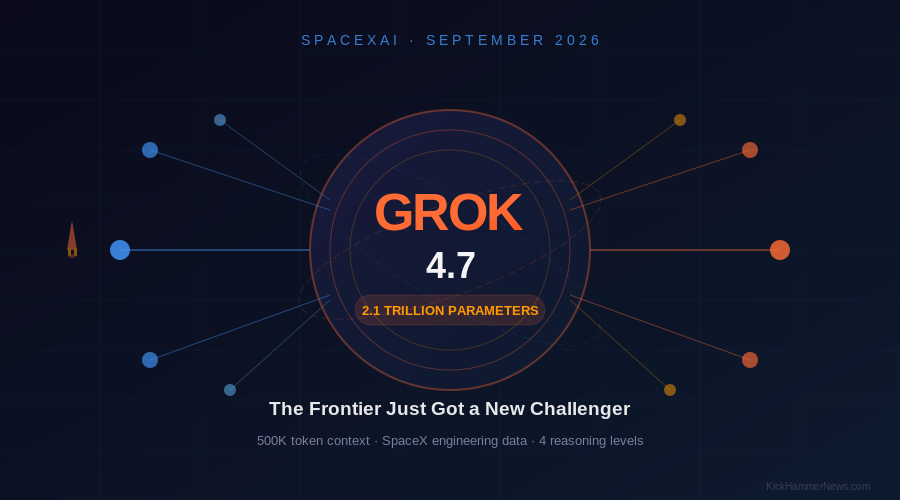
The AI model race got a new contender yesterday when xAI — the artificial intelligence company now operating under the SpaceXAI brand — launched Grok 4.7, its most powerful model to date. With 2.1 trillion parameters, a 500,000-token context window, and a unique training dataset drawn from SpaceX’s own engineering operations, the new model represents a significant upgrade from its predecessor and a bold challenge to Anthropic’s Claude Fable 5.1 and OpenAI’s GPT-6 Astra.
A Monster Under the Hood
The headline number is staggering: 2.1 trillion parameters, a 40 percent jump over Grok 4.6’s already formidable 1.5 trillion. To put that in context, that’s roughly double the estimated parameter count of GPT-5.6 Sol when it launched earlier this year. xAI is betting that raw scale — combined with improved training techniques — can close the benchmark gap that has separated Grok from the top two competitors.
The context window expansion is equally notable. Grok 4.7 can now hold up to 500,000 tokens in a single conversation, up from 256,000 in Grok 4.6. For developers working on large codebases, lawyers parsing lengthy contracts, or researchers sifting through scientific literature, that doubling of working memory opens up use cases that were simply impractical with earlier models.
Thinking Harder, Checking Twice
Beyond sheer size, xAI has restructured how Grok 4.7 approaches difficult problems. The model ships with four reasoning modes — low, medium, high, and xhigh — allowing users to dial up or down how long the model spends deliberating before responding.
At the xhigh setting, Grok 4.7 is designed to systematically verify its own outputs before delivering an answer, much like Claude Fable 5.1’s signed “extended thinking” blocks. Early testers reported that the approach pays dividends on multi-step math, adversarial logic puzzles, and complex debugging scenarios where previous Grok versions would confidently produce plausible-but-wrong answers.
“It spends longer working through hard problems and double-checks its own answers more often than Grok 4.6 did,” xAI said in a post on the Grok developer blog. The claim maps to observable behavior in early benchmarks, where Grok 4.7 shows the sharpest gains on tasks with long reasoning chains and formal verification requirements.
The SpaceX Data Advantage
The most distinctive element of Grok 4.7’s training story is where xAI drew supplemental data from: SpaceX itself. The company says the new model ingested Starlink satellite telemetry, manufacturing records, and engineering failure logs from Musk’s rocket company — data that has never appeared in any public dataset.
The pitch is straightforward: a model trained partly on real-world hardware engineering records should reason better about physical systems than one trained purely on internet text. That means Grok 4.7 may have a genuine edge for aerospace engineers, hardware designers, and anyone working at the intersection of software and physical infrastructure.
Whether that edge holds up in independent evaluations remains to be seen. xAI has not published full benchmark comparisons against Claude Fable 5.1 or GPT-6 Astra, and the company’s tendency toward self-reported metrics has drawn skepticism from independent researchers. But the concept is sound: domain-specific training data does improve performance on domain-specific tasks, and SpaceX’s engineering corpus is about as domain-specific — and exclusive — as it gets.
Pricing Holds Steady
Despite the larger model and added capabilities, xAI kept pricing flat at $2 per million input tokens and $6 per million output tokens — identical to Grok 4.6. That puts Grok 4.7 well below Claude Fable 5.1 and GPT-6 Astra, both priced at $10/$50 per million tokens.
For cost-sensitive enterprise buyers, the math is attractive. If Grok 4.7’s performance on their specific workloads comes within acceptable range of the pricier alternatives, the five-fold cost difference becomes hard to ignore. xAI is clearly targeting the price-conscious enterprise segment rather than going head-to-head with Anthropic and OpenAI on raw benchmark supremacy.
Availability and Ecosystem
Grok 4.7 launched on September 21 and is available immediately through the Grok API, in Cursor (the AI-native code editor that SpaceXAI partially controls following its June acquisition), in Grok Build (xAI’s own agentic coding environment), and across major model routers and cloud platforms including Amazon Web Services.
The Cursor integration is particularly strategic. Cursor has become one of the most popular tools for AI-assisted software development, and embedding Grok 4.7 as a first-class option within it gives xAI access to a large population of professional developers who are already sold on the value of AI coding assistance. Competing for developer mindshare through distribution partnerships — rather than fighting purely on benchmark leaderboards — is a smart play for a company still building its third-party credibility.
How It Stacks Up Against the Field
The frontier model landscape in late September 2026 has never been more competitive. Anthropic’s Claude Fable 5.1 currently sits atop most independent reasoning benchmarks with a score of 84.7 on BenchLM’s composite index; GPT-6 Astra follows at 82.8; and the recently released StepFun Step 5 and Shanghai AI Lab’s Atria Dawn are both attracting attention from the open-weight community.
Where Grok 4.7 lands in those rankings will depend on independent evals that xAI’s launch timeline hasn’t yet allowed. The model is too new for any neutral third-party benchmarking service to have published comprehensive results. Based on xAI’s internal numbers, Grok 4.7 shows “significant improvements” on coding, knowledge work, and hardware reasoning — but the company stopped short of specific comparative claims against Fable 5.1 or Astra.
Safety Claims, With Caveats
xAI says Grok 4.7 ships with its “strongest safety guardrails yet.” The company offered few specifics about what changed, pointing users to a system card that promises more detail. Given Grok’s historical reputation for fewer content restrictions than Claude or ChatGPT, the safety improvements are likely more about reducing factual errors and harmful outputs than about alignment with constitutional AI principles.
Critics note that xAI has not participated in the AI Safety Standards Body that Anthropic, OpenAI, and Google formed earlier this month — a voluntary industry group meant to align safety evaluation practices ahead of expected congressional action. The company’s absence from that body, combined with its tight integration with Elon Musk’s industrial interests, continues to raise questions about whose values the model is ultimately optimized for.
What Comes Next
xAI has not announced a timeline for Grok 5, but the cadence of recent releases — 4.5 in July, 4.6 in August, 4.7 now — suggests the team is shipping on an approximately monthly cycle. At that pace, and with the parameter scale already at 2.1 trillion, the next major question is whether xAI will pursue further scale or pivot toward efficiency, following the trend set by DeepSeek V4.1 Flash and Google’s Gemini 3.8 series.
For enterprise buyers evaluating AI vendors right now, Grok 4.7 is worth a serious look — especially if your workloads touch hardware engineering, physical systems, or large-scale code analysis where the SpaceX training data might carry real weight. But with Claude Fable 5.1 still leading independent benchmarks and GPT-6 Astra close behind, xAI has more proving to do before Grok 4.7 displaces the current top tier.
The announcement, at least, confirms one thing: the frontier AI race is accelerating rather than consolidating, and no single company has yet run away with the competition.
Sources: xAI Grok 4.7 Launch – Unite.AI, Grok 4.7 Benchmarks – iWeaver, xAI Launches Grok 4.7 – Yahoo Finance Tech, Best Reasoning AI Models September 2026 – BenchLM


