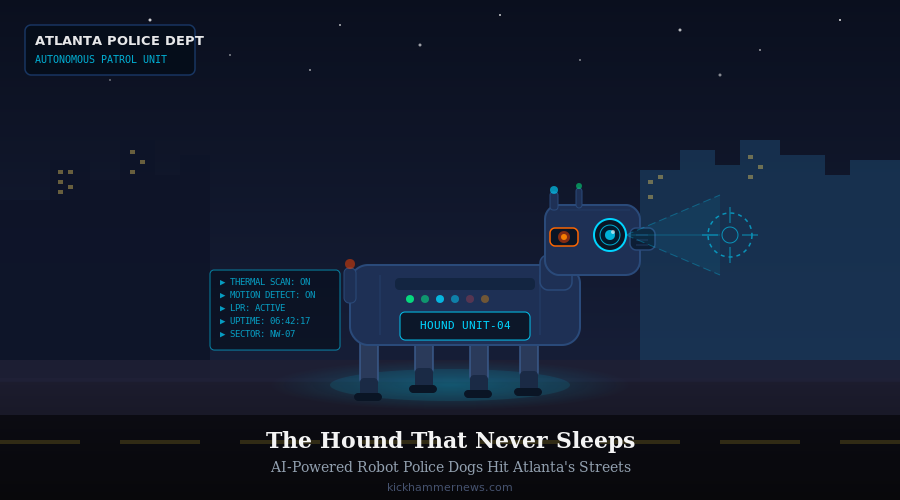
They don’t get tired. They don’t ask for overtime. They don’t demand a union contract or a pension. They are waterproof, thermal-capable, and capable of reading a license plate at 50 feet in total darkness. And starting this spring, they have been patrolling the apartment complexes, parking lots, and construction sites of Atlanta, Georgia — named not by their manufacturer, but by the city’s own police department: Hound Units.
The Atlanta Police Department’s deployment of AI-powered quadruped robots, developed by autonomous security firm Undaunted in partnership with Atlanta-based Cobalt Robotics, marks one of the most visible expansions of robotic surveillance into everyday American public life. And in a country where federal law has nothing specific to say about robot police, the rollout has sparked a collision between law enforcement optimism and civil liberties alarm that’s being watched closely by departments — and advocacy groups — across the nation.
What a Hound Unit Can Do
A Hound Unit looks like what it sounds like: a dog-shaped robot about the size of a large German Shepherd, capable of navigating stairs, uneven terrain, and tight spaces without human guidance. Each unit comes equipped with high-definition cameras providing 360-degree video streaming to remote operators, advanced object recognition software capable of identifying individuals, vehicles, and suspicious packages, thermal imaging sensors for operation in complete darkness, and built-in lights, sirens, and speakers allowing officers to issue commands or warnings from a distance.
The units operate 24 hours a day, 7 days a week, following predetermined patrol routes that can be updated remotely. Unlike a human officer walking a beat, a Hound Unit generates continuous footage that is logged and retrievable — every second of every shift, indefinitely.
Atlanta Police Chief Mark Callahan was direct about the department’s motivations when the deployment was announced in April. “These robot dogs will help us keep our streets safe and deter criminal activity in a more efficient, cost-effective way,” he said.
What he didn’t mention was the price tag — units comparable to the Hound specifications from other manufacturers run $100,000 to $250,000 fully equipped. Or the fact that no federal framework currently governs how the footage those units collect can be stored, accessed, or shared.
The Nation’s Largest Robot Police Trend
Atlanta’s deployment didn’t happen in a vacuum. By the time the Hound Units hit Atlanta’s streets, over 60 bomb squads and SWAT teams across the United States and Canada had already integrated robotic quadruped units into their operations. Boston Dynamics’ Spot robot — the closest commercial equivalent — counts roughly 2,000 units in active global deployment across sectors ranging from industrial inspection to military logistics.
Cities like Houston, Las Vegas, and New York City have fielded Spot units in policing contexts, with the NYPD’s deployment drawing particular scrutiny in 2021 — heavy enough public backlash that the department temporarily suspended the program before quietly reinstating it. Massachusetts State Police have operated two units in active service for years without significant public incident.
And beyond the United States, the template is spreading. In March 2026, Venezuela deployed AI-equipped robot dogs for street patrols in Caracas — a deployment that drew swift international condemnation from human rights organizations who warned that authoritarian governments would find robotic surveillance irresistible precisely because the machines lack the human hesitations that sometimes constrain police misconduct.
Atlanta’s rollout is different in degree, not in kind. But it comes at a moment when the expansion has gone visible, viral, and urban in a way prior deployments never did.
The Viral Wag
One of the first signs that Atlanta’s Hound Units had captured public attention came not from a police incident but from a social media clip: a Hound Unit on patrol, apparently responding to a passing driver’s horn honk, moving its mechanical head and appearing to “wave.” The video accumulated millions of views within 48 hours. The comment sections split predictably — half charmed, half horrified.
That reaction encapsulates the design problem civil libertarians have been warning about for years. Giving a surveillance platform the aesthetic language of a pet is not an accident. It is, critics argue, a calculated strategy to normalize something that should be treated as infrastructure — as a piece of always-on surveillance equipment collecting biometric and behavioral data about everyone who passes within range, regardless of whether they are a suspect, a witness, or simply a resident going about their morning.
“One of the things we are wary of is the normalization,” said Beryl Lipton of the Electronic Frontier Foundation, speaking about robot dog deployments broadly. “Calling it a dog normalizes that for the public when it’s not actually a dog.”
Samantha Nguyen of the ACLU of Georgia was more pointed about the Atlanta deployment specifically. “Unleashing autonomous machines with the power to surveil and command citizens is a dangerous path toward a dystopian future,” she said in a statement. The ACLU has called on the Atlanta City Council to establish a civilian oversight process before the program expands further.
The Regulatory Vacuum
Here is where Atlanta’s Hound Units represent something more than a local story about one city’s policing strategy: there are no federal regulations specifically governing the deployment of robotic units in law enforcement. None.
Boston Dynamics requires buyers to disclose their intended use cases for Spot. But the company cannot, as a legal matter, control what happens after a unit is purchased and deployed. The Hound Units are a proprietary product from Undaunted and Cobalt Robotics — companies not bound even by those disclosure guidelines.
There is no federal law mandating transparency about what footage is collected, how long it is retained, who can access it, or what machine-learning algorithms are being run against it. There is no law requiring cities to notify residents before robotic surveillance is introduced into their neighborhoods. There is no law establishing a baseline for public comment or council approval before a police department can stand up a robot patrol program.
This is not an oversight — it is a gap. Congress’s Civilian Oversight of Police Systems Act, first introduced in 2021, has never passed. The Great American AI Act of 2026 addresses AI systems broadly but has no specific provisions covering law enforcement robotics. New York City’s sweeping 10-bill AI package — introduced by Council Speaker Julie Menin in September 2026 and widely watched as a potential national template — includes mandatory kill switches and third-party audits for AI systems, but focuses primarily on municipal agency AI rather than physical robotic deployments in the field.
What Comes Next
Atlanta’s police department has confirmed expansion plans for the Hound Unit program. Which neighborhoods, what timeline, and on what criteria the expansion will be decided remain unspecified.
Ryan Calo, a robotics law professor at the University of Washington, has argued that the stakes go beyond privacy. “The overuse of robotics in policing will further dehumanize police to the public and break down those community ties,” he wrote. The concern is not only surveillance — it is the slow erosion of the human texture of community policing, replaced by a 24/7 machine that logs everything and forgets nothing.
The Hound Units of Atlanta are not, by any objective measure, the most sophisticated robotic surveillance systems in active deployment. They are not armed. They are not yet fully autonomous — a human operator remains in the loop for any direct intervention. They are, in many ways, a first generation product.
That is exactly why they matter. First generations establish templates. They set the tolerance. They normalize the presence of things that, once normalized, expand.
The next city that rolls out a robot police dog program will not face the questions Atlanta is facing now. It will point to Atlanta and say: this is already how things work.
That may be the most consequential thing the Hound Units do — not what they see, but what they make possible.
Sources: Newsweek, Governing, ACLU of Georgia, Electronic Frontier Foundation, Undaunted, Atlanta Police Department


