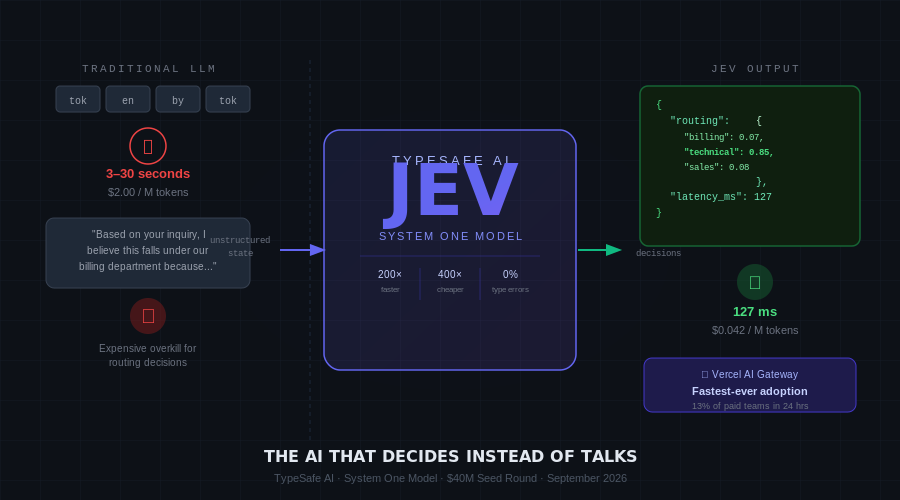
There is a moment in almost every AI agent workflow where the machine has to make a decision. Route this customer inquiry to billing or technical support? Is this generated output safe to send? Should this agent continue executing or escalate to a human? For two years, the industry answered these questions with the same tool it used to write sonnets: a large language model, burning tokens by the thousands and waiting seconds for an answer that should have taken milliseconds.
TypeSafe AI thinks that’s insane. And two weeks after launching Jev — a new class of model it calls a “System One” — the company has the adoption numbers to suggest it might be right.
A Model That Stops Talking and Starts Deciding
Jev doesn’t generate text. That’s the first thing to understand, and arguably the most important. While GPT-6 and Claude Opus 5 are busy composing sentences one token at a time, Jev takes a piece of unstructured program state — a customer email, an agent’s action log, a JSON object — and returns typed, probabilistic decisions in a single parallel pass. Not a paragraph. Not a summary. An answer.
Diogo Almeida, TypeSafe’s CEO and a former OpenAI researcher who worked on the instruction-following methods underlying ChatGPT, describes it as “unstructured state in, typed probabilistic decisions out.” Developers define what questions they want Jev to answer using three types: Choice (selecting from a fixed list of options), Score (rating state on an ordered scale), and Noul (evaluating a yes/no statement). Jev responds with structured JSON containing a probability for every possible answer — not a made-up story about why it chose the answer, just the answer, with numbers attached.
A routing decision that previously cost a developer an LLM call — 3 to 30 seconds of latency, $2.00 per million tokens or more — now takes 70 to 500 milliseconds and $0.042 per million input tokens. Output is free.
Why the Industry Named This “System One”
TypeSafe borrowed the term from Daniel Kahneman’s famous cognitive psychology framework, which distinguishes between System 1 thinking (fast, automatic, reactive) and System 2 thinking (slow, deliberate, analytical). For years, AI development has concentrated almost entirely on building better System 2: models that reason through problems step by step, weigh evidence, and produce nuanced explanations.
Jev is a bet that much of what enterprises actually need from AI is System 1: fast, cheap pattern recognition that routes work to the right place, checks that an action is safe before executing it, and determines whether a document belongs in billing or compliance. Tasks where generating a sentence is not only unnecessary — it’s the expensive part.
The model was trained entirely on synthetic data using a method TypeSafe calls Reinforcement Learning for Calibrated Decisions (RLCD), distinct from the RLHF approach used by frontier language models. Because outputs are constrained to predefined schemas, the company says Jev achieves a 0% structured output error rate — it is mathematically impossible for the model to return a value that doesn’t fit the declared type. That’s the basis of TypeSafe’s “hallucination-free” claim, though independent observers are quick to note the distinction: structured outputs can still be wrong, just not wrong in the way that language models sometimes fabricate citations or invent facts.
The Doom Demo and the Numbers Behind It
TypeSafe demonstrated Jev’s real-time decision-making capabilities with an unusual showcase: feeding it live game state from the classic first-person shooter Doom and having it make moment-to-moment decisions. The stunt was deliberate — it illustrated how the model could operate in latency-sensitive, dynamic environments that frontier LLMs would simply fail to serve. It also got people to pay attention.
The benchmark numbers are harder to ignore. On TypeSafe’s internal test suite spanning four enterprise workflows, Jev matched GPT-5.6 Terra’s decision accuracy (67.8% versus 67.9%) while costing approximately 1/76th as much per decision. The company’s peak comparisons are more dramatic — up to 193.6 times faster, 444.6 times cheaper — though TypeSafe acknowledges these represent high-end scenarios from internally designed workflows, and independent benchmarks remain limited.
What isn’t in dispute is the adoption curve. Jev launched to limited early access on September 15 on Vercel’s AI Gateway, backed by a $40 million seed round led by DCVC that valued the company at $200 million. Within 24 hours, nearly 13% of Vercel’s paid teams were using it — more than double the adoption rate of any previous model launch, including the GPT-5.6 family. Vercel called it “the fastest-adopted model in AI Gateway history.” Within three days, Cloudflare, LangChain, and Langfuse had all added integration support.
What Jev Actually Does in the Wild
The clearest enterprise use case is agent workflow routing. Modern AI agents make dozens of calls per task — and the vast majority of those calls are not “write me a cover letter” problems. They are classification and decision problems: Is this tool the right one? Has this output met quality thresholds? Does this action need human review? Until now, those decisions were either hardcoded as rules (brittle, requiring constant maintenance) or outsourced to frontier LLMs (expensive, slow). Jev introduces a third option: a cheap, fast specialized model trained for exactly this kind of judgment.
Enterprise security and compliance teams have shown particular interest in Jev’s ability to serve as a “decision gate” inside agentic AI: a verification layer that checks agent actions against safety criteria before they execute, running at speeds that don’t break the latency budget of real-time workflows. The model’s calibrated confidence scores are especially useful here — rather than a binary pass/fail, developers receive a probability that an action falls within acceptable bounds, enabling nuanced risk-based routing.
Customer support automation is another natural fit. Instead of sending every incoming ticket through a full LLM to route it, a company can run Jev on the raw message, get a routing decision in under 500 milliseconds with a confidence score, and invoke an LLM only for the cases where Jev’s confidence falls below a threshold. The LLM becomes a fallback for ambiguous cases rather than a first-pass processor for everything.
The Unanswered Questions
Jev is not without its skeptics, and some of the criticism is substantial. TypeSafe has declined to disclose Jev’s underlying architecture or publish its weights, which has led independent observers to speculate that the model may be built on top of open-weight LLMs rather than trained from scratch — a meaningful distinction for customers with data sovereignty concerns. The company’s hosted-only model also raises questions for regulated industries: there is no published SLA, no on-premises option, and no guaranteed availability timeline.
The “hallucination-free” framing, while technically accurate, has been called misleading. When a language model hallucinates, it generates confident text about things that aren’t true. When Jev makes a wrong classification, it still assigns the highest probability to the wrong answer. The structured output format reduces a certain class of errors entirely, but it doesn’t guarantee correctness — it guarantees type safety. That’s a valuable property. It’s not the same property being implied.
There are also capability ceilings. Jev cannot reason about arithmetic, handle large option sets reliably, or make decisions that require understanding temporal relationships or date logic. It processes text only — no images, audio, or multimodal input. And the model produces probabilities without language-based justification, which creates audit trail problems for regulated industries where decisions must be explainable in human terms.
The Bigger Picture
What TypeSafe has actually introduced is a fourth option in the enterprise AI decision stack. For two years, architects had three tools: hardcoded rules, traditional ML classifiers, and LLMs. Rules are fast but brittle. Traditional ML is fast and robust but requires labeled training data and retraining cycles. LLMs are flexible and powerful but expensive and slow for operational decisions.
System One models like Jev occupy a new category: flexible like LLMs (handling unstructured input, adapting to new decision criteria without retraining), fast like rules (sub-second decisions), and cheap enough to run on every agent action rather than only the high-value ones.
Whether TypeSafe can sustain this position is a separate question. The company is tiny, the architecture is undisclosed, and the AI industry’s largest players are not historically shy about replicating features that prove useful. OpenAI, Anthropic, and Google all have structured output capabilities in their existing models, and the gap Jev exploits — cost and latency on narrow decision tasks — could narrow as inference costs continue to fall.
But for now, the fastest-adopted model launch in Vercel’s history belongs to a two-year-old startup nobody had heard of six months ago, with a model that doesn’t say a single word.
Sometimes the most important thing an AI can do is stop talking and make a decision.
TypeSafe AI’s Jev is available via early access on Vercel AI Gateway, Cloudflare, LangChain, and the TypeSafe API. Pricing: $0.042 per million input tokens; output is free. The company raised a $40 million seed round in September 2026 led by DCVC.


