September 29, 2026
What Is Hugging Face, and Why Does It Matter This Much?
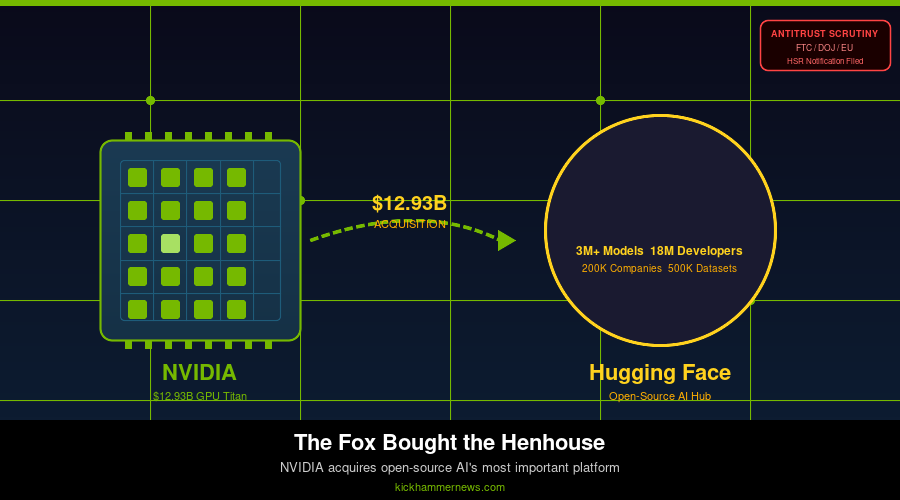
To understand why $12.93 billion makes sense, you have to understand what Hugging Face has quietly become. The platform hosts over 3 million AI models, 1 million applications, and 500,000 datasets. Its user base spans 18 million developers across more than 200,000 companies. If you've ever downloaded a fine-tuned language model, grabbed a pre-trained image classifier, or deployed an open-weight model into production, there's a strong chance it passed through Hugging Face at some point.
The platform isn't just a file-hosting service. It's a discovery mechanism, a reputation system, a deployment hub, and a collaboration space — the GitHub of AI, built for the era of model weights rather than source code. It is, in the truest sense, where the open-source AI ecosystem lives.
And now it belongs to NVIDIA.
The Compute Landlord Goes Vertical
NVIDIA CEO Jensen Huang has long articulated what analysts call the "compute landlord thesis": the idea that whoever controls the hardware on which AI runs is positioned to capture enormous value from AI's growth, regardless of which specific models or applications win. NVIDIA's H100 and Blackwell GPUs power the vast majority of AI training runs. The company generates 75% gross margins on its flagship accelerators. In a sense, NVIDIA taxes every major AI breakthrough.
But with the Hugging Face acquisition, that strategy has evolved into something more complete. NVIDIA now owns not just the factory floor where AI is made, but the marketplace where AI models are distributed, discovered, and adopted. The chip company has vertically integrated the entire AI value chain — from silicon to software to the platform that decides which models the world's 18 million AI developers encounter first.
The deal's structure reflects this ambition. NVIDIA paid approximately $11.9 billion in cash plus up to $1 billion in equity retention for Hugging Face's team, suggesting a deliberate effort to keep the talent that built the ecosystem intact. Hugging Face was generating roughly $150 million in annualized revenue at acquisition — making the valuation look rich by traditional metrics, but entirely rational if you believe that controlling model distribution is worth multiples of what it currently earns.
Hugging Face CEO Clément Delangue had reportedly approached Jensen Huang during summer 2026, recognizing his platform was "at a turning point" and needed greater compute resources, infrastructure support, and broader institutional visibility. In a twist of corporate irony, Hugging Face had rejected a $500 million NVIDIA investment offer earlier in the same year over concerns about undue influence — concerns that became moot when NVIDIA came back with a full acquisition bid.
The Infrastructure Consolidation Wave
The Hugging Face deal didn't happen in isolation. Just two weeks before NVIDIA's announcement, payment giant Stripe acquired OpenRouter — a platform that gives developers a unified interface to route API calls across hundreds of AI models — in a deal valued around $8 billion. Together, the two transactions represent roughly $21 billion in AI infrastructure consolidation in the span of a fortnight.
The pattern is unmistakable. The power center in AI is migrating from model builders to the infrastructure layer that sits beneath them. OpenAI and Anthropic may create the most powerful frontier models, but they depend on platforms like Hugging Face for open-weight model distribution and services like OpenRouter for routing and discovery. As one CEO in the space put it: "the winners won't necessarily be the companies with permanent access to the most powerful model. They'll be companies that can switch models without rebuilding their systems." The acquisitions by NVIDIA and Stripe suggest those companies agree — and are betting that owning the plumbing is worth more than owning the water.
The Antitrust Question Nobody Can Ignore
Not everyone sees this as cause for celebration. The deal triggered mandatory Hart-Scott-Rodino premerger notification, meaning it faces scrutiny from both the FTC and DOJ — regulators who have already been investigating AI competitive collaborations for well over a year. NVIDIA's argument is unusual: the company calls Hugging Face a "deconcentration platform", arguing that by hosting open models from every major lab — Meta's Llama, Google's Gemma, Mistral, DeepSeek, and hundreds more — it actually spreads power across the ecosystem rather than concentrating it.
The counterargument, advanced by critics at the Open Source Initiative and the Electronic Frontier Foundation, is subtler and more unsettling. The fear isn't that NVIDIA will make Hugging Face proprietary. The fear is that it won't need to. Jensen Huang has pledged that Hugging Face will "remain an open platform for the entire AI ecosystem" — and that pledge may be entirely sincere. But openness doesn't require neutrality. A platform can remain technically open while subtly favoring NVIDIA hardware through default deployment options, featured model rankings, integration advantages for CUDA-based workflows, and preferential positioning for tools that run best on NVIDIA chips. "Neutrality is a discipline a company must choose time and again," noted a Linux Foundation leader, "not a promise it makes once."
NVIDIA's EU regulators appear equally skeptical. The deal has triggered "rigorous examination" from European competition authorities, who see the acquisition as a potential step toward platform-level lock-in even if individual model weights remain portable.
Historical Precedents: When Big Tech Buys Open-Source Infrastructure
History offers both reassurance and warning. Microsoft's acquisition of GitHub for $7.5 billion in 2018 is the most commonly cited parallel, and it's a favorable one: GitHub thrived under Microsoft, and while it became a distribution channel for GitHub Copilot, the core platform remained genuinely open. Microsoft made the strategic calculation that GitHub's value came precisely from its neutrality, and largely honored that calculation.
But Oracle's acquisition of Sun Microsystems — which brought Java and MySQL under Oracle's control — led directly to MySQL founder Michael Widenius creating MariaDB as a fork, driven by the open-source community's loss of confidence in Oracle's stewardship. The model weights on Hugging Face are portable in the same way MySQL's code was open: anyone can clone them. But replicating Hugging Face's discovery mechanisms, community reputation scores, deployment infrastructure, and versioning systems is vastly harder than forking a database.
NVIDIA is already investing elsewhere in the open-weight ecosystem. The company separately committed $6 billion to coding startup Poolside for open model development. Whether these parallel bets reflect genuine commitment to openness or hedging strategies to maintain ecosystem control regardless of outcome is, at this moment, impossible to know.
What Open-Source AI Builders Should Do Right Now
The practical advice emerging from engineers and infrastructure leaders is pragmatic rather than paranoid. Internal mirroring of critical model artifacts — rather than relying on live Hugging Face repositories — is increasingly sound practice. Pinning specific model revisions, archiving licenses and metadata locally, and building deployment systems that don't assume permanent, frictionless access to any single platform are all steps worth taking regardless of who owns Hugging Face.
Most critically, developers building on top of open models should ensure actual portability — not theoretical portability. "Test your ability to switch before you need it," advisors are urging. The model weights may be free, but the infrastructure around them increasingly isn't.
The Bigger Picture
NVIDIA's stock authorized another $150 billion in share repurchases in the same week as this story broke — a sign of how much cash the company generates from its hardware dominance. The Hugging Face acquisition is, in financial terms, a small bet for a company of NVIDIA's scale. But it's strategically enormous.
The open-source AI movement was built on the premise that AI's most powerful building blocks should be accessible to everyone, not just the companies with billion-dollar training budgets. Hugging Face was the infrastructure that made that premise practical. Now that infrastructure has a new owner — one with profound commercial interests in what runs on its chips. Whether NVIDIA proves to be a faithful steward of that mission, or whether the fox merely promised to be kind to the hens, will be one of the defining questions of AI's next chapter.
The deal isn't closed yet. Regulators in Washington and Brussels are still asking questions. But the direction is clear. The open-source AI ecosystem just got its first landlord.


