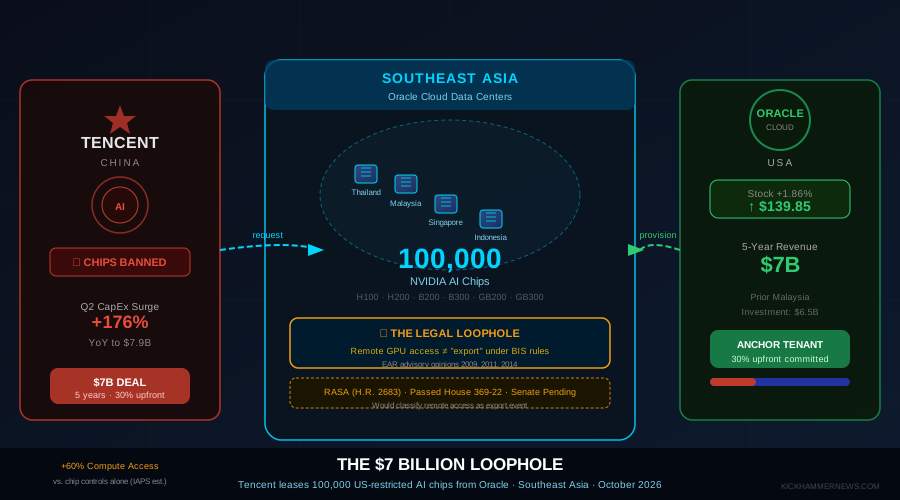
On paper, the United States has spent the better part of three years building a wall between China’s technology companies and the advanced AI semiconductors that power modern artificial intelligence. NVIDIA’s most powerful chips — the H100, H200, Blackwell B200, B300, GB200, and GB300 — are, in theory, off-limits to Chinese buyers. In practice, that wall has a door in it the size of a server farm.
On Wednesday, the Financial Times reported that Tencent has signed a five-year, $7 billion agreement with Oracle to lease access to approximately 100,000 of those advanced AI chips, housed in Oracle’s data centers across Southeast Asia. The chips will help Tencent train and run its Hunyuan AI models. The deal is entirely legal. And that, to critics in Washington, is exactly the problem.
The Loophole That Swallowed the Rule
The Bureau of Industry and Security — the Commerce Department division that administers U.S. export controls — has for decades defined an “export” as the physical movement of a controlled item across a border. A chip that travels from a California factory to Shanghai is an export. A chip that sits in a data center in Kuala Lumpur while a Tencent engineer in Shenzhen logs into it remotely is, under existing legal interpretation dating back to BIS advisory opinions from 2009, 2011, and 2014, not an export. The chips stay where they are. Only the compute crosses the border.
That distinction, which made sense in an era when remote computing meant spreadsheets and email, now enables a strategy that the Institute for AI Policy and Strategy estimates has boosted China’s effective compute access by at least 60 percent relative to chip controls alone. Chinese tech giants don’t need to buy what they can’t buy. They can rent it.
Tencent has been circling this arrangement for some time. Earlier this year, the company reportedly accessed roughly 15,000 of NVIDIA’s Blackwell processors through Datasection, a Japanese cloud provider with a facility near Osaka. ByteDance, the TikTok parent, is running 2,304 NVIDIA B200 GPUs through a Norwegian data center operated by UK cloud provider Nscale. Alibaba is funding Moonshot AI’s use of 20,000 Hopper-class chips through overseas infrastructure. INF Tech operates from Indonesian telecom facilities.
Wednesday’s announcement is simply the largest of these arrangements by a significant margin.
The Math Behind the Move
The scale of Tencent’s investment reflects how seriously it is treating the AI race. In the second quarter of 2026, the company’s capital expenditures surged 176 percent year-over-year to 52.8 billion yuan — roughly $7.9 billion — a figure so large it pushed free cash flow negative by 13.8 billion yuan. That’s an unusual position for a company of Tencent’s stature, and it signals that the investment in AI infrastructure is not discretionary.
The Oracle deal fits that pattern. At $7 billion over five years — with approximately 30 percent due upfront — Tencent is committing roughly $2.1 billion before it runs a single training job. But what it gets in return is immediate access to compute capacity that would otherwise take years to build domestically and cannot currently be purchased outright.
For Oracle, the arrangement is a windfall. The company has been aggressively expanding data center capacity across Southeast Asia, including a previously announced $6.5 billion investment in Malaysian infrastructure, and Tencent’s multi-year commitment provides exactly the kind of anchor customer deal that makes those capital outlays pencil out. Oracle shares climbed 1.86 percent in pre-market trading on the news.
Washington Moves — Slowly
The deal has not gone unnoticed in Washington, even if the response has arrived too late to affect this particular arrangement.
The Remote Access Security Act (RASA), which would amend U.S. export law to treat offshore compute leasing as a regulated export event, passed the House 369-22 in January 2026. It is still pending Senate action. A Senate companion bill (S. 3519) exists but defines “remote access” more narrowly — covering Infrastructure-as-a-Service specifically, rather than the broader Software-as-a-Service category that the House version would capture.
A separate measure, the Cloud Security Act introduced by Representatives Josh Gottheimer and John Moolenaar in June 2026, takes a softer approach: rather than banning arrangements like Tencent’s outright, it gives U.S. cloud providers legal clearance to voluntarily report suspected misuse by customers linked to U.S. adversaries — solving a different problem, namely that current law restricts companies from disclosing customer information to government agencies even on national security grounds.
A third bill, the Chip Security Act (H.R. 3447), would mandate embedded location-verification hardware directly in advanced chips, making it physically impossible to use them in unauthorized jurisdictions regardless of what legal category the transaction falls into. That measure passed committee but has not received a full House floor vote.
None of these bills is law. BIS has announced that its enforcement division is conducting “a systematic review of legal channels” for compute access — examining transactions companies believed were fully compliant. The phrasing matters: BIS is now asking whether technical legal compliance is, in fact, a complete legal defense.
Two Tracks, One Race
What makes the Tencent-Oracle deal notable is not that it exploits a loophole — that has been established practice for months — but its scale, its visibility, and what it reveals about China’s dual-track AI strategy.
Chinese companies are pursuing overseas compute aggressively precisely because they are simultaneously investing in domestic alternatives. Tencent, Alibaba, Baidu, Huawei, and others are all funding development of proprietary AI accelerators that would eventually reduce dependence on NVIDIA hardware. But those efforts take time — often years — and the AI race is not waiting. Overseas leasing fills the gap.
The strategy is rational, legal under current rules, and potentially temporary. If RASA passes the Senate and the Chip Security Act becomes law, the architecture of these arrangements could be disrupted. If they don’t, the gap between what export controls promise and what they deliver will continue to widen.
“Providing a foreign customer remote access to a GPU sitting in your data center is not legally an ‘export’ of that GPU,” one policy analyst told TechTimes in August. The Bureau of Industry and Security is now deciding whether it agrees.
What Comes Next
The immediate effects are clear: Tencent gains a significant boost in compute capacity, Oracle gains a $7 billion revenue commitment, and Southeast Asia’s data center ecosystem gains further confirmation that it has become a critical node in the global AI infrastructure map.
The longer-term implications are harder to map. If BIS recharacterizes overseas compute leasing as a regulated export event through guidance rather than waiting for legislation, it could retroactively expose existing arrangements to enforcement action. That would create significant legal uncertainty for Oracle, Microsoft Azure, Amazon Web Services, and other U.S. cloud providers who have similar customers in their tenant lists.
What is clear is that the semiconductor controls that form the backbone of U.S. AI competitiveness strategy were designed for a different era of computing — one in which owning a chip and using a chip were the same thing. In 2026, they are not. And until legislation catches up, a wall with a door in it is just a very expensive fence.


