When Kevin Brough graduated with a computer science degree in 2020, the career trajectory seemed obvious: write code, climb the ladder, collect stock options. Four years later, he was laid off. His replacement wasn’t a cheaper developer overseas. It was an AI agent that didn’t need health insurance, didn’t ask for raises, and never went home for the night. Today, Brough is elbow-deep in an engine bay at Rosedale Technical College in Pittsburgh, learning auto repair.
“Reaching into a tight space and tightening a part by feel alone is something robots won’t be able to do for at least the next 20 years,” he told reporters recently. “I’m done betting on a career that can be replaced while I sleep.”
Brough is far from alone. A tectonic shift is reshaping how young Americans think about work — and for the first time in a generation, the most coveted career path isn’t software engineering, finance, or consulting. It’s the trades.
The Numbers Tell the Story
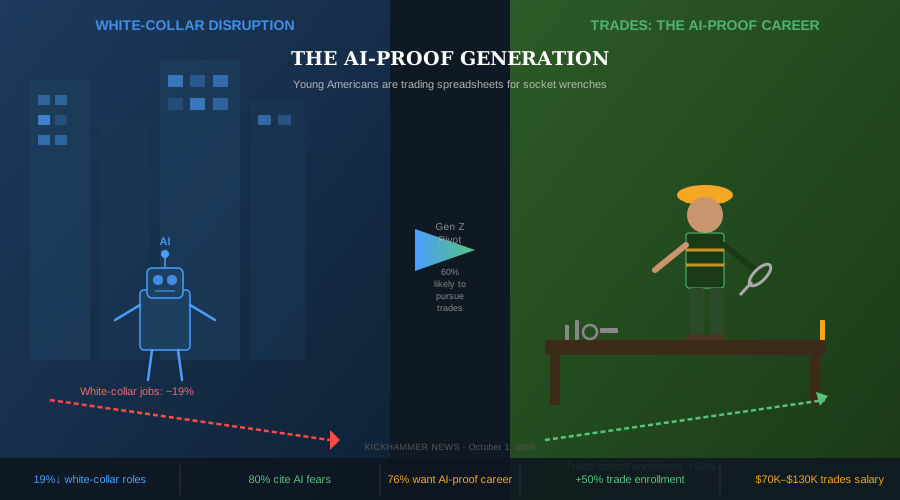
According to new data reviewed this week, employment in high-AI-exposure jobs among workers aged 22 to 25 — roles like customer service, software development, and content moderation — fell 19 percent relative to low-exposure occupations between November 2022 and June 2026. That’s not a rounding error. It’s a demographic rerouting, driven by a generation that watched its career plans get automated in real time.
The enrollment data confirms the pivot. Rosedale Technical College reports 50 percent enrollment growth over the past two years, with inquiry calls up 80 percent. Government-registered apprenticeship participation among workers under 24 increased 20 percent between 2022 and 2024. Even teacher training programs are seeing surges: Teach for America enrollment rose 43 percent from 2022 to 2025, and Teachers of Tomorrow applications climbed 30 percent year-over-year — as graduates reasoning that classrooms, at least, still need a human in the room.
Jobber’s 2026 Blue Collar Report, one of the most comprehensive surveys of Gen Z attitudes toward work, found that 60 percent of respondents are very likely or somewhat likely to pursue blue-collar work this year. Critically, 80 percent of those citing job security as their primary motivation specifically named AI replacement fears. And 76 percent said it was important to choose a career that is difficult to automate.
“We’ve never seen numbers like this,” said Julia Toothacre, Chief Career Strategist at ResumeTemplates.com. “Many young adults are questioning college debt value entirely and exploring blue-collar careers with solid income, skill development, and long-term security.”
The White-Collar Panic
The shift didn’t come from nowhere. The AI-driven white-collar displacement that economists had modeled for years began materializing in earnest in 2025 and 2026, hitting the sectors that had long attracted the most college-educated workers fastest and hardest.
Customer service departments shed roles at scale as AI agents handled millions of daily inquiries without fatigue. Marketing teams shrank as generative AI automated content pipelines that once required dozens of writers and designers. Software development — the gold standard career for two decades — entered an existential reckoning as AI coding agents began handling 80 percent or more of routine programming work at leading tech companies.
Megan Acevedo, a human resources professional who watched her team get trimmed from fourteen to three after her company deployed an AI HR agent, made the decision that an increasing number of her peers are now making. She enrolled in an electrician apprenticeship. The first weeks meant waking at 3 a.m. to haul 75-pound wire spools to job sites. It was, she said, the most physically demanding thing she’d ever done.
She hasn’t looked back.
Why the Trades Are Suddenly Attractive
The appeal isn’t purely defensive. The financial case for trades has strengthened considerably, and Gen Z is listening.
Electricians, plumbers, and HVAC technicians in major metro areas regularly earn between $70,000 and $130,000 annually, with experienced master tradespeople pulling more. Meanwhile, the student debt burden — still averaging over $37,000 for four-year graduates — looks increasingly difficult to justify for jobs that AI may render obsolete within a career’s lifetime.
Sixty-seven percent of Gen Z respondents in Jobber’s survey said they become more interested in trades upon learning about the six-figure earning potential. Forty-six percent believe trades offer the best path to eventual business ownership, compared to just 24 percent who said the same of a college degree.
Keon Davis, who spent his college summers doing marketing internships, watched AI automate the majority of his work tasks during a post-graduation job in 2025 — consumer research, email drafting, competitive analysis. He joined Teach for America, choosing to teach third grade in New York City. “There’s a child in front of me,” he said. “No model has figured out how to do what happens in a third-grade classroom.”
The Parents Have Come Around
For decades, pushing a child toward vocational training carried a social stigma — the implicit message being that college was for the capable and trades were the fallback. That calculus has inverted.
Jobber found that 92 percent of parents would encourage their child to pursue a skilled trade if interested, and 93 percent would provide the same financial support for trade school as for a four-year college. Fifty-two percent of parents believe skilled trades offer a better return on investment than college, compared to just 18 percent who still favor the degree.
Seventy-three percent of parents said they worry specifically about AI’s impact on future careers, and 68 percent said AI had made them reconsider white-collar career stability. The signal from a generation of parents who spent their own careers in office jobs is growing louder: the white-collar path is no longer the safe path.
The Structural Shift Underneath
The trades preference isn’t just an AI anxiety response — it’s a correction years in the making. Fifty percent of Gen Z survey respondents said school staff never recommended trades to them. Fifty-five percent of parents believe schools don’t take vocational training as seriously as university pathways.
That counselor bias built a structural shortage in skilled labor at exactly the moment the trades became both better-compensated and AI-resistant. The plumber who fixes your burst pipe, the electrician who wires a data center, the HVAC technician who keeps that data center cooled — none of them can be replaced by a language model. They work in physical space, navigate unpredictable environments, adapt to conditions no simulation can fully replicate.
“Physical dexterity in unstructured environments remains one of the hardest problems in robotics,” said one AI researcher who declined to be named. “We’re still years from fully autonomous systems that can handle field service work. The tradespeople know this better than most.”
A New Career Calculus
The shift being described here is not a wholesale rejection of technology. Many young workers entering trades are doing so with tools that previous generations couldn’t have imagined — AI-assisted diagnostics, augmented reality training systems, sensor networks on job sites. The question they are answering differently from their predecessors isn’t whether to use technology. It’s whether to bet their livelihood on performing tasks that technology can also perform.
For Kevin Brough, diagnosing a transmission in a bay in Pittsburgh, the answer was clear enough. He’ll graduate in the spring. He already has job offers.
The algorithm, for once, is not competing.


