On the last day of September, Governor Gavin Newsom quietly signed a law that could reshape the balance of power between workers and machines in a state that employs millions more people than most countries. The bill was called the No Robo Bosses Act. Its implications are anything but quiet.
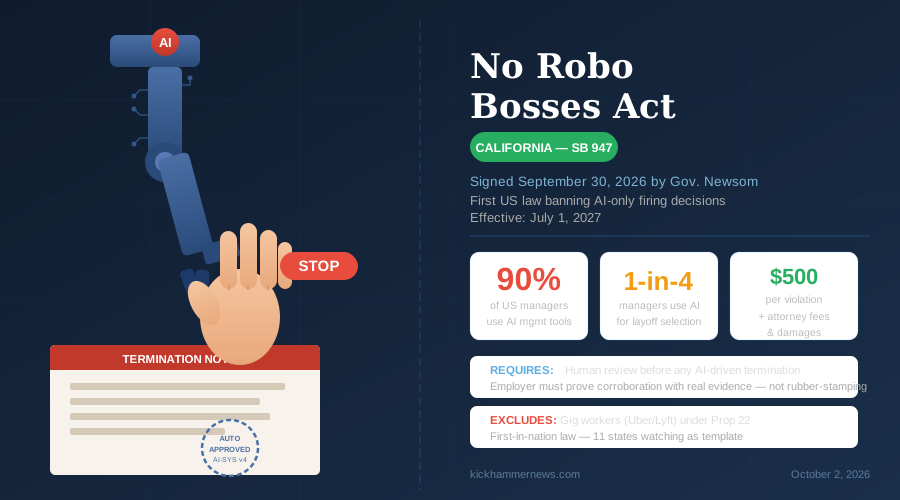
California’s Senate Bill 947, signed September 30, 2026, makes California the first state in the nation to prohibit employers from using artificial intelligence as the sole basis for firing or disciplining workers. Beginning July 1, 2027, any employer that relies on an automated decision system — AI-driven performance scores, behavioral tracking algorithms, productivity ratings — to terminate or discipline an employee must first have a real human being corroborate that decision with actual evidence. Supervisory evaluations. Personnel files. Peer reviews. Witness interviews. Something beyond a machine’s output.
“No worker should ever be fired or disciplined by a robo boss,” said Sen. Jerry McNerney, the Pleasanton Democrat who authored the bill. “AI must remain a tool controlled by humans.”
It sounds obvious. The fact that it needed to become law suggests we are further from obvious than most people realize.
The Algorithm Has Been Managing People for Years
The term “robo boss” has the ring of science fiction, but the underlying reality has been building for a decade. OECD data cited in analysis of the bill found that 90 percent of US managers now use some form of algorithmic management tools. One in four managers regularly use AI to identify which employees to eliminate during layoffs. The technology hasn’t replaced human judgment about employment — in many workplaces, it has already displaced it.
The most visible cases involve warehouse workers and gig economy drivers whose livelihoods are governed almost entirely by algorithmic performance tracking. Amazon workers have long reported termination letters generated when their measured “time off task” exceeds system thresholds — thresholds determined by software with no awareness that the worker paused to help a fallen coworker or stepped away because the building was too hot. Uber and Lyft drivers have described deactivations triggered by ratings algorithms, without warning and without any human review of the underlying circumstances.
The law that Newsom signed takes direct aim at this paradigm. Under SB 947, before an employer can fire or discipline a worker when an automated decision system was involved, a designated human reviewer must independently examine the evidence and confirm that the AI’s conclusion holds up. Crucially, if that reviewer determines the AI output is “inaccurate, incomplete, or misleading,” the termination must stop. The human isn’t there to rubber-stamp the machine. The human is there to actually evaluate the decision.
Workers also gain the right to be notified when AI influenced an employment action taken against them — including what data was used and how to reach the human reviewer responsible. Workers can request their own AI-generated data once annually.
A Reversal, and a Concession
For Newsom, signing SB 947 required some political course-correction. He had vetoed an earlier version of the bill in 2025 — part of his pattern of resisting the most sweeping AI legislation while California labor groups pushed harder for worker protections. The final version that reached his desk was narrower: advance-notice requirements were stripped out, and gig workers were excluded entirely. Uber and Lyft drivers, who are classified as independent contractors under California’s Proposition 22, remain unprotected.
That carve-out for gig workers is the most visible gap in the law — and its most obvious political compromise. The workers most exposed to algorithmic management, the ones whose entire professional lives are governed by ratings and automated dispatch systems, are exactly the ones SB 947 doesn’t cover. Labor advocates have flagged this as unfinished business.
Still, Newsom framed his signature as an affirmation of principle. “AI should expand opportunity,” he said, “not come at the expense of workers and families.”
The bill was backed by the California Federation of Labor Unions, AFL-CIO. Its president, Lorena Gonzalez, was more direct about what the moment represented. “When working people organize, we get results,” she said. “California’s workers and our unions have changed the national narrative on how Americans can fight back.”
Four Bills, Not One
SB 947 was part of a broader package of workplace AI laws Newsom signed on September 30. Together, they form the most aggressive state-level framework in the US for governing how AI intersects with employment.
Senate Bill 951 addresses mass layoffs driven by automation. It requires 60 days’ advance notice when an AI-influenced restructuring displaces 25 percent or more of a company’s workforce — extending WARN Act principles explicitly into the era of algorithmic workforce reduction. It also directs a state agency to study AI’s cumulative impacts on hiring and job displacement across California industries.
Assembly Bill 1883 prohibits employers from using AI tools that infer workers’ emotional states or collect neural data — a response to growing use of affective computing systems in customer service call centers, where some AI platforms now monitor vocal tone, facial expressions, and physiological signals to flag employees as “disengaged” or “unstable.”
Assembly Bill 1979 draws a hard line in healthcare. It prohibits AI from replacing the clinical judgment of licensed healthcare professionals and limits AI to an advisory role — a provision that directly counters the push by some hospital systems to use AI-driven triage and treatment recommendation systems without physician sign-off. Health chatbots are now subject to the same medical confidentiality protections as licensed practitioners.
What Employers Are Saying
The California Chamber of Progress, a tech-industry advocacy group, pushed back on SB 947’s implementation language, arguing that the phrase “primarily relies” on an ADS sets an ambiguous standard that employers lack objective tools to measure. In a statement issued before the signing, the group warned that unclear definitions could expose companies to enforcement risk even for good-faith use of AI as an assistive tool.
Legal analysts suggest the burden-shifting provisions make the concern mostly theoretical. Once a worker establishes that an ADS was used in a termination decision, the employer must demonstrate that proper human review occurred. That burden tends to push cautious employers toward overcompliance rather than undercompliance. Penalties under SB 947 run $500 per violation — but stack quickly across large layoffs — with courts also empowered to award injunctions, full damages, and attorney’s fees.
A Template Others Will Watch
Eleven states are currently tracking versions of similar legislation. New York City’s AI employment audit bill — which requires bias audits for any automated employment decision tool used by New York employers — has been in effect since 2023, and a statewide version passed the state assembly in September. Illinois has a companion bill for the No Robo Bosses Act framework pending in committee. At the federal level, the Algorithmic Accountability Act has stalled since 2022, leaving states to fill the regulatory vacuum.
California’s lawmaking carries disproportionate weight. Its labor market employs roughly one in eight American workers. Tech companies that operate in California generally can’t afford to build parallel compliance infrastructure, which means California workplace AI standards often become de facto national standards.
The law doesn’t take effect until July 2027, giving employers roughly nine months to build human review processes into their automated HR pipelines. For workers, it means that — for the first time in American legal history — an algorithm cannot be the last word on their livelihood.
Whether the gig economy eventually follows will be the next chapter.


