October 2, 2026 — For most of 2026, Google DeepMind seemed content to watch from the sidelines as OpenAI launched GPT-6 Astra, Anthropic pushed Claude Opus 5.5 and Sonnet 5.5, and competitors jostled for position at the AI frontier. Seven months passed without a flagship model from the company that co-invented the transformer architecture. Insiders grew restless. Analysts wrote cautious assessments. Then, on October 1, Google answered.
Gemini 4 Argon is here — and it did not arrive quietly.
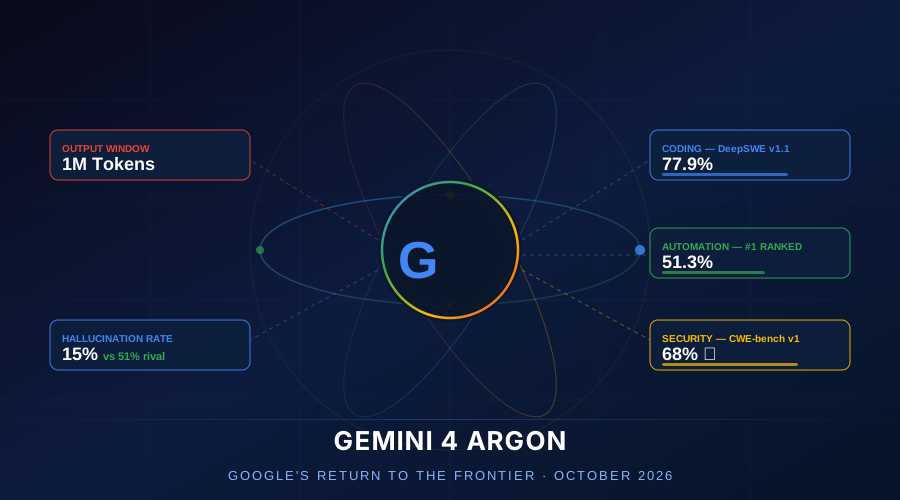
The model debuted with a benchmark performance that analysts are already calling competitive with GPT-6 Astra, a pricing structure that undercuts nearly every rival at the frontier, and a 1-million-token output window that is five times larger than anything else currently on the market. Google is calling it “our frontier model for real-world coding, enterprise knowledge work, and cyber defense.” What it looks like, in practice, is a calculated, deliberate attempt to take back the top of the leaderboard from a company that has spent 2026 running alone.
What Argon Actually Does
The headline capability is the output window. Every major frontier model today caps its output at 64,000 to 128,000 tokens. Gemini 4 Argon outputs up to 1 million. That is not a specification tweak — it is an architectural choice that fundamentally changes what the model can do. Long-horizon coding tasks that previously required chaining multiple calls, breaking work into fragments, and manually stitching results together can now run end-to-end in a single context. Legal documents, financial analyses, and enterprise knowledge retrieval workflows that span hundreds of thousands of words can be processed whole rather than windowed.
Google demonstrated the capability internally before launch. Their results are eye-catching: a 40 percent improvement on quantum algorithm optimization benchmarks, more than 300 terabytes freed across data centers through automated memory optimization, an 800,000-line migration of the Fuchsia Zircon kernel completed as a single agentic task, and a 2.7x speed improvement on the libgav1 video decoder. These are not toy benchmarks. They are production-scale engineering problems, and Argon handled them.
The Numbers That Matter
On the DeepSWE v1.1 coding benchmark, Argon scored 77.9 percent — a result Google described as “a record.” On AutomationBench, which tests end-to-end business automation workflows, Argon finished first at 51.3 percent. On LVBench for long video understanding, it scored 91.7 percent. On CWE-bench v1, the industry’s standard test for autonomous vulnerability remediation, Argon tied for first place at 68 percent.
The number that may matter most to enterprise buyers: hallucination rate. On AA-Omniscience, Argon produced incorrect or fabricated answers 15 percent of the time. GPT-6 Astra’s rate, on the same benchmark, was 51 percent. That is a 3.4x accuracy advantage on factual grounding — the kind of gap that determines whether a model is deployable in legal, financial, and medical contexts or whether it remains a productivity toy.
On Artificial Analysis’s Intelligence Index, Argon scores 53 at highest reasoning, matching GPT-6 Astra. Claude Opus 5.5 leads the overall field at 58; Claude Sonnet 5.5 sits at 56. Argon is not yet the top-scoring model in the world. But it achieves parity with OpenAI’s best at 60 percent of the cost per task — a value proposition that is going to be very difficult for enterprise procurement teams to ignore.
The Cybersecurity-First Launch Strategy
Google did not release Argon to the general public on day one. Instead, the model rolled out exclusively through the Fairwind Program — a network of vetted cybersecurity defenders and enterprise security teams who received access before any paid API customers. The move is partly practical and partly strategic.
Practical, because Argon’s autonomous vulnerability discovery capabilities are genuinely powerful and need real-world validation before broad exposure. The model can independently identify, verify, and patch software vulnerabilities. On prompt-injection resistance — a critical security benchmark given the current wave of AI agent attacks — Argon achieved a 0.7 percent adversarial success rate, better than Claude Opus 5.5 and Fable 5.1 (both at 1 percent). Before putting that capability into the hands of anyone who can spin up an API key, Google wants to establish verifiable track records in controlled environments.
Strategic, because leading with cybersecurity defenders creates a compelling narrative. Wiz, one of the enterprise security industry’s most respected names, is already named as an early adopter through the “Scan for Good” initiative, using Argon to hunt for critical vulnerabilities in healthcare software. When Argon graduates to general availability — expected to follow soon, with broader API access and Google AI Ultra subscriptions — it arrives with production deployments and real-world credibility rather than benchmark slides alone.
The Pricing Play
Gemini 4 Argon enters at $2 per million input tokens and $10 per million output tokens at introductory rates, rising to $4 and $20 respectively at standard pricing. Compare that to Claude Fable 5.1 at $10 per million input and $50 per million output, or Claude Opus 5.5 at $4 and $20. Argon’s introductory rate undercuts Opus 5.5 on inputs and matches it on outputs — while offering a context window eight times larger and superior hallucination performance.
The 95 percent discount on cached input tokens is an additional advantage for enterprise workflows, where the same system prompts, legal documents, and codebases are queried repeatedly. For organizations running AI-heavy operations — law firms, banks, software companies — cached token discounts can reduce effective costs by 50 percent or more on real workloads.
Alphabet shares gained approximately 2 percent in premarket trading on the day of the announcement. Jefferies maintained a “buy” rating while noting that “early benchmark results will need to be validated through real-world use.”
The Internal Skeptics
Not everyone within Google is celebrating. Bloomberg reported internal dissent, with employees arguing the benchmarks overstate real coding performance. “It does less well when employees actually put it to work,” one anonymous Google employee told Bloomberg, suggesting a gap between the controlled benchmark environment and the messier conditions of actual production use.
This is not an unusual problem in AI. Benchmark performance and real-world performance diverge for every major model at launch, and the gap tends to close as teams learn to prompt and deploy effectively. But it is worth noting, particularly for buyers making infrastructure commitments based on headline numbers. The intelligence gap between Argon and Claude’s frontier models on the overall Intelligence Index — five to six points — suggests that for pure reasoning horsepower, Google has not yet reclaimed the pole position.
What Argon has claimed is something arguably more important for enterprise adoption: a credible cost-performance story, a leading accuracy-grounding result, a security-first rollout strategy, and a capability ceiling that no competitor has yet matched.
The Bigger Picture
Google’s seven-month absence from the frontier did not go unnoticed. OpenAI’s DevDay filled the vacuum, expanding ChatGPT into a productivity platform. Anthropic raised a $2 trillion IPO valuation. AMD acquired Fei-Fei Li’s World Labs. The AI landscape moved relentlessly.
Argon’s arrival is Google’s declaration that the absence was not a retreat — it was a reloading. Whether the model lives up to that narrative in production will take weeks or months to determine. But on October 1, 2026, the frontier got crowded again. And this time, Google did not show up empty-handed.


