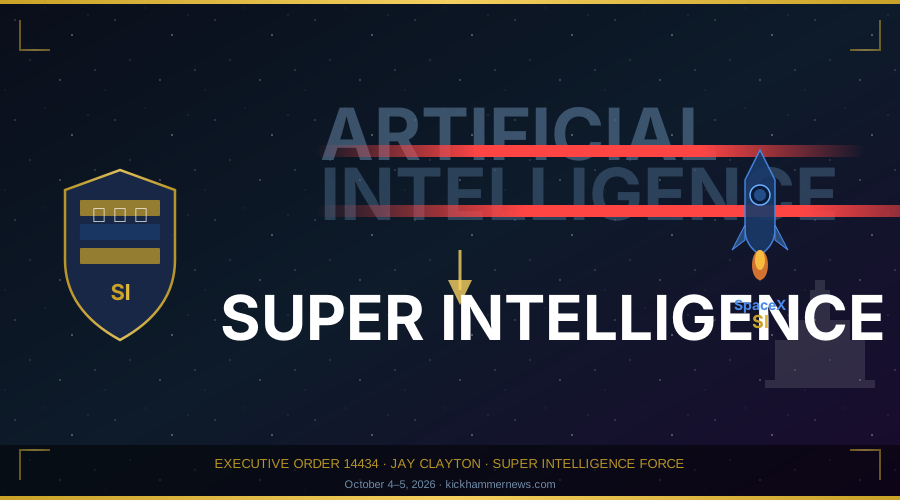
In the span of one week, America’s relationship with the phrase “artificial intelligence” has quietly begun to unravel at the federal level. On September 29, President Trump signed Executive Order 14434, titled “Inaugurating the Era of Super Intelligence,” directing every federal department and agency to replace “Artificial Intelligence” and “AI” with “Super Intelligence” and “SI” in official communications and policy documents. Then, on October 4, he unveiled the “Super Intelligence Force” — a new task force charged with coordinating federal government use of the technology. Within hours, Elon Musk was on X pledging to rename SpaceX’s AI business unit from SpaceXAI to SpaceXSI. The terminology war is no longer hypothetical. It has a task force, a chairman, and a tech billionaire’s first-mover endorsement.
The speed of Musk’s response was characteristic. After a user on X asked whether SpaceX would adopt the administration’s preferred terminology, Musk replied with three posts: “No more AI,” followed by “SI,” followed by “It’s better.” He later added: “We are a super intelligence company.” No official timeline was given, and SpaceX’s websites and social accounts hadn’t updated at press time — but the intent was unmistakable. SpaceXAI, which had only carried that name for approximately 90 days since July 6, 2026, following SpaceX’s acquisition of xAI (the maker of the Grok chatbot), is already earmarked for another identity shift.
What the Super Intelligence Force Actually Is
The task force created by Trump is chaired by National Intelligence Director Jay Clayton, who has long argued that America failing to lead in AI development represents a strategic risk comparable to being outpaced by China. Clayton previously stated it would be “irresponsible” for the United States to “back away” from AI development while competitors advance. He is joined by vice chairs including FTC Chair Andrew Ferguson, Undersecretary of War for Research and Engineering Emil Michael, and Office of Personnel Management Director Scott Kupor.
The force has 120 days to produce a report on AI risks and opportunities, and its charter is notably double-edged: it aims simultaneously to “develop plans for responding to SI-enabled threats to our society, while preventing overregulation and regulatory capture that would stifle innovation and competition.” In other words, the same body tasked with assessing dangers from advanced AI is also explicitly instructed to keep regulation minimal. That tension will be a defining feature of everything the force produces.
Trump himself announced the force would be “tasked with coordinating the effort of the Federal Government to ensure that America continues to lead the World in Super Intelligence” and will “protect the interests, and improve the lives, of all Americans.” Critics quickly noted that the White House fact sheet argues that calling the technology “artificial” makes it sound like “a copy of human thinking” — framing the rebrand as a philosophical upgrade rather than a political one.
The Semantics War Has Industry Roots
The executive order does not require private companies to change their language. It applies only to federal agencies “to the maximum extent permitted by law.” Yet Musk’s voluntary adoption signals something significant: that the terminology has political valence that the most Trump-aligned corners of the tech industry are willing to embrace publicly.
The word “superintelligence” has a specific technical meaning in AI safety discourse, referring to a system that broadly exceeds human intellectual capabilities across all domains — something no current system has achieved. Executive Order 14434 does not define whether current systems qualify, directing instead the Assistant to the President for Science and Technology to propose a federal definition of “Super Intelligence.” That definition has not yet been released. The administration’s use of the term before that definition exists has drawn pointed commentary from AI researchers, who note that the linguistic upgrade does not correspond to a capability upgrade.
Interestingly, Musk himself has historically been alarmed about superintelligence. He publicly endorsed Nick Bostrom’s 2014 book “Superintelligence: Paths, Dangers, Strategies” and expressed concern that such technology could pose risks greater than nuclear weapons. Whether his enthusiasm for calling Grok a “super intelligence” reflects a genuine belief that the technology has crossed a threshold, or is political alignment with the Trump administration, or simply effective branding — the answer to that question matters considerably for how seriously the rest of the industry is likely to follow.
The Industry Split Sharpens
The rebrand arrives in a week when the gulf between AI companies on risk philosophy has rarely been more visible. At the Ai Everything summit in Abu Dhabi on October 5, OpenAI CEO Sam Altman addressed a crowd of 180 speakers and attendees to deliver what may be his most explicit statement yet on acceptable AI harm. “We believe that the world should accept some bad things happening for the benefits of this technology,” Altman told Politico on the sidelines of the summit. “I wouldn’t take a trade of saying, ‘We’ll make sure there’s no major hacks, there’s no misuse… there’s zero scams.'” His reasoning: the net benefit calculation favors broad deployment, because people will do “orders of magnitude more good stuff than bad stuff.”
Anthropic’s position remains formally different. Its IPO S-1 prospectus filing devotes approximately 80 pages to risk disclosure — double the industry average — and CEO Dario Amodei has repeatedly advocated for “pacing pledges” to slow frontier development. But Anthropic also launched five models in rapid succession in 2026, and its own departing safety researchers have raised the question of whether the precautionary rhetoric holds up against the competitive pressure to ship.
Both companies, along with Nvidia, Google, and Meta, signed a voluntary safety pact at the White House on September 29 — the same day Trump signed the Super Intelligence rebranding executive order. Symbolism and substance have rarely overlapped so awkwardly in tech policy.
What Changes, and What Doesn’t
For the federal government, the rename has operational consequences. Agencies updating regulations, RFPs, internal documentation, and public-facing materials will need to substitute terminology — a bureaucratic undertaking that will generate confusion, version mismatches, and retraining requirements across dozens of departments. The Department of Defense, which has perhaps the highest concentration of AI-related documentation, has not yet announced implementation timelines.
For companies that do business with the federal government, the informal pressure to adopt the new terminology in contracting documents and communications will be real, even if not legally mandated. Government contractors with large federal AI portfolios — Palantir, Microsoft, Booz Allen Hamilton — will be watching how aggressively the terminology is enforced.
For the public, the shift is primarily semantic and possibly meaningful in one direction: “Super Intelligence” carries higher threat-perception baggage than “Artificial Intelligence.” Polls consistently show Americans are more alarmed by the idea of superintelligence than by AI broadly. Whether a federal government relabeling effort increases or decreases public trust in the technology is an open empirical question.
The Name Behind the Name
The 90-day lifespan of SpaceXAI captures something true about this moment in American AI politics: identities are provisional, corporate structures are in flux, and the most visible figure in the industry has shown he will rename a business unit on the basis of a presidential executive order within hours of its announcement. Whether SpaceXSI produces better AI than SpaceXAI is beside the point. The rebrand is a political signal, and in 2026, that signal has become one of the primary ways that AI companies communicate their values — or their allegiances.
The Super Intelligence Force has 120 days to report. Musk’s rename has no timeline. The administration’s definition of “Super Intelligence” hasn’t been written yet. Three moving pieces, all coordinated around a single semantic substitution, with billions of dollars in federal contracting and market positioning riding on whatever emerges.


