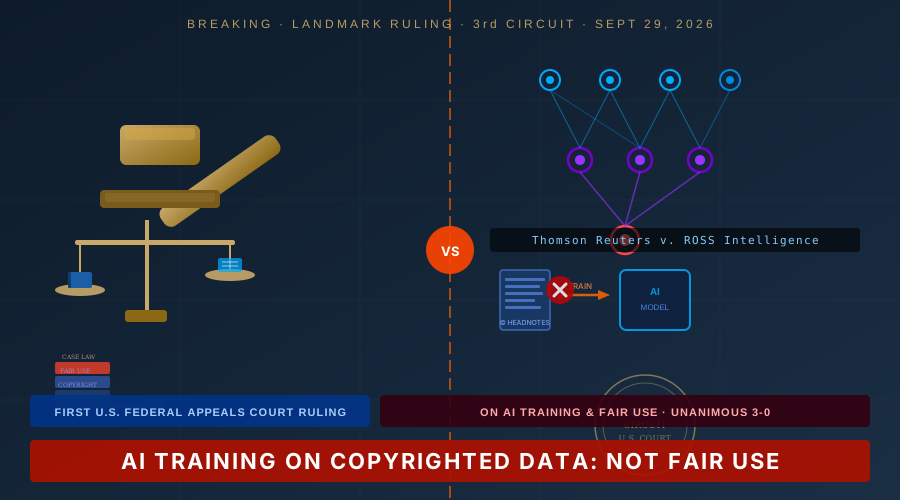
For more than six years, every major AI company has been operating under a legal assumption: that training a machine-learning model on copyrighted material constitutes “fair use” under U.S. law. On September 29, 2026, the United States Court of Appeals for the Third Circuit quietly demolished that assumption — and the reverberations are still spreading across Silicon Valley, publishing houses, newsrooms, and law firms trying to figure out what it all means.
The case is Thomson Reuters Enterprise Centre GmbH v. Ross Intelligence Inc., and while it originated in 2020 as what looked like a narrow dispute between a legal database giant and a now-defunct AI startup, it has become the most consequential intellectual property ruling since the dawn of the generative AI era. The Third Circuit’s unanimous opinion, authored by Judge Tamika Montgomery-Reeves and joined by Judges L. Felipe Restrepo and Emil J. Bove III, upheld a February 2025 district court ruling: artificial intelligence companies cannot simply scrape proprietary databases to build competing products and call it fair use.
The ruling was unsealed publicly on October 1, 2026, making it the first opinion from a federal court of appeals to squarely address whether AI training on copyrighted works qualifies as fair use under the Copyright Act.
The Case That Started It All
ROSS Intelligence launched with a compelling pitch: an AI-powered legal research tool that would make it easier for attorneys to find relevant case law. The problem was the training data. Unable to build a competitive product from scratch, and having been denied a Westlaw subscription by Thomson Reuters when the company figured out what ROSS intended to do with it, ROSS turned to a data broker named LegalEase Solutions. Through LegalEase, ROSS obtained approximately 25,000 Westlaw headnotes — the brief, attorney-crafted editorial summaries that appear above judicial opinions, identifying the key legal points each case stands for.
These headnotes are the lifeblood of Westlaw. They are not the judicial opinions themselves, which are government documents in the public domain. They are original creative works — condensed, precisely worded editorial judgments about what each case means, written by trained legal editors and organized within Thomson Reuters’ proprietary Key Number System. ROSS used them to teach its AI how to understand legal research queries and surface relevant authority. Thomson Reuters sued in 2020, and it was the first known AI copyright lawsuit in the United States.
By the time the case reached the Third Circuit, ROSS Intelligence had shut down. But the legal question survived.
What the Court Decided
Working through the traditional four-factor fair use analysis, the court found against ROSS on three of the four factors.
Factor 1 – Purpose and Character of the Use: This is where most modern copyright disputes are won or lost, because it’s where courts ask the critical question: was the use “transformative”? ROSS argued that using headnotes as training data for an AI system was fundamentally different from publishing them directly – that the training process transformed the works into something new. The Third Circuit disagreed. Both Westlaw and the ROSS system ultimately served the same commercial function: helping lawyers find legal authority. The intermediate step of running the headnotes through a machine-learning algorithm did not change the competitive purpose. The use was “highly commercial and only minimally transformative.”
Factor 3 – Amount and Substantiality: ROSS copied entire headnotes. When you copy the whole of a protected work, this factor weighs heavily against fair use, and here it did.
Factor 4 – Market Effect: Perhaps most importantly for the AI industry at large, the court found that ROSS harmed Thomson Reuters in two distinct ways. First, it competed directly in the legal research market. Second, and more significant for the future, the court recognized an emerging market for AI training data licenses. Thomson Reuters had already begun licensing its content for AI training purposes. By copying without paying, ROSS deprived Thomson Reuters of licensing revenue it would have otherwise received. The court treated this nascent licensing market as worthy of legal protection.
The lone factor that cut in ROSS’s favor was Factor 2 – the nature of the copyrighted work – because headnotes, which summarize legal rules, sit closer to the “factual” end of the originality spectrum. But that one factor was not enough.
The Generative AI Carve-Out That Everyone Is Reading Carefully
Here is where the ruling becomes complex – and where the real legal intrigue lies.
Judge Montgomery-Reeves was at pains to limit the ruling’s reach. The opinion includes an explicit acknowledgment that ROSS’s technology was a non-generative retrieval system – it did not create new text, it indexed and surfaced existing text. The court expressly declined to rule on whether training generative AI systems (the ChatGPTs and Claudes and Geminis of the world) on copyrighted material would also fail the fair use test.
In fact, the opinion took note of the U.S. Department of Justice’s September 2026 argument in a separate case, where the DOJ contended that large language model training is “extraordinarily transformative” because a model trained on millions of texts generates new expression rather than republishing the originals. The court acknowledged this argument without endorsing or rejecting it.
The explicit carve-out is being read two ways in the legal community. Optimists see it as preserving space for generative AI companies to win their own fair use fights. Skeptics point out that the same market harm logic applies: if OpenAI trains on the New York Times and the result is a tool that competes for readers with the Times, Factor 4 looks very similar to what sank ROSS. ROSS’s attorney confirmed the company intends to petition the U.S. Supreme Court, arguing the decision creates unacceptable uncertainty for the AI development industry.
The Stakes for Publishers, Newsrooms, and the AI Industry
The ruling has landed at a particularly charged moment. Dozens of AI copyright cases are pending in federal courts – the New York Times against OpenAI and Microsoft, record labels against music AI companies, book authors against Anthropic and Google, visual artists against image generators. None of those cases involves the same fact pattern as Thomson Reuters v. ROSS, but all of them involve the same fundamental question: can you train a machine on someone else’s creative work without paying for it?
What ROSS does provide is a dangerous template for plaintiffs. The Third Circuit’s Factor 4 analysis – protecting nascent AI training licensing markets – is directly applicable to any content sector where licensing markets for AI training have already emerged. News organizations, academic publishers, music labels, and stock photo agencies have all begun building licensing businesses around AI training data. Under the ROSS logic, once those markets exist, training on the underlying content without paying threatens them.
The ruling also creates an uncomfortable question for AI companies’ entire legal theory. The industry has long argued that training is different from infringement because the copyrighted work “disappears” into the model’s weights. The Third Circuit was not persuaded. What matters, the court said, is the commercial purpose and the market effect, not the technical mechanism.
What Happens Next
The AI industry is watching several things simultaneously. ROSS’s petition for certiorari to the Supreme Court could take the question of AI training fair use to the nation’s highest court for the first time. The district court cases against OpenAI, Anthropic, Google, and others will proceed with this ruling as a new data point – not controlling precedent on generative AI, but a significant signal from a federal appellate court about how copyright law applies to machine learning.
Meanwhile, the ruling may quietly accelerate a trend that was already underway: major AI companies negotiating licensing deals with content owners before litigation forces them to. In the past two years, OpenAI has signed deals with the Associated Press, several major publishers, and music rights organizations. Anthropic and Google have pursued similar arrangements. The economics of these deals have always been murky – AI companies want to pay as little as possible; content owners want to maximize leverage. The ROSS ruling just handed content owners a new card to play.
For the legal profession itself, the ruling carries a particular irony. A case that began as a fight between two legal research companies has become the foundational precedent in the law governing machines that are now capable of doing legal research themselves.
The courts are still catching up to the technology. But as of September 29, 2026, the first federal appellate court to reach the question has given its answer: you cannot train a competitor’s AI on another company’s work and call it fair use. The rest of the industry is now waiting to learn whether that answer applies to them too.


