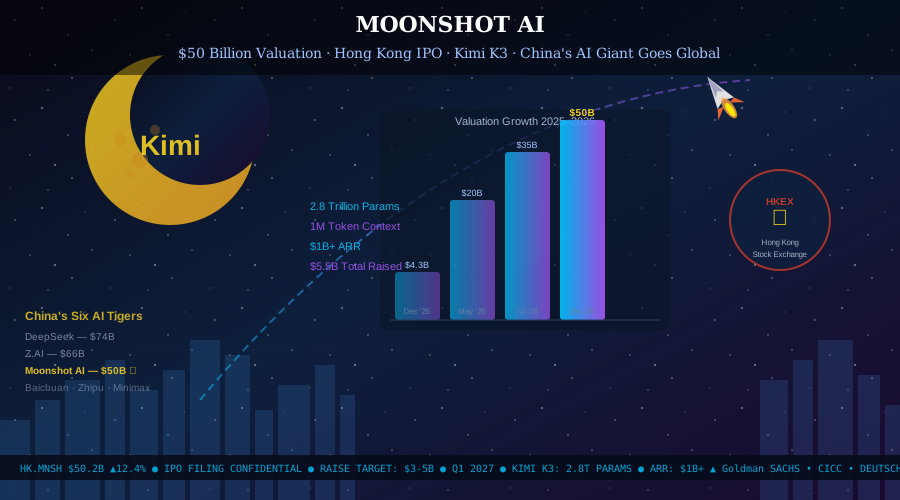
Beijing’s Moonshot AI has completed its final private funding round at a staggering $50 billion valuation — and the company is now preparing what could be one of the most consequential technology IPOs in years. The maker of the Kimi AI chatbot has confidentially filed for a Hong Kong stock exchange listing, targeting a raise of up to $5 billion, with a window for the debut tentatively set for early 2027. If it proceeds, the listing would make Moonshot one of the largest publicly traded AI companies in the world by market capitalization — a remarkable ascent for a startup that barely registered outside China just eighteen months ago.
The company has already retained Goldman Sachs, CICC, and Deutsche Bank as underwriters. China Mobile has joined the existing syndicate of Alibaba and Tencent as major backers. And according to people familiar with the matter, preliminary conversations have begun with Microsoft, Amazon, and Google about potential revenue-sharing arrangements around the Kimi model — what would be an unprecedented US-China AI partnership in a political climate that has otherwise been defined by deep suspicion and export controls.
From Academic to Billionaire: Yang Zhilin’s Moonshot
Moonshot AI was founded in early 2023 by Yang Zhilin, a former professor at Tsinghua University who had previously worked at both Meta Platforms and Google. Yang’s academic background was in natural language processing, and his research at Carnegie Mellon University produced work on language model architectures that would inform the design of what eventually became Kimi. He was not a celebrity founder in the style of Sam Altman or Elon Musk. He was a technical researcher with an unusually clear vision of where language models were heading — and the patience to build toward it.
That patience has paid off in a way few expected. When Moonshot raised its Series A in 2023, its valuation sat below $300 million. By the end of 2025, it had reached $4.3 billion. Then the acceleration began in earnest: $20 billion in May 2026, $35 billion in July, and $50 billion by October. In less than twelve months, Moonshot’s paper value increased by more than tenfold. The company has now raised more than $5.5 billion in total capital, making it one of the best-funded AI startups in Chinese history.
The revenue numbers have kept pace. Annual recurring revenue was approximately $200 million in April, climbed to roughly $300 million by June, and has since crossed $1 billion with analysts projecting $2 billion by year’s end. For a company with no meaningful presence outside Asia three years ago, those are extraordinary figures.
Kimi K3: The Model That Changed Everything
The inflection point was July 2026, when Moonshot launched Kimi K3 — an open-weight model with 2.8 trillion parameters and a 1-million-token context window. To put those numbers in context: 2.8 trillion parameters is larger than any previously disclosed open-weight model, and the 1 million token context window means the system can process documents, codebases, and conversation histories of a length that most AI systems cannot approach.
The release sent shockwaves through the AI research community. Benchmark evaluations placed K3 in competitive territory with OpenAI’s GPT-6 and Anthropic’s Claude Opus families across multiple domains, including code generation, mathematical reasoning, and long-document comprehension. For an open-weight model — one where the weights are publicly available and anyone can run, fine-tune, or study it — those results were genuinely unprecedented. Most of the models at this capability tier are locked behind API walls. Moonshot made K3 freely available.
The decision to go open-weight was strategic. It generated enormous goodwill in the developer community, drove adoption across the Asia-Pacific region, and positioned Kimi as a credible alternative to US-controlled AI infrastructure at a moment when many governments and enterprises are actively searching for one.
The Six AI Tigers and China’s Race to the Top
To understand what Moonshot’s rise means, it’s necessary to understand the competitive environment it inhabits. China’s domestic AI industry is often described through the framework of the “Six AI Tigers” — the six private AI companies that have emerged as the country’s most capable and best-funded: Moonshot AI, DeepSeek, Z.AI, Baichuan, Zhipu AI, and Minimax. Together, they represent a multi-hundred-billion-dollar bet on Chinese technological independence.
Of these, DeepSeek commands the highest valuation at approximately $74 billion, while Z.AI follows at around $66 billion. Moonshot’s $50 billion places it firmly in the upper tier of this group. But what sets Moonshot apart from its domestic competitors is its global ambition. While several of the other tigers have focused primarily on the domestic Chinese market, Kimi has been designed from the beginning for cross-border deployment. The interface is available in English. The model has been optimized for international regulatory contexts. And the IPO will be listed in Hong Kong — the financial gateway between mainland China and global capital markets.
The discussions with Microsoft, Amazon, and Google are perhaps the most striking aspect of the story. US-China technology collaboration has been effectively frozen by export controls on advanced semiconductors, restrictions on AI technology transfer, and a political environment defined by mutual suspicion. If those conversations produce actual agreements — and it’s important to note they remain preliminary — it would represent a genuine détente in the technology cold war.
A Shadow Over the Filing: Data Security Review
Not everything is as clean as the valuation trajectory suggests. Chinese authorities have initiated a data security examination targeting both Moonshot AI and DeepSeek, adding a layer of regulatory uncertainty that the company will need to navigate before its listing.
The examination, conducted by the Cyberspace Administration of China, is focused on how both companies collect, store, and process user data — including data flowing across borders. China has some of the world’s most demanding data localization requirements, and AI companies that handle vast quantities of personal and business information have found themselves under increasing scrutiny as regulators work to bring the industry in line with national security frameworks. The investigation does not necessarily signal any wrongdoing; regulators have subjected most major platform companies to similar reviews. But it introduces a variable that could delay the IPO timeline or require structural changes to how Moonshot operates.
For international investors evaluating the listing, this uncertainty will need to be weighed against the company’s extraordinary growth story. A data security finding that required significant changes to Kimi’s architecture or data pipeline could affect the product itself — and the revenue projections that justify the current valuation.
What a $50 Billion IPO Would Mean
If Moonshot successfully lists in Hong Kong at or near its current private valuation, it would arrive on public markets as one of the most valuable AI companies in the world — comparable in scale to some of the most prominent names in the US and European markets. That outcome would validate something that seemed unlikely as recently as 2024: that China’s domestic AI industry, despite operating under severe compute constraints imposed by US chip export controls, has built models and companies that can compete globally on capability.
The story of how that happened is still being written. Part of it is architectural efficiency — Chinese labs have been forced by circumstance to do more with less, and some of that constraint has driven genuine innovation. Part of it is talent: Yang Zhilin is not an isolated case; the Six AI Tigers collectively employ an extraordinary concentration of technical expertise trained at the world’s top universities. And part of it is funding — the willingness of Chinese institutional investors, backed ultimately by state industrial policy, to commit capital at a scale and patience that few private markets elsewhere can match.
For Moonshot specifically, the Hong Kong IPO would be the beginning of a new chapter rather than an endpoint. The company has signaled ambitions far beyond its current position in the Asian market. A successful listing would give it a public currency to make acquisitions, a balance sheet to fund the next generation of training runs, and a global credibility that remains difficult to establish from a private position.
The chatbot that Yang Zhilin built in a Tsinghua lab has already surprised the world once. The listing that turns it into a publicly traded entity may surprise it again.


