Imagine getting a meeting invite from a new colleague. You check their name in the company directory — they have a profile, a calendar, a shared drive folder, and an @company.com email address. But they’re not a person. They’re an AI. And they’ve been quietly handling your team’s most time-consuming work while you slept.
That’s not a science fiction scenario anymore. At its Gemini at Work 2026 event on October 8, Google rolled out what it calls a universal agent for work — a single AI that can be assigned objectives, create and coordinate sub-agents, and most remarkably, exist inside your organization as an entity with its own verified identity, complete with a dedicated corporate email address.
From Tool to Teammate
For years, enterprise AI has been sold as a productivity assistant: something you talk *to*. Ask a question, get an answer. Summarize this document. Draft that email. The interaction is transactional and synchronous — you prompt, it responds, and then it forgets.
Google’s announcement this week marks a decisive move away from that model. The new Gemini agent doesn’t wait to be asked. It can be given *objectives*, not just instructions — a crucial distinction. Where a prompt-response tool says “here’s your draft,” an objective-driven agent says “I’ll handle the contract review, coordinate with legal, flag the three clauses that need revision, and have results in your inbox by tomorrow morning.”
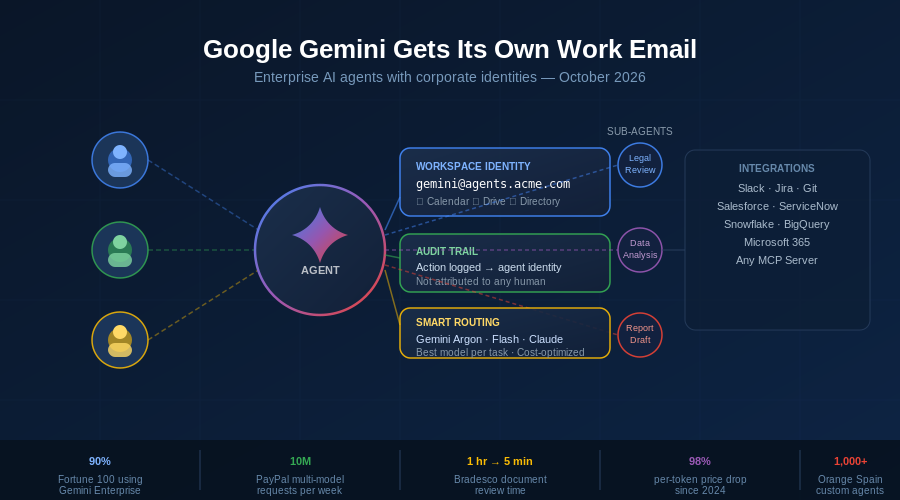
The agent runs persistently in the cloud. When you close your laptop, it keeps working. When you open it on a different device, it has the same memory. And when it creates sub-agents to tackle parallel workstreams, each of those sub-agents gets its own attested identity and audit trail.
The Email Address That Changes Everything
The most striking detail from Wednesday’s announcement isn’t the AI’s capabilities. It’s the email address.
Google is giving each “coworker agent” its own @agents.company.com address. It gets a Workspace account: inbox, calendar, Drive storage, and a presence in the company directory. When it takes an action — edits a document, approves a workflow, sends a message — that action is logged under the agent’s identity, not the user’s. You can @mention it in a group chat. You can email it. You can share a file with it the same way you’d share one with a colleague.
This is a governance decision as much as a product one. By giving agents distinct, cryptographically attested identities with least-privilege permissions, Google is solving one of enterprise AI’s most persistent headaches: accountability. When an AI makes a decision at scale, you need to know which agent made it, what permissions it was operating under, and what data it touched. An agent acting under a human’s credentials makes that impossible. An agent with its own identity makes it auditable.
One Agent, Many Models
The Gemini brand gives the impression this is a single-model product. It’s not. Google has quietly built a multi-model orchestration layer that selects the best model for each specific task. Gemini’s own model family includes Argon for frontier reasoning, Flash for speed and volume, Omni for generative media, and Gemma for lightweight edge work. But the agent can also route tasks to Anthropic’s Claude models, and Google has announced plans to add open-source and private models.
This model-agnostic architecture, combined with Google’s Smart Routing that optimizes for performance and cost simultaneously, means the enterprise agent doesn’t bet everything on one model’s strengths. A legal document review might go to a reasoning-optimized model; a quick summarization task might go to Flash for speed and economy. Meanwhile, per-token prices have fallen 98% since 2024, making large-scale agentic workloads economically viable for the first time.
What Early Customers Are Seeing
The numbers Google is sharing are striking. PayPal is already routing 10 million multi-model requests weekly through Gemini Enterprise. At Bradesco, one of Brazil’s largest banks, a document review workflow that previously required an hour now takes five minutes. Orange Spain has deployed more than 1,000 custom Gemini Enterprise agents. Nearly 90% of the Fortune 100 are now using Gemini Enterprise in some form — a figure that would have been unimaginable for a generative AI product three years ago.
Shopify is using the multi-model system to blend different capabilities for merchant-facing interactions. On, the Swiss running shoe brand, is using the model-selection capabilities. And the Chief Digital and Artificial Intelligence Office has deployed Gemini for more than 3 million U.S. service members.
The agent works inside Google Workspace apps — surfacing in Gmail, Docs, Slides, Sheets, Chat, and Calendar — but it also connects to Slack, Microsoft 365, Confluence, Jira, Git, Salesforce, ServiceNow, Snowflake, and Databricks. Any Model Context Protocol (MCP) server is supported, which means the agent can plug into essentially any enterprise system that exposes an MCP endpoint.
Security Built In
Skeptics of enterprise AI agents typically worry about two things: security and cost. Google has addressed both directly. Agents run inside an Agent Sandbox with their own network boundary. All traffic passes through an Agent Gateway — described as an AI network firewall — that enforces organization-wide policies in real time. Permission propagation follows OAuth standards, and each agent sees only what it’s been explicitly shared.
On cost, real-time spend caps can be set per project in Cloud Billing. When a cap is hit, the agent pauses and waits for a human to authorize continuation. Companies can also track AI spending per department and run saved analytical reports on demand without consuming additional tokens.
The Shift That’s Actually Happening
What Google announced isn’t just a product. It’s a new mental model for how AI fits into organizations. The question is no longer “what can AI do when I ask it a question?” It’s “what can AI accomplish when I assign it a role?”
Coworker agents with their own email addresses, calendar entries, and audit trails aren’t a stretch of the product roadmap. They’re live now, rolling out to business customers first, with consumer availability coming later. The agents are joining team directories alongside people who have been there for years.
The implications for how companies hire, delegate, and structure work are only beginning to surface. But one thing is clear: AI has stopped waiting to be asked. It now has its own inbox, and it’s already busy.


