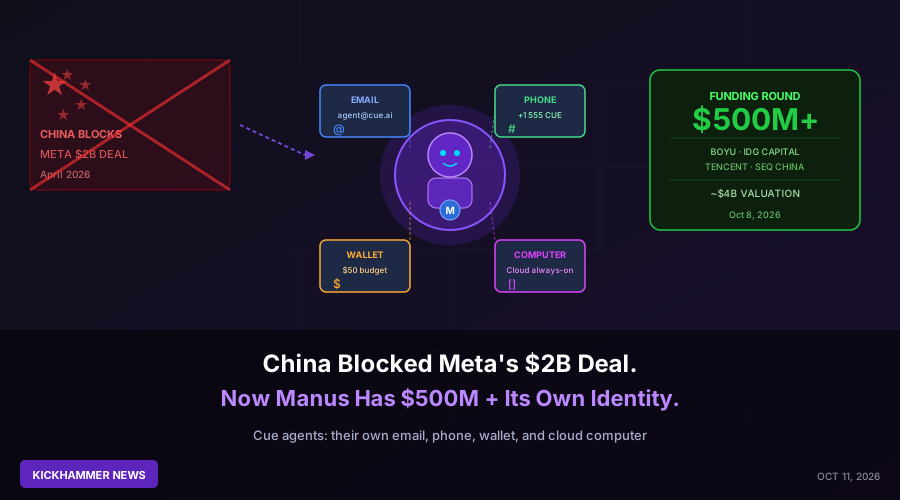
When Meta announced in December 2025 that it had agreed to acquire Manus — the Chinese AI agent startup that had gone viral with a demo that stunned the tech world — it looked like a tidy ending. A $2 billion deal. A celebrated team absorbed into the world’s largest social media company. Another promising AI lab subsumed into Big Tech.
Then China said no.
In April 2026, Chinese authorities ordered the acquisition unwound. The message from Beijing was unmistakable: the era of Western companies quietly buying up China’s most promising AI talent was over. Manus was sent back to operate independently. It had to delete some user data as part of the split. Its Singapore-based team — the staff had relocated there from China in mid-2025 — was suddenly on its own.
Four months later, Manus is raising $500 million and launching products that may be more ambitious than anything Meta had planned for it.
From Acquisition Target to $4 Billion Independent
On October 8, 2026, Manus’s parent company Butterfly Effect confirmed a funding round of more than $500 million, led by Boyu Capital and IDG Capital, with participation from existing investors Tencent, HSG (formerly Sequoia China), and ZhenFund. While the company did not disclose an official valuation, reports in September had placed it at approximately $4 billion — a figure that would make the Meta deal look like a bargain in retrospect.
The speed of the reversal is striking. In April, Chinese regulators forced Manus to untangle itself from one of the world’s most powerful tech companies. By October, it had rebuilt its investor base, shipped two major new products, and secured capital that gives it runway to compete globally on its own terms.
The company says it plans to keep hiring in China and abroad, and has indicated it is building a dedicated team for the Chinese domestic market, working with local AI model makers to ensure compatibility and performance for Chinese users.
What Manus Actually Built
To understand why investors lined up, it helps to understand what Manus shipped in September and early October.
Manus 2.0 is not a version update — the company explicitly calls it a new architecture. At its core is Cascade, a proprietary agent system that loads specialized tools only when a specific task requires them. In internal benchmarks, Cascade used 23.2% fewer tokens, completed tasks 28.2% faster, and ran at 32% lower cost than the previous system. For a company whose product is AI agents running complex, multi-step tasks, this kind of efficiency gain compounds dramatically at scale.
Beyond Cascade, Manus 2.0 introduces Automations — the ability to trigger agent tasks based on events in connected services like email, Slack, calendar, or Notion, rather than only at scheduled times. This transforms Manus from a task-runner into something closer to a persistent digital assistant that responds to the flow of your actual workday.
Cloud Computer is a dedicated environment that keeps running after a user closes their laptop — a practical acknowledgment that meaningful AI tasks often take longer than a single session. Manus Studio, the redesigned desktop app, adds a video editor, a game development environment that publishes playable web games, and Remote Control, which lets users direct their computer from a phone while watching the desktop live.
These are not minor additions. They are the building blocks of an AI agent operating system.
Cue: The AI Agent With Its Own Identity
The most striking thing Manus launched alongside 2.0 is Cue, a standalone app that takes a step that most AI companies have been reluctant to take: giving individual AI agents a persistent, functional identity.
Each agent in Cue gets its own email address, its own phone number, its own digital wallet, and its own computer. These are not simulations. Agents can send emails, make calls, and process payments — within a spending budget the user defines. When a call comes in for a user who is busy, their Cue agent can take the call and leave a summary in the app.
Multiple Cue agents can collaborate through shared group chats, dividing complex projects into parallel workstreams. The company’s example: one agent researches potential venues for a New York product launch, another shortlists the top candidates, and a third drafts a presentation deck — all working simultaneously, handing off to each other without waiting for human direction.
The practical use cases go further. At participating restaurants, users can scan a QR code and have a Cue agent place an order or hold a spot in a queue. It is a small example, but it illustrates the direction: Cue agents are not assistants that wait to be asked. They are participants in daily life with the credentials to act on a user’s behalf.
Cue is currently in early access by invite code, available on web and desktop. An iOS version was pending App Store review at the time of the funding announcement.
Why Beijing Intervened — and What It Means
China’s decision to block the Meta deal was not primarily about Manus. It was about a pattern.
As Chinese AI companies matured in 2024 and 2025, a succession of them found themselves acquired by or merged into Western tech giants. The talent, the research, and the technology went with them. Beijing appears to have decided that Manus — which had reached over $100 million in annual recurring revenue at the time of the Meta deal, and had demonstrated genuine technical differentiation in the agent space — was too strategically valuable to export.
The immediate effect was disruption. The longer-term effect may be the opposite of what Beijing feared from the acquisition: rather than Manus’s capabilities being quietly absorbed and deprioritized within Meta’s vast product portfolio, the company now has independent capital, independent leadership, and a strong incentive to build something Meta cannot copy quickly.
There is also a broader competitive dynamic at work. Meta’s own personal agent, Muse, has been topping app store charts in recent weeks. The company that Meta tried to acquire is now, directly, one of Meta’s most capable competitors in the agent space — funded in part by investors with deep ties to the Chinese technology ecosystem.
The Agent Identity Race
What makes the Manus story significant beyond its own funding round is what it signals about where the agent market is heading.
For the past two years, the dominant question in AI products has been which model is most capable. GPT-6 versus Claude versus Gemini. Benchmarks, reasoning scores, coding evaluations. The race has been about raw intelligence.
The next race — and Cue makes this explicit — is about identity and persistence. An AI agent with its own email, phone number, and wallet is not a chatbot. It is something closer to a contractor: an entity that can be given ongoing responsibilities, that accumulates context over time, that can transact on your behalf within defined limits.
Google’s enterprise agents now have their own corporate email addresses. Meta is building Muse as a persistent personal AI. Manus, through Cue, is making the same bet at the consumer level. The question is not whether AI agents will have persistent identities. It is who will define what those identities can do.
Manus, now with $500 million and no corporate parent telling it what to deprioritize, has given itself a chance to answer that question on its own terms.
Manus raised $500 million in October 2026, led by Boyu Capital and IDG Capital. Cue is available in early access at manus.im.


