October 11, 2026
Two weeks ago, Nvidia completed its $12.93 billion acquisition of Hugging Face — the platform where 18 million developers discover, share, and deploy AI models. The deal made strategic sense even if it unsettled the open-source community: Nvidia wanted to own the place where models are distributed. Now, according to a Financial Times report citing sources with direct knowledge of the discussions, Nvidia is in early talks to go one step further — and buy Reflection AI, the startup where the next generation of Western open-weight models is being built.
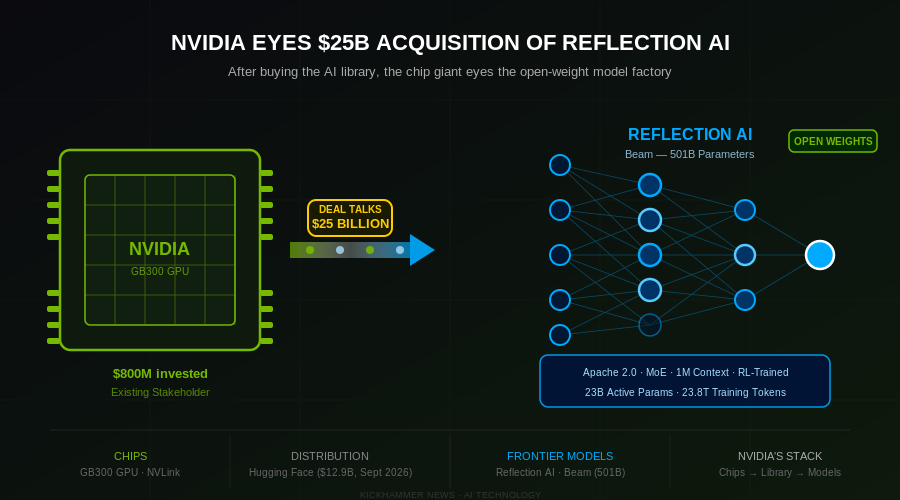
The price tag would be steep. Reflection AI raised at a $25 billion pre-money valuation in April and has since attracted $4.6 billion in total funding from Sequoia Capital, Lightspeed Venture Partners, DST Global, and Nvidia itself, which already has $800 million committed. If a deal closes at or near that valuation, it would be nearly double what Nvidia paid for Hugging Face just weeks earlier — and the largest acquisition in Nvidia’s history by a wide margin.
Nvidia declined to comment. Reflection AI did not respond to requests for comment. But the logic of the deal is not hard to follow.
What Reflection AI Actually Is
Reflection AI was founded by veterans of Google DeepMind who left to answer a question that was becoming uncomfortable inside the company: what happens when AI capability becomes concentrated in the hands of just a few institutions?
CEO Misha Laskin has articulated the mission plainly: closed models are like renting an apartment. You get access to something powerful, but you don’t own it, you can’t inspect it, you can’t modify it, and when the landlord decides to change the terms, you have no recourse. CTO Ioannis Antonoglou has taken the argument further, warning that concentrating AI power in one or two institutions creates what he calls “a single point of failure” for humanity’s most consequential technology.
To make the alternative real, Reflection has been building Beam — a 501-billion-parameter mixture-of-experts model that the company describes as its answer to the growing dominance of Chinese open-weight labs. The model has 23 billion active parameters at inference time (the rest sit dormant, called up only for tasks that require their specific expertise), a 1 million token context window, and benchmarks that put it in credible competition with the leading Chinese open models, including GLM 5.2, Qwen 3.8 Max, and Kimi K3.
The training scale is striking. Beam was pretrained on 23.8 trillion tokens using 6,144 Nvidia GB300 GPUs over less than four weeks — and then put through a reinforcement learning phase that generated more than 100 million rollouts on 10,500 GB300 GPUs. That RL phase cost Reflection roughly $150 million per month in SpaceX compute time alone. Laskin says performance kept improving throughout, with “no sign of a plateau.” The model’s weights, technical report, and full developer tooling are expected to ship later this month under an Apache 2.0 license.
The benchmarks Reflection has released are its own, and independent verification will have to wait until the weights are public. But Artificial Analysis, which received early access, called early indicators “strong” and suggested Beam would rank among the most token-efficient open models at its intelligence level — 3 to 4 times less inference compute than GLM 5.2 on comparable tasks.
The Deal That Could Happen Several Ways
According to the FT, Nvidia is weighing at least three approaches. The most straightforward is a full acquisition — but also the most exposed to regulatory risk. The FTC and the EU’s competition authorities have already been scrutinizing Nvidia’s expanding reach across the AI stack, and a $25 billion purchase of a frontier model lab would almost certainly trigger a lengthy formal review.
The more likely path may be an acqui-hire: Nvidia takes the team and licenses the technology without formally acquiring the company, sidestepping some of the merger-control requirements. There is a recent precedent. In December 2025, Nvidia effectively absorbed the chip startup Groq in a deal CNBC valued at roughly $20 billion — structured as an acqui-hire of the leadership team and a technology license rather than a traditional M&A transaction. An acqui-hire is not immune to antitrust scrutiny, the FT notes, but it creates a narrower target.
The third option is simpler: more money. Nvidia could deepen its existing $800 million stake, funnel more computing credits toward Reflection’s work, or both, without triggering any acquisition review at all.
The FT says a deal could close in weeks. It also notes the talks could still collapse entirely.
Why Nvidia Wants This
Look at the sequence and a strategy comes into focus. In September, Nvidia acquired Hugging Face — the GitHub of AI, where 3 million models, 500,000 datasets, and the work of 18 million developers live. Jensen Huang promised that Nvidia compute would not be required to use the platform. Critics remain skeptical.
Now Nvidia is circling Reflection AI, which has pre-committed to releasing its weights under Apache 2.0 — the most permissive license in AI, one that allows commercial use and modification without restriction. If Nvidia owns both the distribution layer (Hugging Face) and one of the leading Western open-weight model labs (Reflection), it controls an increasingly complete arc: the chips models train on, the platform where developers find models, and the frontier open-weight models themselves.
Nvidia is also developing its own open models through the Nemotron family — a 1-trillion-parameter model is reportedly in training — but owning Reflection would accelerate that effort by orders of magnitude, bringing in a team that has already run one of the most compute-intensive RL training campaigns in the history of open AI development.
The Wider Race This Is Part Of
For the past year, Chinese open-weight labs have largely dictated the pace. DeepSeek R1, Qwen 3.8 Max, and Kimi K3 have set benchmarks that Western open-source efforts have struggled to match. That asymmetry has become a strategic concern for US technology companies and government alike. Constellation Research, citing data from Vercel’s AI Gateway, found that open-weight models now account for 62% of total token volume globally — but only a fraction of total AI spending, because most of that volume runs on low-cost or free Chinese models.
Beam is Reflection’s answer to that problem. So, in a very different way, is Mistral Large 4, the 1-trillion-parameter model that the Paris-based Mistral AI previewed earlier this month and will release by the end of October.
The difference is that Mistral is building an independent European AI champion. Reflection AI, if Nvidia’s deal goes through, would become the open-weight arm of the world’s largest semiconductor company.
That is not the same thing as open AI. It is a powerful company with a large financial interest in AI compute releasing free weights for developers to use — which may be beneficial, but is not the same as the distributed, institution-independent open AI that Misha Laskin and Ioannis Antonoglou described when they founded the company.
What Happens Next
The weights for Beam are expected in late October. Independent benchmarks will follow shortly after, and the AI community will learn whether Reflection’s efficiency claims hold up in practice. If they do, and if Nvidia completes an acquisition, the open-weight landscape will have been reshaped twice in the same month — first by Mistral’s 1-trillion-parameter release, and then by the largest AI hardware company on earth folding the most-funded Western open-weight lab directly into its portfolio.
The antitrust regulators are watching. The FTC has an ongoing inquiry into Nvidia’s AI investment and acquisition activity. The EU’s competition authority has expressed concern about hardware-software bundling across the AI stack. Whether any of that scrutiny translates into a formal block — or merely a lengthy delay — will determine whether this deal concludes in weeks, as the FT suggests, or drags into 2027.
In the meantime, Reflection AI is red-teaming Beam, and Nvidia is making a decision about whether to buy the future of Western open-weight AI or simply continue to fund it from a distance.
The difference, in the end, is who writes the terms of that Apache 2.0 license — and who decides what comes next.
Word count: ~1,050


