Microsoft announced the Azure Maia 300 on Monday, and the message embedded in the silicon is unmistakable: the world’s largest software company no longer wants to be entirely dependent on Nvidia to run the AI revolution.
The Maia 300 is the third generation of Microsoft’s in-house AI accelerator, and it arrives with a significant step up in ambition. Microsoft says it plans to scale the Maia family to multi-gigawatt deployments starting in 2027, and that Maia 300 will become the primary inference system powering its products and services — from GitHub Copilot to the company’s clinical AI platform Dragon Copilot to the MAI models that run inside Azure Foundry. Scott Guthrie, Microsoft’s Executive Vice President of Cloud and AI, described the chip as a “complete intelligent system,” a phrase that signals Microsoft is no longer thinking about silicon as a commodity it buys from someone else.
What the Maia 300 Is Built to Do
The Maia 300 is not a general-purpose AI training chip. It’s designed from the ground up for inference — specifically the kind of inference that is expensive, context-heavy, and hard to accelerate with hardware optimized for training runs. Microsoft is targeting what it calls “long-context, memory-intensive, and decode-heavy workloads,” language that maps directly to the multi-step agentic tasks that have become the dominant AI product paradigm in 2026: coding agents that iterate across thousands of lines, clinical copilots that maintain detailed patient context, and reasoning systems that chain dozens of tool calls together.
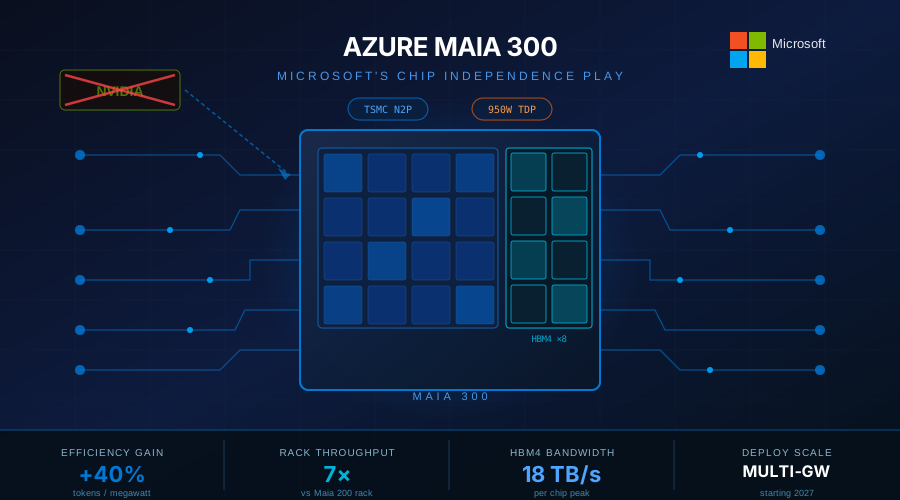
The hardware specs are formidable. Each chip carries eight HBM4 memory stacks delivering 18.0 terabytes per second of peak bandwidth, with a 950-watt thermal design power. Compute chiplets are built on TSMC’s N2P process — the same leading-edge node powering this year’s most advanced chips — while memory-control and I/O functions are handled by separate chiplets on a less expensive node, a design Microsoft says improves “efficiency, scalability, and cost structure.” The system’s software-defined dataflow architecture, combined with AI-assisted kernel optimization, is engineered to keep data local and minimize the expensive memory movement that tends to bottleneck inference at scale.
At rack scale, the numbers grow more striking. A full 96-accelerator Maia 300 rack fits in a 167-kilowatt power envelope and delivers 27.6 terabytes of total HBM memory with 1.7 petabytes per second of aggregate bandwidth across the scale-up domain. Microsoft claims that configuration delivers up to seven times the token throughput of a comparable Maia 200 rack, and roughly 40 percent more tokens per megawatt than “leading GPU-based systems” — language that is clearly aimed at Nvidia’s GB300 NVL rack without naming it directly.
Reuters, which obtained details ahead of the announcement, drew the comparison explicitly: Nvidia’s GB300 rack reportedly runs 72 GPUs in approximately 142 kilowatts. Microsoft’s 96-chip Maia 300 at 167 kilowatts is a different configuration, and the chips themselves have different architectures, so the efficiency comparison is not apples-to-apples. But the scale of Microsoft’s claim — 40 percent more tokens per megawatt — is designed to land in exactly that conversation.
The Business Logic Behind the Silicon
To understand why Microsoft is doing this, it helps to look at where the money is flowing. Microsoft is expected to spend over $175 billion in capital expenditures this calendar year, the vast majority of it on AI infrastructure. Analyst firm Evercore ISI estimates that by Q1 2027, Maia chips will account for approximately 10 percent of Microsoft’s AI chip spending. That’s still a minority — Nvidia GPUs will remain the backbone of Azure’s AI capacity for years — but it is not a rounding error. At Microsoft’s scale, 10 percent of AI silicon spending represents billions of dollars annually.
The Maia 200, the previous generation launched in January 2026, is already running production workloads. It handles Microsoft Copilot inference today. GitHub Copilot and Azure Foundry are scheduled to follow on Maia 200 by the end of 2026. The chip is deployed across the United States, Europe, and Australia. Microsoft has claimed it delivers up to 1.7 times more tokens per watt than its existing GPU infrastructure for Copilot and Teams AI workloads — a number that, if accurate, represents a meaningful operating cost advantage.
The Maia 300 design, Microsoft says, was informed directly by what it learned running workloads on Maia 200. That feedback loop — building chips, running production AI services on them, learning from the data, designing the next generation — is exactly the same loop that has allowed Google’s TPUs and Amazon’s Trainium to improve rapidly. Microsoft is now three generations into that cycle.
Reuters reports that Microsoft may deploy “potentially more than a million” Maia chips next year. Microsoft declined to provide a specific chip count, but the phrase “multi-gigawatt deployments” in its own announcement implies an installation scale that would have been inconceivable even two years ago. For context, a single modern AI data center can consume 100 to 500 megawatts. A multi-gigawatt Maia deployment means multiple such facilities running primarily on Microsoft’s own silicon.
What This Means for Nvidia — and for the AI Industry
Microsoft was careful not to frame the Maia 300 as a replacement for Nvidia. Guthrie’s announcement used “model diverse” language — a pointed way of saying that Maia runs OpenAI models, Microsoft’s own MAI models, and open-source model families, and that Nvidia hardware will remain in the Azure portfolio. The AI chip market is large enough for multiple winners, and Microsoft has no interest in damaging a partner relationship that has enabled its AI business.
But the direction of travel is clear. Every major cloud provider is now building its own silicon. Google has TPUs. Amazon has Trainium. Meta has deployed hundreds of thousands of its own MTIA chips. And now Microsoft is scaling Maia to a level that will make it, for certain workloads, the default inference substrate for Microsoft’s AI products. Nvidia remains the market leader by a wide margin, but the composition of that market is shifting under its feet.
The Maia 300 story is ultimately about control — and cost. Running AI at the scale Microsoft operates means that even small improvements in tokens per watt translate to enormous savings. If the 40 percent efficiency claim holds up in production, and Microsoft deploys even half a million of these chips, the savings would run into the hundreds of millions of dollars annually. That’s the real reason to build your own silicon: not to compete with Nvidia, but to stop paying Nvidia prices for workloads you understand better than anyone.
Microsoft says it will share additional details at Ignite 2026 in San Francisco next month, and has published a Maia 300 technical paper for those who want to go deeper on the architecture. Production hardware arrives in 2027. Independent benchmarks will follow.
Until then, the 40 percent efficiency claim is Microsoft’s claim — not a verified number. But the chip itself is real, the deployment timeline is concrete, and the strategy is unambiguous. Microsoft is betting billions that it can build AI infrastructure better, and cheaper, than it can buy it.
That bet, more than any benchmark, is what makes the Maia 300 worth watching.


